

Space Technology - September 2024
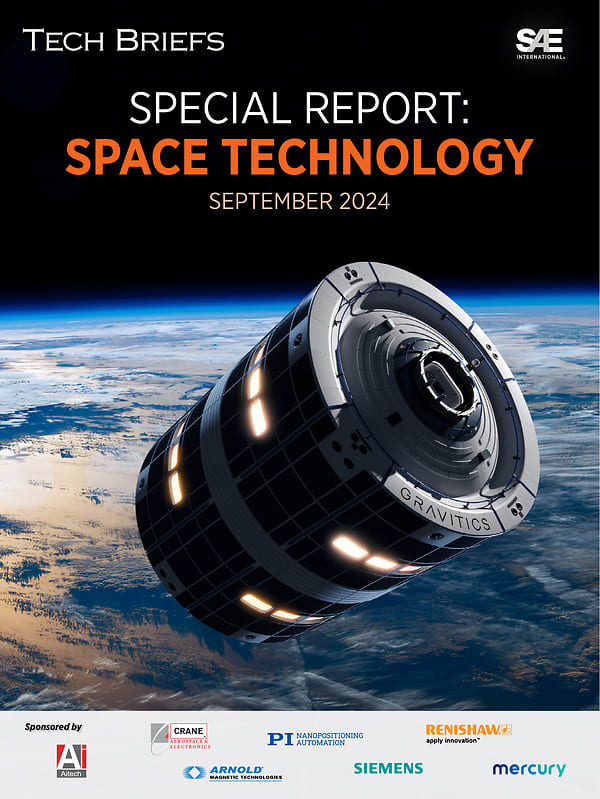
Next‐gen spacecraft electronics…engineering future space habitats…manufacturing in orbit…how to launch it before you build it. Read about these and other exciting advances in this compendium of articles from the editors of Tech Briefs and Aerospace & Defense Technology.
Don't have an account?
Overview
The September 2024 Special Report on Space Technology explores the evolving landscape of space exploration, focusing on advancements in in-space servicing and manufacturing, as well as the technologies driving these changes. The report highlights several key areas of innovation and their implications for the future of space operations.
One of the central themes is the rise of in-space manufacturing, which is becoming increasingly feasible due to technological advancements. The report discusses how manufacturing in space can reduce the need to transport materials from Earth, thereby lowering costs and increasing efficiency. This shift is driven by the need for rapid prototyping and iteration, which is more easily accomplished in a terrestrial environment. However, certain applications, particularly those requiring unique materials or conditions found only in space, may necessitate off-Earth manufacturing.
The report also delves into the role of MEMS-based accelerometers, which are crucial for measuring microgravity conditions essential for in-orbit manufacturing. These sensors enable precise measurements that can enhance the quality and reliability of manufactured components in space.
A significant focus is placed on the potential of space lasers for global communications. The report outlines how advancements in laser technology can facilitate faster and more efficient data transmission compared to traditional radio frequency (RF) methods. Space lasers can transmit data over long distances with minimal signal loss, making them ideal for the increasing demands of global communication networks. The report notes that while RF ground stations require large antennas, space lasers can operate with smaller, more efficient systems, potentially revolutionizing how data is communicated from space.
Additionally, the report discusses the economic implications of these technological advancements. As the space industry evolves, companies are increasingly looking to optimize manufacturing and service operations for cost efficiency. The trend towards distributed manufacturing is highlighted, where production is localized and automated to minimize costs. This approach is not only applicable to space technology but also resonates across various industries, including aviation and transportation.
The report also touches on the importance of artificial intelligence (AI) in reshaping space applications. AI technologies are being integrated into various aspects of space operations, from autonomous spacecraft navigation to data analysis, enhancing the capabilities and efficiency of missions.
Furthermore, the report emphasizes the significance of collaboration between private companies and governmental agencies in advancing space technology. Partnerships are essential for pooling resources, sharing knowledge, and driving innovation in the rapidly evolving space sector.
In conclusion, the September 2024 Special Report on Space Technology presents a comprehensive overview of the current state and future prospects of in-space manufacturing and servicing. It highlights the transformative potential of emerging technologies, such as space lasers and MEMS-based sensors, while also addressing the economic and collaborative aspects that will shape the future of space exploration. As these advancements continue to unfold, they promise to open new frontiers in our understanding and utilization of space.







