


In the year 2024, AI continued to dominate headlines and make inroads into new industries — a trend that’s expected to continue next year. Generative AI took center stage in 2024, driving higher efficiency, creativity, and productivity.
With another year of Tech Briefs almost in the books, let’s look back at the engineering stories that resonated most with our audience. AI, battery technologies, metamaterial breakthroughs, humanoid and household robots, next-generation solar cells, as well as the first 3D-printed brain — these are few of the topics that appealed to our readers this year.
See this year’s standout stories below.
Engineers at Duke University demonstrated a system they’ve dubbed MadRadar for fooling automotive radar sensors into believing almost anything is possible. The technology can hide the approach of an existing car, create a phantom car where none exists, or even trick the radar into thinking a real car has quickly deviated from its actual course. Plus, it can do these things in the blink of an eye without having any prior knowledge about the specific settings of the victim’s radar, making it the most troublesome threat to radar security to date.
The solar energy world is ready for a revolution. Scientists are racing to develop a new type of solar cell using materials that can convert electricity more efficiently than today’s panels. A team from the University of Colorado Boulder unveiled an innovative method to manufacture the new solar cells, known as perovskite cells, an achievement critical for the commercialization of what many consider the next generation of solar technology. The synthetic material has the potential to convert substantially more solar power than silicon at a lower production cost.
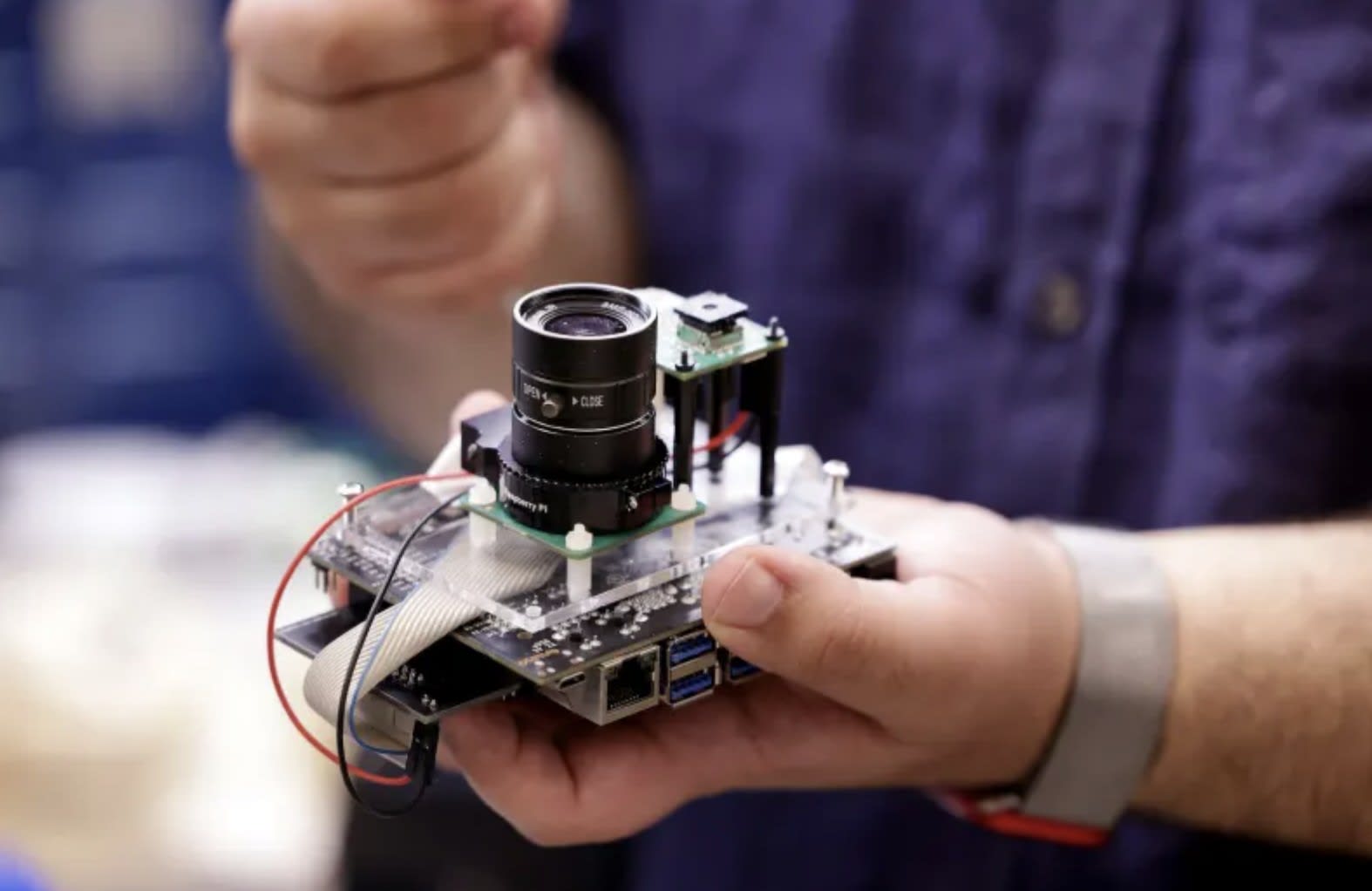
A new camera made by University of Michigan engineers could prevent companies from collecting embarrassing and identifiable photos and videos from devices like smart home cameras and robotic vacuums. PrivacyLens uses both a standard video camera and a heat-sensing camera to spot people in images from their body temperature. The person’s likeness is then completely replaced by a generic stick figure, whose movements mirror those of the person it stands in for. That extra anonymity could prevent private moments from leaking onto the internet, which is increasingly common in today’s world.
From wiping up spills to serving up food, robots are being taught to carry out increasingly complicated household tasks. They are programmed to copy the motions that a human physically guides them through. But unless engineers also program them to adjust to every possible bump and nudge, robots don’t necessarily know how to handle these situations, short of starting their task from the top. Now, MIT engineers are aiming to give robots a bit of common sense when faced with situations that push them off their trained path. Their method connects robot motion data with the “common sense knowledge” of large language models.
Researchers have successfully transformed CO2 into methanol by shining sunlight on single atoms of copper. A team of researchers from the University of Nottingham's School of Chemistry, University of Birmingham, University of Queensland, and University of Ulm, has designed a material made up of copper anchored on nanocrystalline carbon nitride. The copper atoms are nested within the nanocrystalline structure, which allows electrons to move from carbon nitride to CO2, an essential step in the production of methanol from CO2 under the influence of solar irradiation. The discovery paves the way for creating new green fuels.
In a joint project between Medical University of Vienna and TU Wien, the world's first 3D-printed “brain phantom” has been developed; it is modeled on the structure of brain fibers and can be imaged using a special variant of magnetic resonance imaging. The team has shown in a study that these brain models can be used to advance research into neurodegenerative diseases such as Alzheimer's, Parkinson’s, and multiple sclerosis.

Engineers have created a new class of tunable dynamic material that mimics the inner workings of push puppets. Inside a push puppet, there are connecting cords that, when pulled taught, will make the toy stand stiff. But by loosening these cords, the “limbs” of the toy will go limp. Using the same cord tension-based principle that controls a puppet, UCLA researchers have developed a new type of metamaterial, a material engineered to possess properties with applications for soft robotics, reconfigurable architectures, and space engineering.
High-power lithium-sulfur batteries are used in various devices such as mobile phones, laptops, and electric vehicles. Current state-of-the-art lithium-sulfur batteries suffer from low charge-discharge rates, typically requiring several hours — typically from one to 10 hours — for a single full charge-discharge cycle. University of Adelaide Professor Shizhang Qiao, Chair of Nanotechnology, and Director, Center for Materials in Energy and Catalysis, at the School of Chemical Engineering, led a team which examined the sulfur reduction reaction — the pivotal process governing the charge-discharge rate of lithium-sulfur batteries.

While the adoption of autonomous mobile robots (AMRs) and collaborative robots (cobots) has increased in logistics and manufacturing industries, mobile manipulation robots (MMRs) — or humanoid robots — still seem like a distant reality. Melonee Wise, Chief Product Officer at Agility Robotics presented her insights about MMRs at Automate 2024, where she talked about how to prepare your facility for the next phase of robotics — human-centric, humanoid robots — and how to connect existing islands of automation.
A commonplace chemical used in water treatment facilities has been repurposed for large-scale energy storage in a new battery design by researchers at the Department of Energy’s Pacific Northwest National Laboratory. The design provides a pathway to a safe, economical, water-based, flow battery made with Earth-abundant materials. It provides another pathway in the quest to incorporate intermittent energy sources such as wind and solar energy into the nation’s electric grid.
This article was written by Chitra Sethi, Director, Editorial and Digital Content Strategy, at SAE Media Group.











