

Automotive & Battery Testing - December 2024
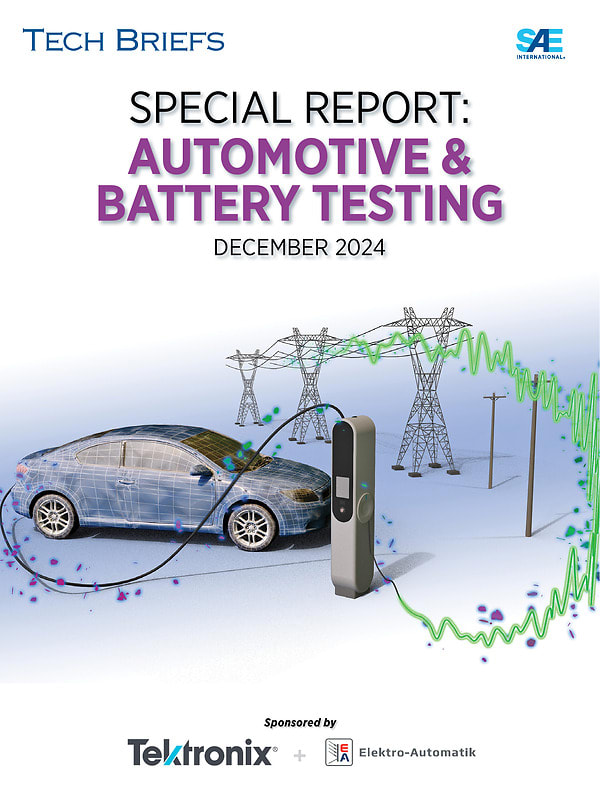
Overcoming EV drivetrain challenges…leveraging AI to boost EV performance…best practices for battery design and testing. Read these articles and more in this compendium from the editors of Automotive Engineering and Battery & Electrification Technology.
Don't have an account?
Overview
The Automotive & Battery Testing Special Report for December 2024 provides a comprehensive overview of the latest advancements and challenges in electric vehicle (EV) technology, focusing on battery management, charging infrastructure, and testing methodologies.
One of the key highlights of the report is the ongoing research at the Oak Ridge National Laboratory (ORNL), which aims to enhance the reliability of EV charging stations. As electric vehicle adoption grows, driver concerns about charging accessibility during long trips remain a significant barrier. ORNL researchers are developing algorithms and multilayered communication systems to ensure that EV chargers remain operational even during electrical disturbances or hardware failures. This innovation addresses two primary causes of charger failure: voltage shifts in the electric grid and internal component malfunctions. By improving the resilience of charging infrastructure, the goal is to provide a seamless charging experience akin to traditional gas stations.
The report also emphasizes the importance of precise battery management systems (BMS) in improving EV performance. Effective BMS monitoring can enhance range, extend battery life, and ensure the safety and reliability of lithium-ion batteries. As battery technologies evolve, manufacturers are expected to offer vehicles with significantly increased ranges—up to 500 to 600 miles on a single charge—compared to the current average of 300 miles. This advancement is crucial for attracting hesitant buyers and alleviating range anxiety.
In addition to battery management, the report discusses the complexities of testing various lithium-ion battery technologies. Accurate measurement of battery cells is vital for ensuring the longevity and performance of EVs. The testing process must be precise, often requiring measurements that are ten times more accurate than the devices themselves. This level of precision is essential for guaranteeing the quality and reliability of new EV models.
The report also covers the integration of artificial intelligence (AI) in enhancing EV performance. As commercial fleets increasingly adopt electric vehicles, the need for accurate state-of-health measurements and smart charging algorithms becomes paramount. These technologies help minimize unscheduled downtime, ensuring that fleets operate efficiently.
Furthermore, the report highlights the collaboration between researchers and industry professionals to develop innovative technologies and sustainable materials for battery development. This collaboration is crucial for addressing the engineering limits of battery power, particularly in emerging applications like electric vertical takeoff and landing (eVTOL) vehicles.
Overall, the Automotive & Battery Testing Special Report underscores the critical role of advanced testing and innovative research in shaping the future of electric vehicles. By addressing the challenges of charging infrastructure, battery management, and performance testing, the industry is poised to enhance EV adoption and contribute to a more sustainable transportation ecosystem. The insights provided in this report are essential for stakeholders looking to navigate the evolving landscape of automotive technology and battery systems.










