

Space Technology - January 2025
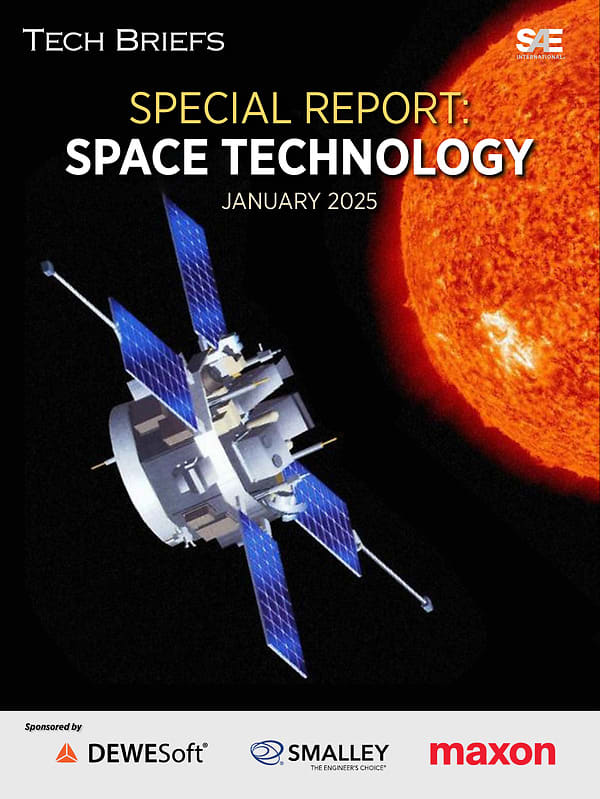
Engineering NASA's next great space telescope…how to build a better rocket…the groundbreaking material that could propel future space travel. Read about these and other exciting advances in this compendium of articles from the editors of Tech Briefs and Aerospace & Defense Technology.
Don't have an account?
Overview
The January 2025 Special Report on Space Technology presents a comprehensive overview of recent advancements and innovations in the field of space exploration and technology. This edition highlights several key features and breakthroughs that are shaping the future of aerospace and defense.
One of the standout features is the design and testing of optics for NASA’s Nancy Grace Roman Space Telescope. This telescope is set to play a crucial role in expanding our understanding of the universe, particularly in the areas of dark energy and exoplanet discovery. The report details the meticulous processes involved in ensuring the telescope's optics meet the high standards required for deep-space observation.
Another significant development discussed is the use of 3D-woven materials in aerospace applications. Collaborating with NASA and Lockheed Martin, BRM has developed a thermal protection system that meets the needs of the Multi-Purpose Crew Vehicle (MPCV). This innovative material is designed to withstand extreme conditions in space, showcasing the potential of advanced weaving techniques and new loom technologies that allow for the control of thousands of yarns.
The report also covers a novel approach to infrastructure monitoring using Synthetic Aperture Radar (SAR). Researchers at Texas A&M University have developed a method that utilizes high-resolution satellite data to detect early signs of infrastructure issues, such as pavement and retaining wall failures. This technology can significantly reduce the time required for inspections, allowing for quicker responses to potential hazards and saving valuable resources.
In addition, the report introduces a 'first of its kind' composite material designed to enhance the longevity of space vessels. This material aims to improve the durability and efficiency of spacecraft, enabling them to travel longer distances in space.
The report also highlights advancements in GPS navigation devices through new techniques that could enhance their accuracy and reliability. This is particularly important for various applications, from everyday navigation to critical national security operations.
Furthermore, the report discusses a safe and inexpensive method to propel small satellites, which could revolutionize the way these satellites are launched and operated. This innovation is expected to lower costs and increase accessibility for various space missions.
Lastly, the report features a breakthrough in space geodesy, where researchers have achieved extraordinary advancements in the precision of reference frames. By utilizing data from the Very Long Baseline Array and the McDonald Geodetic Observatory, scientists have extended the reach of signals from GPS satellites to astronomical objects billions of light-years away, marking an impressive leap in measurement capabilities.
Overall, the January 2025 Special Report on Space Technology encapsulates the dynamic and rapidly evolving landscape of space exploration. It showcases how collaborative efforts, innovative materials, and advanced technologies are paving the way for future missions and enhancing our understanding of the universe. This report serves as a testament to the ongoing commitment to pushing the boundaries of what is possible in space science and technology.









