

Inside this issue
Supplements
Overview
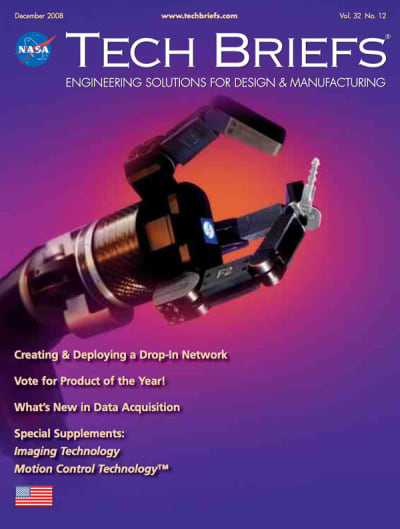
The December 2008 issue of NASA Tech Briefs presents a comprehensive overview of advancements in technology, particularly focusing on motion control and imaging systems. This edition is designed to inform professionals and enthusiasts about the latest innovations, applications, and products in these fields.
Key Highlights:
-
Creating & Deploying a Drop-In Network: This article discusses the methodologies and technologies involved in establishing a drop-in network, which allows for seamless integration of new systems into existing infrastructures. The focus is on enhancing connectivity and efficiency in various applications, particularly in industrial settings.
-
Vote for Product of the Year: Readers are encouraged to participate in the voting process for the Product of the Year. This initiative highlights innovative products that have made significant impacts in their respective fields, showcasing the best in technology and engineering.
-
What’s New in Data Acquisition: This section provides insights into the latest developments in data acquisition technologies. It covers new tools and systems that improve the collection, analysis, and utilization of data across various industries, emphasizing the importance of accurate data in decision-making processes.
-
Special Supplements: The issue includes special supplements focusing on Imaging Technology and Motion Control Technology. These supplements delve deeper into specific advancements and applications within these domains, providing readers with detailed information on cutting-edge technologies.
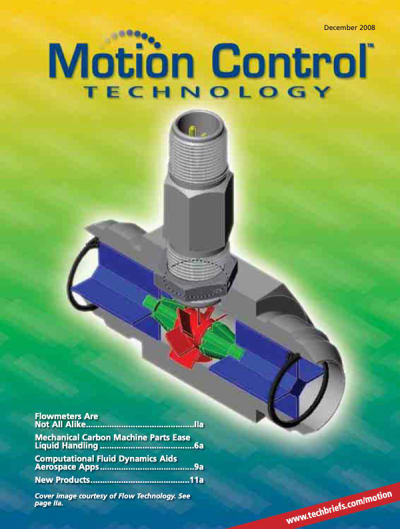
Flowmeters Are Not All Alike: An article dedicated to flow measurement technologies discusses the various types of flowmeters available in the market. It emphasizes the importance of selecting the right flowmeter for specific applications, considering factors such as accuracy, reliability, and cost-effectiveness.
-
Mechanical Carbon Machine Parts Ease Liquid Handling: This feature highlights the use of mechanical carbon components in liquid handling systems. It discusses how these materials enhance performance, reduce wear, and improve the efficiency of liquid handling processes in various applications.
-
Computational Fluid Dynamics Aids Aerospace Apps: The application of computational fluid dynamics (CFD) in aerospace is explored, showcasing how CFD simulations help in designing and optimizing aircraft and spacecraft. The article discusses the benefits of using CFD in reducing development time and costs while improving performance.
-
New Products: The issue includes a section dedicated to new products, featuring innovative technologies and solutions that have recently entered the market. This section serves as a valuable resource for professionals looking to stay updated on the latest tools and equipment available for their work.
-
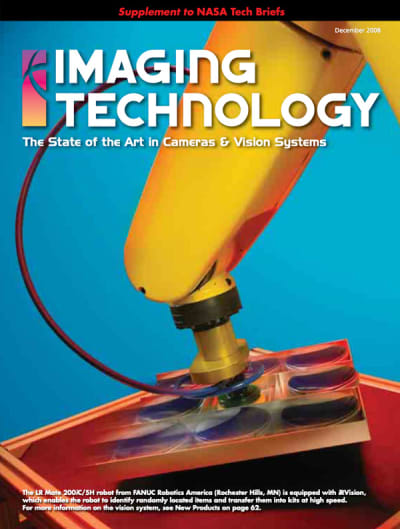
Robotics and Vision Systems: A notable highlight is the LR Mate 200iC/5H robot from FANUC Robotics America, which is equipped with iRVision technology. This robot can identify and handle randomly located items, showcasing advancements in robotics and vision systems that enhance automation and efficiency in manufacturing processes.
Conclusion:
The December 2008 issue of NASA Tech Briefs serves as a vital resource for professionals in engineering, technology, and related fields. It not only highlights the latest innovations and products but also provides insights into the practical applications of these technologies. The focus on motion control and imaging systems reflects the ongoing evolution in these areas, emphasizing their significance in modern industrial and aerospace applications.
Overall, this edition encourages readers to engage with the content, participate in voting for the Product of the Year, and explore the advancements that are shaping the future of technology. Whether you are a seasoned professional or a newcomer to the field, this issue offers valuable information and inspiration for continued innovation and development.
Features
-
Application Briefs
Coded Mask Instruments Key to HETE-2 Satellite’s Gamma-Ray Burst Discoveries
System Provides Critical Communications Among Stennis Rocket Test Team Members
Tech Briefs
-
Physical Sciences
-
Manufacturing & Prototyping
-
Software
Distributing Data to Hand-Held Devices in a Wireless Network
Converting EOS Data From HDF-EOS to netCDF
HDF-EOS 2 and HDF-EOS 5 Compatibility Library
XML DTD and Schemas for HDF-EOS
Converting From XML to HDF-EOS
Simulating Attitudes and Trajectories of Multiple Spacecraft
-
Materials
Oxide Fiber Cathode Materials for Rechargeable Lithium Cells
Electrocatalytic Reduction of Carbon Dioxide to Methane
Progress Toward Making Epoxy/Carbon-Nanotube Composites
Heterogeneous Superconducting Low-Noise Sensing Coils
Predicting Properties of Unidirectional-Nanofiber Composites
-
Information Sciences
Multibeam Altimeter Navigation Update Using Faceted Shape Model
MODIS Atmospheric Data Handler
Reducing Surface Clutter in Cloud Profiling Radar Data
-
Mechanics & Machinery
Nonventing, Regenerable, Lightweight Heat Absorber
“Bootstrap” Configuration for Multistage Pulse-Tube Coolers
Miniature High-Force, Long-Stroke SMA Linear Actuators
-
Semiconductors & ICs
-
Electronics & Computers
Spaceborne Hybrid-FPGA System for Processing FTIR Data
FPGA Coprocessor for Accelerated Classification of Images
SiC JFET Transistor Circuit Model for Extreme Temperature Range
TDR Using Autocorrelation and Varying-Duration Pulses
Update on Development of SiC Multi-Chip Power Modules
Radio Ranging System for Guidance of Approaching Spacecraft
Improved Short-Circuit Protection for Power Cells in Series
Communication Limits Due to Photon-Detector Jitter
Electromagnetically Clean Solar Arrays
Products
-
Applications











