

Space Technology - May 2025
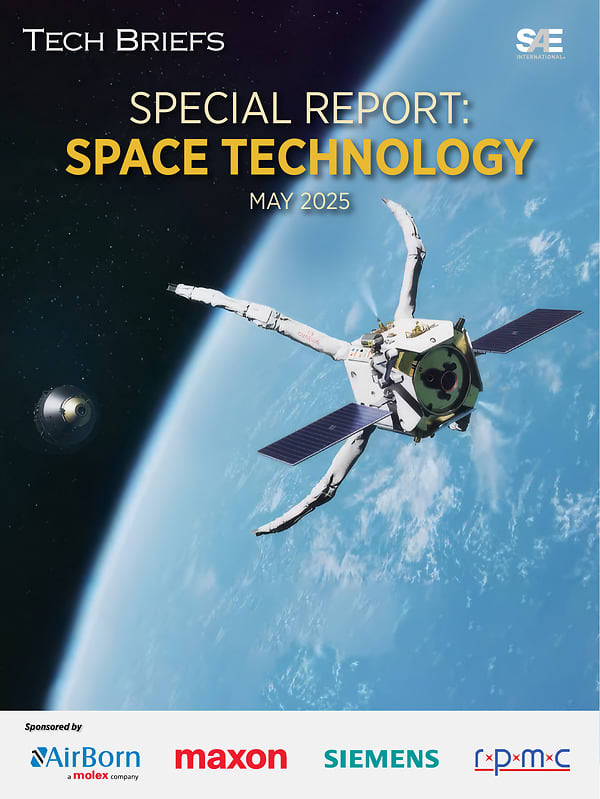
Seven space start‐ups you should know…how to machine complex parts for space flight…advanced sensors monitor motion on Martian moon rover. Read these stories and more in this compendium of articles from the editors of Tech Briefs and Aerospace & Defense Technology.
Don't have an account?
Overview
The May 2025 Special Report on Space Technology presents a comprehensive overview of recent advancements and innovations in the field of space exploration and sustainability. The report highlights several key areas of focus, including the emergence of space sustainability startups, advancements in thermal management, and the development of new technologies for carbon dioxide removal in space.
One of the standout features of the report is the section on space sustainability startups. It emphasizes the growing concern over space debris and the innovative solutions being proposed to tackle this issue. Companies like ClearSpace are at the forefront, utilizing advanced sensors, radar technologies, and telescopes to track and clean up space junk, thereby contributing to a safer orbital environment.
The report also delves into the importance of thermal management in spacecraft. Effective thermal management is crucial for ensuring the safety of astronauts and the optimal performance of onboard systems. The report discusses various design trade studies that have been conducted to improve thermal management, including the comparison of internal versus external heaters and the use of different materials, such as aluminum beds versus vapor chambers. These studies aim to achieve rapid and uniform heating, which is essential for the functionality of spacecraft in extreme temperature conditions.
Another significant topic covered is NASA’s Glenn Research Center's role in developing ion thrusters for various missions, including the Dawn and DART missions. The report details how Orbion has partnered with NASA to gain insights into the development of ion thruster technology, particularly focusing on advancements in materials research and the efficiency of cathode heaters. This collaboration aims to enhance the performance and longevity of ion thrusters, which are critical for deep space exploration.
The report also features application briefs, including the development of gyro sensors designed for monitoring motion on the Martian moon rover. These sensors are vital for ensuring precise navigation and operation in the challenging environment of Mars.
Additionally, the report touches on NASA's efforts in bioprinting artificial organs in space, which not only aims to advance medical technology for astronauts but also holds potential benefits for human life on Earth. This innovative approach could revolutionize organ transplantation and medical treatments by utilizing 3D printing technology in microgravity.
Overall, the May 2025 Special Report on Space Technology encapsulates the dynamic and rapidly evolving landscape of space exploration. It underscores the importance of sustainability, innovative technologies, and collaborative efforts in addressing the challenges of space travel and environmental stewardship. As the space industry continues to grow, these advancements will play a crucial role in shaping the future of exploration and ensuring a sustainable presence beyond our planet.







