

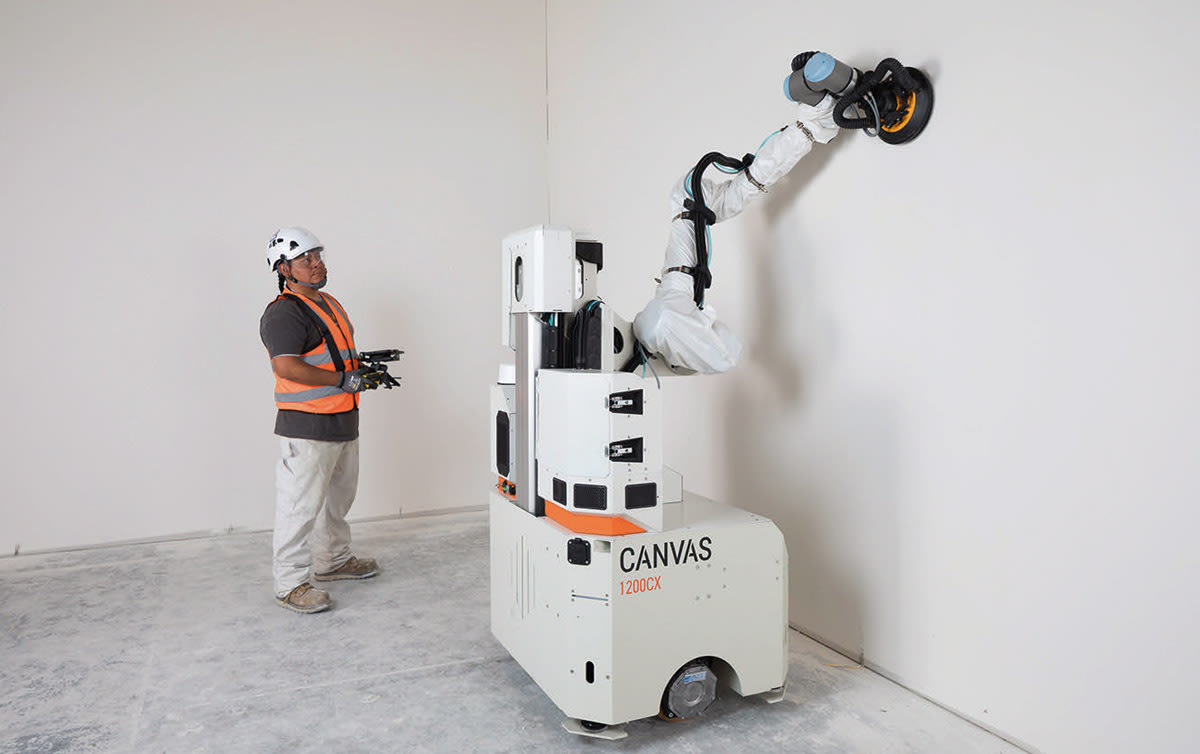
San Francisco startup Canvas has developed a robotic system handling one of the most labor-intensive trades in construction: drywall finishing. Leveraging robotic arms from Universal Robots, Canvas has built a machine that reduces the usual five to seven days of spraying and sanding the drywall to just around two days for both Level 4 and Level 5 finishes.
“It was long overdue,” Kevin Albert, the Co-founder and CEO of Canvas, reflects on the need to bring robots into construction — historically a very under-automated industry: “Construction is an incredibly dynamic environment, and every single construction site is unique,” he said. “This is why we haven’t seen the same proliferation of robots as in logistics or manufacturing that have more fixed, predictable environments.”
Yet, the Canvas CEO felt the need for robotic automation outweighed the challenge. “What really inspired us to go into construction is when we learned that we have to build twice as much over the next 40 years, but at the same time, we have two people retiring from the industry for every one that comes in,” he explained. “So, we urgently need better tools to make our workforce more productive.”
The Canvas team wanted to build agile automation and started developing a mobile platform with advanced sensing, AI, and collaborative robot arms from Universal Robots. “We’ve designed the system so that you don’t need any prior plans; our machine automatically detects the site, so you can instantly bring the machine into the building and start working right away, no mapping required,” said Albert.
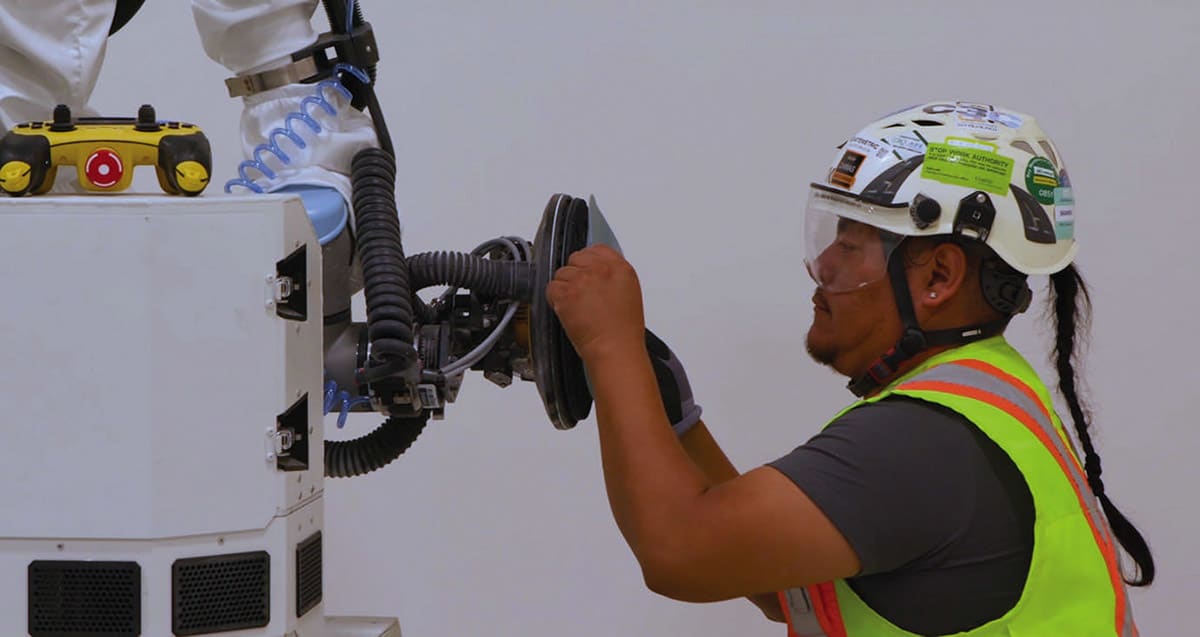
Instead of the usual five-seven days of manually applying joint compound on drywall, Canvas uses the accuracy of the machine to reinvent that process to apply a defined profile onto the wall in one shot on the first day, let that dry one drying cycle, followed by sanding on the second day.
“This means we can reduce schedules by up to 60 percent, and we can reduce the amount of labor it takes to produce the same amount of square foot by about 40 percent,” said Albert. In a manual approach, the worker has to keep coming back to the same wall, so 20,000ft2 of wall space takes about 100,000ft2 of work. With Canvas, you only have to come back to that same wall three times. “So we can now reduce the process down from five days down to only two, while achieving both level 4 (drywall seams only) and level 5 (entire wall) with high levels of precision and consistency,” he added.
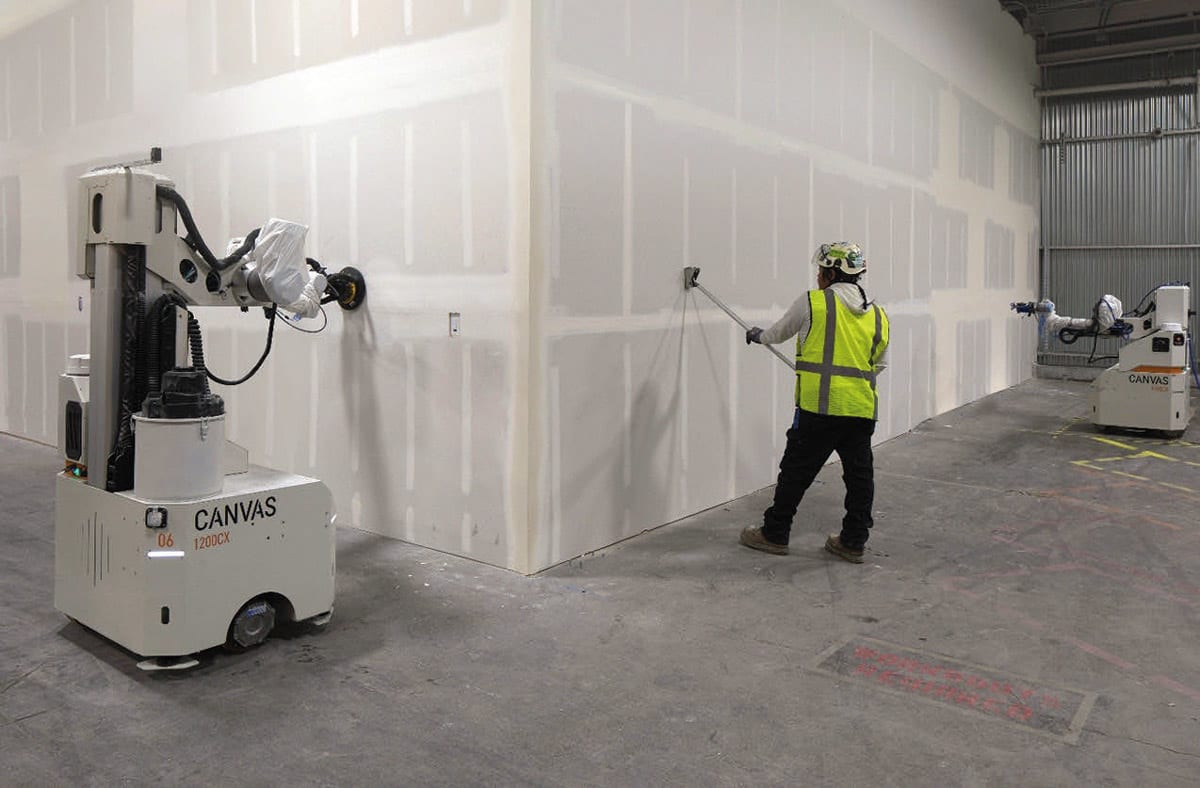
It takes just a week to train an apprentice finisher to operate the user-friendly Canvas interface and be on the scene independently with the machine. Bringing automation into the construction site has huge benefits in safety for the workers, said Albert: “One in every four construction workers ends their career with a musculoskeletal problem, either usually a back injury or very commonly, a rotator cuff, from holding their arms over their head and doing tasks such as finishing and sanding for their entire career.” By using the Canvas machine, the brunt, hard work is done with the robot arm on the machine. A concept that Canvas successfully introduced to labor unions.
Having the robot do a big portion of the physical work, frees the worker to pay attention to how they can continuously move along the site and coordinate other systems, or even work alongside the robot, for example in corner cases where the robot can’t go. “This is really a collaborative solution, that’s also why it was important that we chose a safe, collaborative robot arm that is safe around workers,” said Albert who picked the cobots (short for collaborative robots) from Universal Robots.
At the core of the Canvas system is Universal’s UR10e cobot. “This is a huge enabler for us because it’s one of the lightest robots for the strength that it has,” said Albert, explaining that Canvas needed a very lightweight robot for the mobile platform to finish tasks up to 15ft. in the air without tipping over.
The second aspect was the need for very good force control. “The material we’re using is very soft, you can actually scratch it with your fingernail,” said Canvas Co-founder and CTO Maria Telleria. “It’s very important that we precisely control the amount of material we use with a very light touch. With UR, we don’t need any external force control, it’s built into the robot arm and it’s extremely precise. We looked at other cobot arms with force control but were disappointed in the maturity of their force control.”
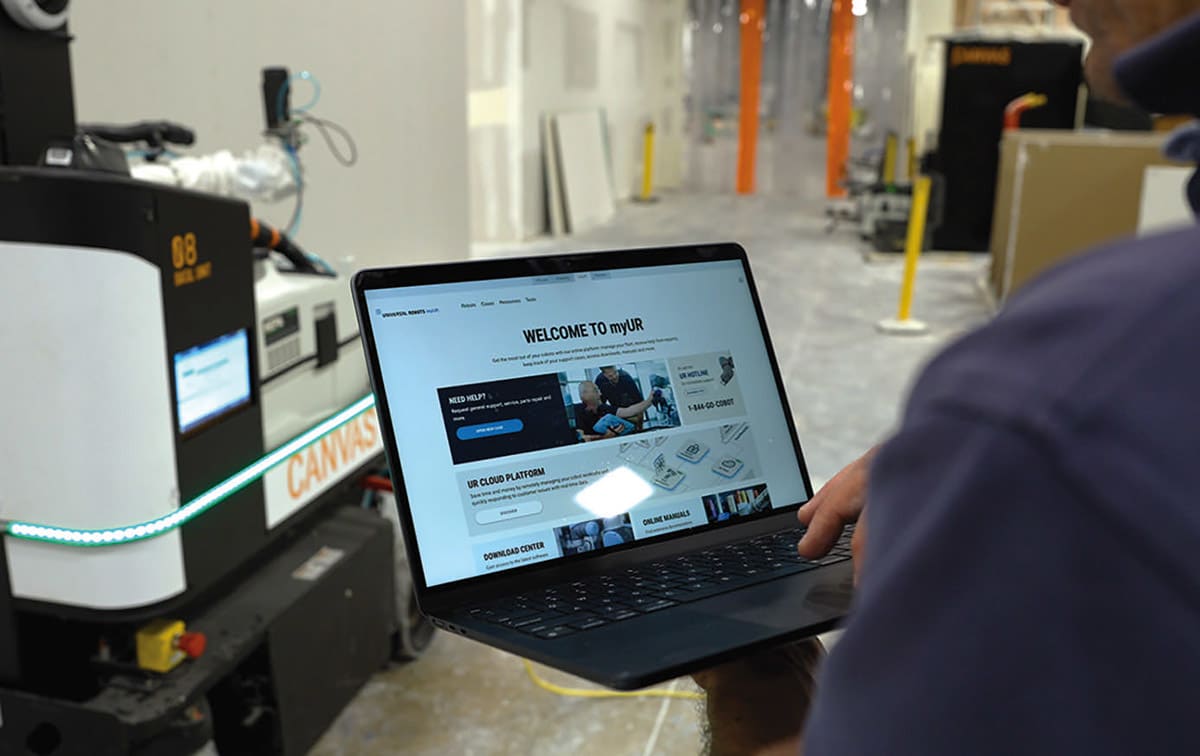
‘Maturity’ is also the adjective used by Albert when he lists additional reasons for building on the UR platform. “The product maturity of the UR cobots are pretty much unmatched for collaborative robots right now. This has allowed us to ramp up very quickly,” he said, recalling how Canvas got the first UR robot very early in their development phase. “Only two months after that, we were doing our first job. The support that we get from UR has been incredible and has allowed us to move very fast.” All support happens through the myUR portal, which streamlines submitting cases, logs, and fixes.
Canvas’ CTO also emphasizes the openness of the Universal Robot software platform. “As a developer, we have access to all the low-level information; current sensor, temperature sensor of every joint, everything on the UR system. You can rebuild your inverse kinematics and control at the joint level space and do everything you want,” she said, adding that the DC version of the UR control box is key on a mobile platform. “If we have to supply 110V to 220V to the controller of the UR, that means we have to build an inverter inside and use a lot of power for that. Avoiding that conversion with the DC version, means that we use our battery more efficiently.”
The next iteration of our self-drive 1200CX machine will be a taller robot capable of reaching heights above 20 feet. With high work presenting serious fall concerns, we can help workers reduce safety risks and increase career longevity. Painting is also an obvious next step for us. We’re already there spraying material on the walls, by stringing together multiple tasks, we can affect more of the construction project, allowing the project to speed up and thus reduce schedules, which helps all of us.
This article was contributed by Universal Robots (Odense, Denmark). For more information, visit here .











