


In an office in Bordeaux, the Pollen Robotics teams are working on an ambitious mission: to imagine and advance useful robotics for humans. Their flagship creation, Reachy, combines accessibility, innovation, and open-source collaboration. But first, let’s go back to where it all started.
Founded in 2016 by two former INRIA researchers, Matthieu Lapeyre and Pierre Rouanet, the French startup Pollen Robotics initially focused on custom robotics projects for artistic and cultural installations.
In 2019, an event changed the game. Augustin Crampette, an engineering intern, developed a bio-inspired joint system called Orbita. This innovation, capable of imitating human articulated movements with great precision, became the basis of a more ambitious project: Reachy.
Reachy made its first public appearance at the 2020 CES event in Las Vegas and immediately fascinated visitors with its fluid and natural movements as well as its interactiveness.
Then, in 2022, a new challenge pushed the Pollen Robotics team even further: participation in the international robotics competition ANA Avatar XPRIZE.

Invited by the organizers, the team presented Reachy 1 for the semi-finals, and the version successfully passed the tests. However, to hope to win the final, it became necessary to improve the robot’s capabilities in terms of robustness and payload.
“We needed a reliable and high-performance solution to meet this challenge in a very short amount of time,” said Elsa Kervella, Sales and Marketing Director at Pollen Robotics.
It was then that Pollen Robotics decided to collaborate with maxon. The maxon motors were integrated into the Orbita joints, which allowed this new robotic avatar to handle heavier loads, making it eligible for the final tests. Faced with established competitors with much larger budgets and resources, Pollen Robotics stood out as a formidable outsider.
This teamwork paid off, and Pollen Robotics secured second place in the competition, with a robotic platform that would be the first iteration of the future version of Reachy, Reachy 2, launched in October 2024.
Reachy is a unique humanoid robot designed to operate in various environments where human-machine interaction is essential. Versatile, intelligent, and fully modular, it is much more than just a robotic platform.
With its asymmetrical eyes and expressive antennas, it immediately garners affection. Reachy 2 was designed to adapt to a wide variety of uses thanks to its modular architecture. Users can choose from several configurations: a single arm, two arms, or even the addition of a mobile base.
Reachy’s design is fascinating. Its natural expressions and gestures make it an intuitive and engaging robot, capable of integrating into social environments.
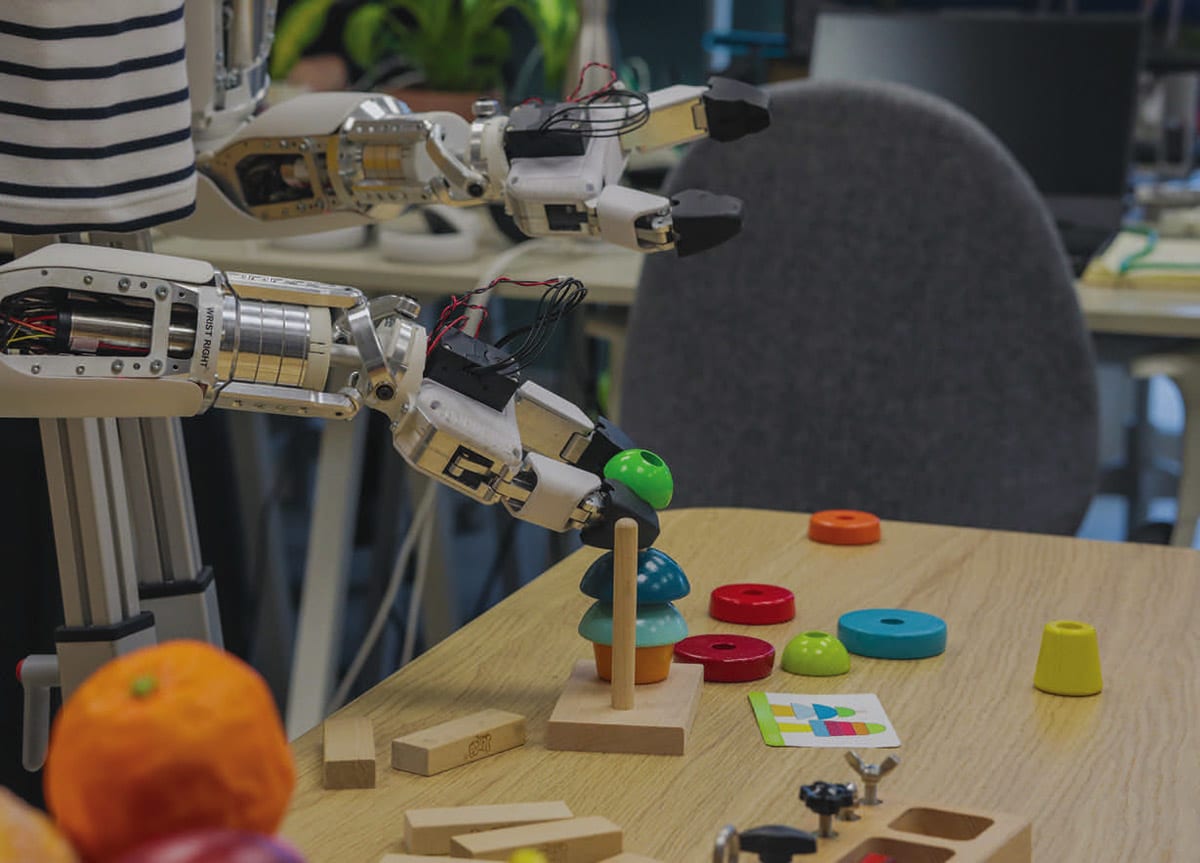
This fluidity is based on Pollen Robotics’ key innovation: Orbita, the bio-inspired joint system. Orbita comes in two versions adapted to different needs.
The first, Orbita 3D, is used for the wrists and neck. It allows harmonious and smooth movements with a wide range thanks to its three degrees of freedom.
Conversely, Orbita 2D, integrated into the elbows and shoulders, articulates via two degrees of freedom and is designed to support loads — of up to 3 kg for our friend Reachy.
Reachy also stands out for its software intelligence. Equipped with a Python SDK and based on ROS 2, Reachy offers researchers and developers an open and flexible programming environment.
“We designed Reachy as a platform: Researchers can integrate their own algorithms, and developers can enrich the software,” said Kervella.
Since 2021, Reachy even includes a teleoperation feature — remote control — opening up fascinating prospects for difficult-to-access environments or those requiring great precision.
How does it work? With a virtual reality headset, an operator can control the robot’s movements in real-time and even teach it new movements. This learning capability allows Reachy to reproduce learned gestures autonomously.

Reachy appeals to both the academic world and industry. In prestigious institutions like EPFL or Cornell University, it is used to explore human-robot interaction and machine learning, pushing the limits of artificial intelligence in real conditions. In industry, its modularity allows it to adapt to complex environments, whether for cobotic tasks or specific simulations.
When Pollen Robotics sought to push Reachy’s limits, the company found a solid partner in maxon. This partnership intensified over the iterations of Reachy. The teams closely collaborated to meet a challenge: adapting the components to demanding environments while respecting the robot’s design and modularity constraints.
Integrating the motors into the Orbita joints was a significant challenge. It was necessary to reconcile performance, compactness, and reliability while respecting Reachy’s humanoid design. maxon met this challenge with a series of integrations: EC45 Flat Motors and ECX22 Torque Motors, GPX32 UP and GPX22C Gearboxes, as well as ENX EASY 22mm Sensors.
“The compactness and performance of the motors were essential to respect Reachy’s humanoid design while increasing its load capacity,” said Kévin Schwartz, Sales Engineer at maxon.
The integration of maxon solutions has pushed the limits of Reachy, making it a platform as powerful as it is modular. Integrating these solutions pushed Reachy’s limits, making it a platform as high-performing as it aims to be modular.
This article was contributed by maxon (Taunton, MA). For more information, visit here .











