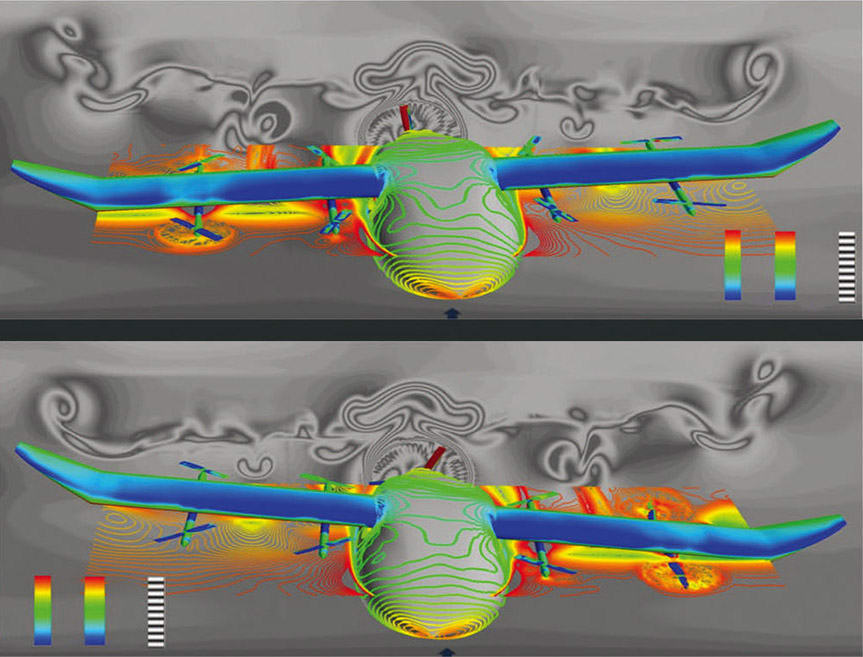
Electric Vertical Take-Off and Landing (eVTOL) aircraft, conceptualized to be used as air taxis for transporting cargo or passengers, are generally lighter in weight than jet-fueled aircraft, and fly at lower altitudes than commercial aircraft. These differences render them more susceptible to turbulence, leading to the possibility of instabilities such as Dutch-roll oscillations. In traditional fixed-wing aircraft, active mechanisms used to suppress oscillations include control surfaces such as flaps, ailerons, tabs, and rudders, but eVTOL aircraft do not have the control surfaces necessary for suppressing Dutch-roll oscillations.
NASA Ames researchers have developed a novel approach for actively controlling Dutch-roll oscillations of an eVTOL aircraft by using existing outboard propellers to dampen oscillations. This novel technology avoids the need to add hardware or change the design of eVTOL vehicles to address the negative effects of turbulence.
The Active Turbulence Suppression (ATS) system for eVTOL vehicles employ existing lifting propellers to dampen instabilities during flight, such as Dutch-roll oscillations and other gust-induced oscillations. When a roll angle of an eVTOL aircraft has deviated or is about to deviate from a current stable aircraft state to an undesirable, unstable, and oscillating aircraft state, the ATS system queries a turbulence suppression database that stores a set of propeller speed profiles for mitigation a deviation of a given roll angle for a particular aircraft with specified propellers. Using this data, the eVTOL flight controller adjusts the speed of the propellers for a certain duration of time, according to the propeller speed profiles for mitigating the deviation.
In models of aircraft with adjustable propeller angles, the database includes blade angle profiles for mitigating the effects of turbulent conditions. Timing and rate of propeller activation can be pre-computed using higher order computational modeling performed with NASA’s super computing resources. Because the data is pre-computed, the use of the ATS system onboard does not require significant computing resources to implement on eVTOL vehicles.
The technology, a mechanism by which existing eVTOL propellers are leveraged to suppress gust-induced oscillations enables a safe and comfortable passenger experience at low-cost and without added hardware.
NASA is actively seeking licensees to commercialize this technology. Please contact NASA’s Licensing Concierge at