Inside this issue
Supplements
Overview
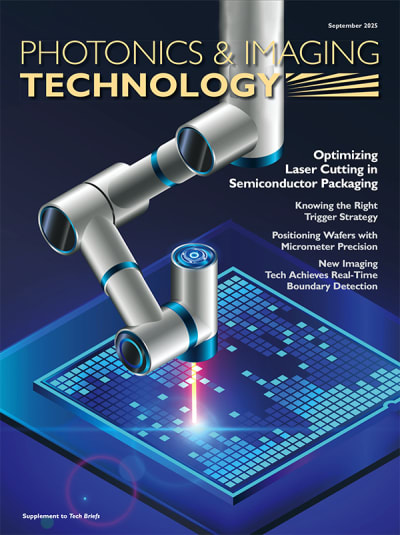
This issue of "Photonics & Imaging Technology" highlights several groundbreaking advancements in the fields of photonics, imaging, and optical technology, showcasing innovations that promise to transform various industries, including telecommunications, medicine, and artificial intelligence.
One of the standout features is the introduction of a new tunable laser developed by researchers at Harvard University. This laser utilizes a series of rings to emit multiple light wavelengths from a single chip, which could have significant applications in telecommunications and medical technologies. The ability to smoothly emit various wavelengths enhances the versatility of laser applications, potentially leading to more efficient communication systems and advanced medical imaging techniques.
In another significant development, engineers at the University of California San Diego have achieved a milestone in creating tiny optical devices that are both highly sensitive and durable. Traditionally, sensitivity and durability were seen as incompatible qualities in photonic devices. This breakthrough opens new avenues for the development of robust sensors and other optical components that can withstand harsh conditions while maintaining high performance.
The issue also features a report on a chiral photonic device developed at the University of Utah. This innovative device can adjust light's circular polarization on the fly, allowing it to store information. This capability is crucial for the advancement of optical computing, where operations based on light rather than electricity could lead to faster and more efficient processing of information. The integration of such devices into computing systems could significantly enhance data processing speeds and reduce energy consumption.
A particularly exciting development discussed in this issue is the work from Université Laval, where a team has designed a tiny optical chip capable of transmitting data at an unprecedented speed of 1,000 gigabits per second. This chip, as thin as a strand of hair, utilizes microring modulators to manipulate light for encoding information. The technology not only achieves remarkable data transfer rates but also does so with minimal energy consumption—only 4 joules to transfer an entire training dataset equivalent to over 100 million books in under seven minutes. This innovation addresses the growing energy demands of artificial intelligence systems, which are often criticized for their high power consumption.
The issue also emphasizes the importance of imaging technologies in biomedical research. A new technique for acquiring high-resolution multi-photon images using NAD(P)H autofluorescence contrast allows researchers to image living tissues more quickly and deeply. This advancement is particularly beneficial for studying metabolic functions in real-time, which is crucial for applications in cancer diagnosis and neuroscience. The ability to monitor fast changes in living tissues opens up new possibilities for understanding complex biological processes and interactions.
Additionally, the magazine discusses the potential of AI models trained with high-speed data transfer capabilities. The ability to transmit vast amounts of data rapidly could revolutionize how AI systems are developed and deployed, making them more efficient and capable of handling larger datasets. This is particularly relevant as the demand for AI technologies continues to grow, necessitating faster and more efficient data processing solutions.
The issue also touches on the challenges faced by current AI data centers, which rely on extensive infrastructure and energy consumption. The innovations presented in this issue, particularly the optical chip technology, could significantly reduce the physical footprint and energy requirements of these systems, making them more sustainable and scalable.
In summary, this issue of "Photonics & Imaging Technology" presents a collection of cutting-edge research and technological advancements that are set to reshape the landscape of photonics and imaging. From tunable lasers and durable photonic devices to high-speed optical chips and advanced imaging techniques, these innovations not only enhance our understanding of light and its applications but also pave the way for more efficient and sustainable technologies in various fields. The ongoing research and development in these areas hold great promise for the future, potentially leading to breakthroughs that could impact everything from telecommunications to healthcare and artificial intelligence.
Features
-
Application Briefs
-
Articles
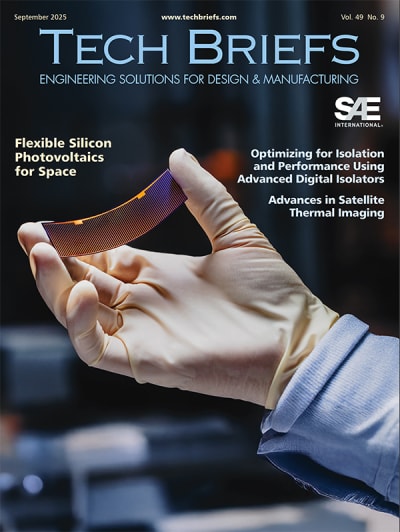
12 How to Optimize for Isolation and Performance Using Advanced Digital Isolators
18 Flexible Silicon Photovoltaics: A Breakthrough in Space-Grade Solar Power
-
5 Ws
-
NASA Spinoff
-
Technology & Society
44 Innovative Membrane Technology Promises Access to Clean Water
Tech Briefs
-
Manufacturing & Prototyping
23 A One-Piece Liquid Rocket Thrust Chamber Assembly
24 Diversifying the Supply Chain for Producing Large-Scale Metal Parts
-
Software
31 New Technique Could Accelerate Noise-Free Superconducting Qubits for Quantum Computing
32 A New Computer Vision Method Enables Faster Screening of Electronic Materials
-
Sensors/Data Acquisition
27 Twisted Moiré Photonic Crystals
28 Advanced Thermal Inspection with Pulsed Light Emitting Diodes (PLED) Technology
-
Energy
34 How ISS Will Be Evaluating Photovoltaic Materials
35 New Physics-Based Simulation Tool Accelerates Battery Development
Products
-
Briefs
14 Noninvasive Imaging Method Can Penetrate Deeper Into Living Tissue
15 A Technological Breakthrough for Ultra-Fast and Greener AI
16 Chiral Photonic Device Combines Light Manipulation with Memory
-
Applications
9 Positioning Wafers with Micrometer Precision for PECVD Coating
11 Knowing the Right Trigger Strategy Ensures Capture of High-Speed Application With Precision
-
Products
19 New Products