Test & Measurement - July 2025
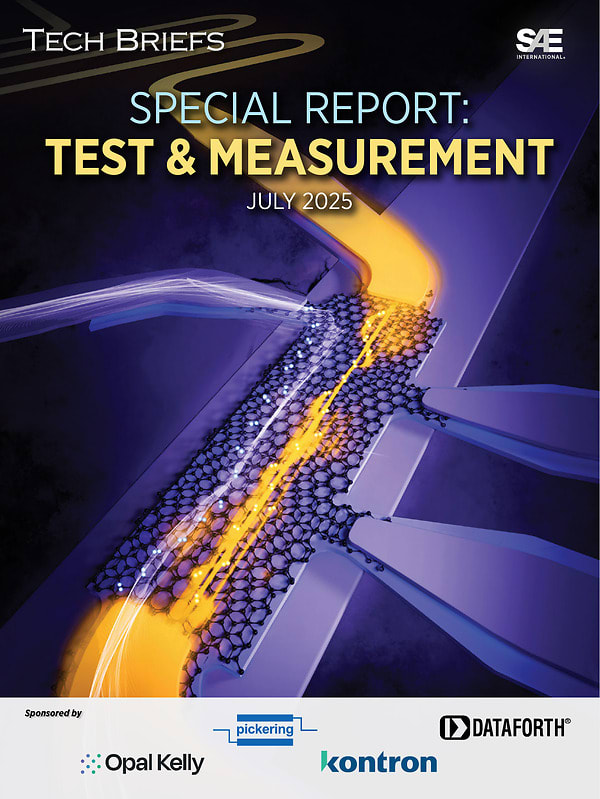
How climate conditions impact EV charging times…a new way to measure superconductivity in “magic” materials…NASA devises a handheld space telescope. Read about these and other innovations in a new report from the editors of Tech Briefs and Aerospace & Defense Technology.
Don't have an account?
Overview
The July 2025 Test & Measurement Special Report highlights significant advancements and research in various technological fields, particularly focusing on electric vehicles (EVs) and wireless systems.
One of the key features discusses the impact of climate conditions on EV charging times, emphasizing the need for manufacturers to understand how environmental factors can affect battery performance and charging efficiency. This understanding is crucial for optimizing charging infrastructure and enhancing user experience.
Another important topic is the quality assurance of EV batteries through CT-scan data analysis and visualization. This innovative approach allows manufacturers to detect potential issues within battery cells, ensuring reliability and safety in EV operations. The report underscores the importance of rigorous testing and quality control in the rapidly evolving EV market.
The report also delves into the realm of wireless industrial systems, where the National Institute of Standards and Technology (NIST) is actively working on best practice guidelines. These guidelines aim to assist manufacturers in implementing effective wireless solutions while ensuring reliability and performance. The report highlights the significance of standardization in wireless networks, particularly in diverse industrial environments, where performance can vary based on specific operational contexts.
Additionally, the report features a groundbreaking development from NASA Johnson Space Center: a handheld digital microscope designed for use in space. This innovative tool enables flight crews to conduct hematological diagnostics and monitor health in microgravity conditions. The microscope is compact, durable, and equipped with advanced imaging capabilities, making it suitable for both space and terrestrial applications.
The report also touches on the research conducted by physicists at MIT and Harvard University, who have made strides in measuring superfluid stiffness in "magic-angle" graphene. This research explores the unique properties of graphene materials, which have potential applications in superconductivity and other advanced technologies.
Overall, the July 2025 Test & Measurement Special Report provides a comprehensive overview of current trends and innovations in EV technology, wireless systems, and advanced materials research, highlighting the importance of testing, standardization, and quality assurance in these rapidly advancing fields.