

Faced with increasing demand for smarter products, shorter design cycles and more efficient, flexible production processes, design and manufacturing companies alike are turning to artificial intelligence to take their processes to the next level. With its unparalleled ability to handle complex data and easily communicate intelligent insights, AI is poised to take on a variety of key roles across every level of the industrial value chain.
As AI continues to advance, not only will it be able to take on complex tasks that were once exclusive to humans, but it will also help bridge the gap between humans and technology, recontextualizing complex tools and data into easy-to-understand insights. AI, especially LLMs, is uniquely suited to bring structure to unstructured data. By layering AI on top of the broad dataset that is the product design and manufacturing process, it is possible to not only accelerate existing processes but also develop new approaches to long-standing problems.
AI as a Decision Support System
It might seem obvious, but quickly and consistently making the right decisions is key to keeping any system running smoothly, be that design, production, or maintenance. However, with as complex as modern processes have become, efficiently reaching the right answer might not always be so simple. Data is the key to the decision-making process but, even for an expert, taking raw information and turning it into actionable insights is rarely quick or straightforward.
Artificial intelligence is a powerful tool in combating these challenges. With its ability to filter and process vast quantities of data, AI can effectively highlight the most important pieces of information, whether that is the best set of designs resulting from a design space exploration process or the connection between a certain material vendor and unusual vibrations in a machine. Further training these models with expert knowledge on how problems are solved, processes are completed, or designs are selected elevates these AI tools to become decision support systems — a tool capable of improving and accelerating the crucial decision-making process.
For example, the problem of optimizing a microorganism activity in a bioreactor which involves maximizing oxygen content, minimizing power input and limiting sheer force as much as possible while only modifying easy-to-change variables, such as impeller speed and configuration as well as aeration rate. Even using these limited variables, an example bioreactor took nearly 300 traditional simulation runs to find an optimal configuration with each run taking over 2 hours to complete.
AI-driven simulation acceleration reduces the number of full simulations run by more than 20 percent. In this process, the first 100 simulations runs are also used to train a reduced order model (ROM) which is then able to replace a portion of the remaining simulations by AI estimations. The ROM not only runs in seconds, but also helps guide the optimization process by informing the user about areas that may or may not be worth exploring further with a full simulation.
AI-powered decision support systems are an important step in bridging the gap between the capabilities of humans and machines, creating a best-case scenario where important choices can be backed by both the wealth of available information — often far beyond what a human can analyze, as well as the experience and critical thinking abilities of an expert. Beyond supporting experts, AI decision support systems could also allow new users and non-experts alike to benefit from the accumulated knowledge and expertise encoded within these models, flattening the learning curve for some and unlocking insights for others they never would have had access to before.
AI Brings DevOps to Hardware
Reaching an optimal design, be that for product or production, is a lengthy process that involves many iterations of changing, testing, and refining to reach the best result. In an ideal world, this process of refinement and innovation should extend through the entire lifecycle of a product or process, supporting continuous improvement from conception to eventual end-of-life. The software development industry has long enjoyed these benefits under the title of DevOps, however, the reality is, due to constraints on time, budget or technology, achieving the same level of rapid, continuous improvement in hardware is simply impractical using traditional methods.
Combining AI with the digital twin does present a path to reach these lofty goals though. AI-powered ROMs, trained on simulation data created during traditional design processes, can accurately reproduce how a part or system would function under various conditions in seconds instead of hours or days. Deploying this technology within the comprehensive digital twin allows changes to be tested in a true-to-life digital environment as quickly as they can be imagined.
ROMs represent a solution to one of the biggest challenges faced by rapid innovation in hardware: testing and validation are slow and expensive. Compared with running code changes in a test environment, validating design and process changes involves, at the minimum, complex and expensive multi-physics simulations and will likely extend to physical prototypes as well. With the costs involved in traditional methods small, incremental, continuous improvements are not practical to implement; but by combining an accurate digital twin with AI accelerated design and simulation tools, the threshold for what a minimum improvement worth testing for drops considerably.
To achieve the DevOps for hardware vision, the combined power of AI and the digital twin cannot just be used to refine the first version of a process, but also to take feedback and further refine it after deployment. This means taking all manner of information, be that from users of products, machine operators, IIoT sensors and countless other data sources, connecting them with the digital twin, then leveraging AI to quickly incorporate that information into a better, smarter system.
While this level of continuous optimization is a long way off, the foundation of digital twin and AI accelerated design and simulation technologies are already being built up today, offering significant improvements to the speed at which products and systems are designed and validated. Together, these tools will not only help make products faster and smarter, but more sustainable too, with faster, cheaper simulation making it easier to find the best, sustainable design while also cutting down the need for physical prototypes.
Bridging the Gap Between People and Technology
When it comes to design and manufacturing, there are a multitude of ways AI will help accelerate those processes, but it is not just speed at which AI excels. With recent advances in generative AI, it can also redefine the way people, technology and information interact. Industrial data is vast, and the tools that govern it are highly complex, which means training new users is slow and even for experienced users, simple tasks can be time consuming.
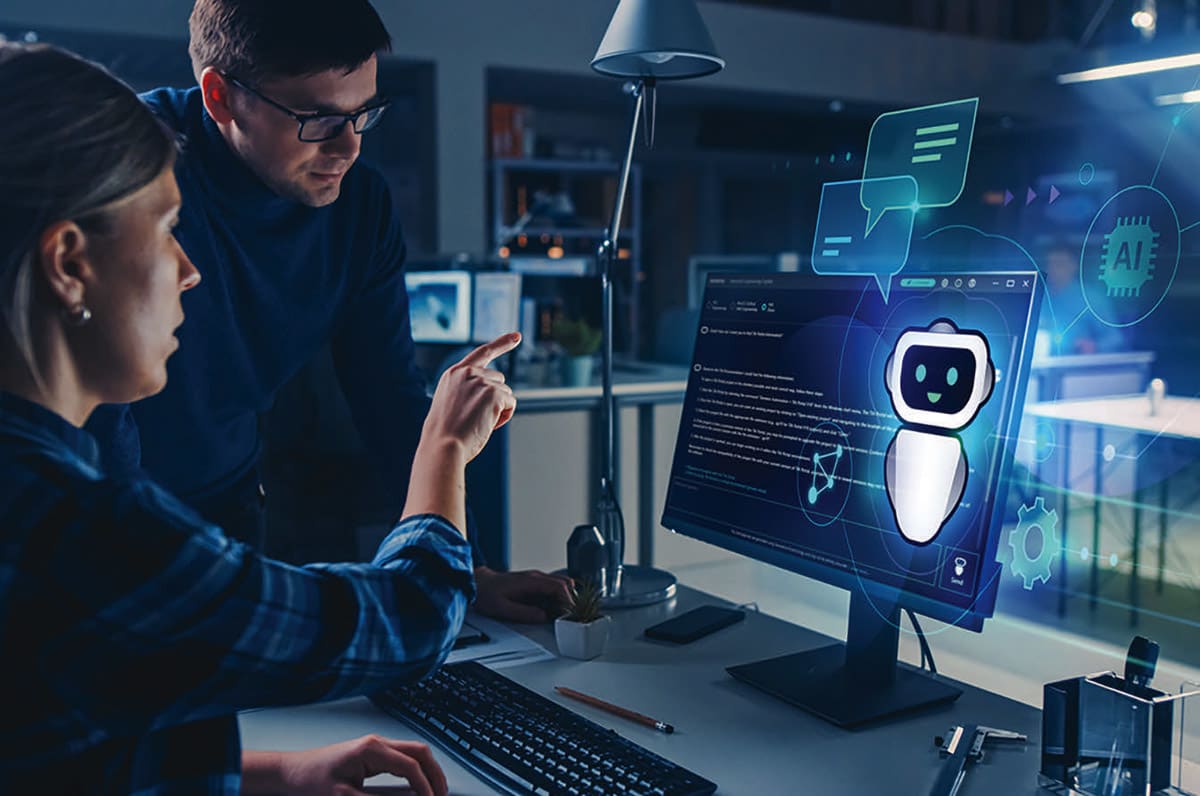
By connecting AI solutions, like Siemens Industrial Copilot, to the tools and data available across every level of design and production, users of all skill level have access to everything from production data insights to expert knowhow for using complex tools all through a simple, natural language interface. Making information, be that statistics or expert knowledge, accessible is a key step in breaking down the silos that exist between different domains which, in turn, supports a more holistic approach to product design and manufacturing.
For example, deploying a maintenance copilot to the shop floor helps rapidly diagnose and fix issues with production equipment. The copilot can quickly identify the root cause of problems based on natural language descriptions and error codes, find the relevant repair documents and formulate a step-by-step procedure for conducting the repair. This flattens the learning curve for new users while also making it faster for experienced users to complete repairs, all thanks to improved data accessibility through AI.
As technology continues to grow more complex, manually handling every detail or processing every data point will become increasingly impractical. Instead, AI systems, grounded in real data, can take over the role of analyzing massive production data sets or filling in all the details needed for a simulation, leaving human operators free to focus on the things only they can, such as creativity, ingenuity, and innovation.
AI Redefines Industry
It is no exaggeration to say that AI will be the next big leap across all of industry, reimagining the way people work, products are designed, and factories are operated. But AI doesn’t mean a fully autonomous future but rather a harmony, uniting people and technology in a way that plays to the strength of both to achieve a result greater than what either could achieve alone. A smart approach to industrial-grade AI will be crucial in realizing the bright, digital, future of manufacturing and design.
This article was written by Boris Scharinger, Senior Innovation Manager and Technology Strategist, Siemens Digital Industries (Plano, TX). For more information visit here .











