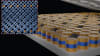


Innovators at NASA Johnson Space Center have developed a technology that can isolate a single direction of tensile strain in biaxially woven material. This is accomplished using traditional digital image correlation (DIC) techniques in combination with custom red-green-blue (RGB) color filtering software. DIC is a software-based method used to measure and characterize surface deformation and strain of an object. This technology was originally developed to enable the extraction of circumferential and longitudinal webbing strain information from material comprising the primary restraint layer that encompasses inflatable space structures.
Whereas traditional methods of monochrome DIC can only measure strain in each of the biaxial directions separately, this DIC with RGB color filtering technology can measure strain in a single analysis. The analysis process begins by applying a speckled pattern to the subject material to which multiple photographic images are generated from a set of stereo cameras.
These images are correlated/analyzed in post-processing to determine relative displacement of the speckles across a surface when testing for tensile strain. Traditional DIC software assumes a solid material substrate, but in interwoven materials the substrate consists of bi-directional patterns. This causes errors in strain data derived when the analysis is performed by DIC software alone.
Although monochrome DIC is a favored technique for measuring tensile strain in soft goods materials, the approach has difficulties when materials are interwoven. As mentioned, traditional DIC software treats regions for analysis as a solid surface and incorrectly represents deformations much larger than those actually present during testing, thus yielding false results. Additionally, considerable investments of time and effort from a trained technician are necessary to parse out strains in each direction of biaxially woven material. This entails meticulously identifying areas of interest whenever an undulating directional weave is visible.
The primary restraint layer of an inflatable space structure is comprised of orthogonally opposed, or interwoven straps. This DIC with RGB color filtering process presents a solution in providing more accurate and timely strain measurement of interwoven strap material by isolating a single strap direction for analysis.
This approach leverages unique post processing capabilities developed at NASA to filter out red or blue photogrammetry patterns, allowing for tunable isolation of a particular color pattern and directional strap.
When restraint layer material was analyzed using VIC-3D software, the addition of RGB color filtering demonstrated improved strain field accuracy when compared to monochrome DIC alone. Notably, the implementation of RGB filtering allows the selection of a larger area of interest that results in minimal influence from the orthogonally opposed straps. This streamlines the tensile strain analysis process, significantly reducing the time needed to analyze large bodies of interwoven material.
NASA is actively seeking licensees to commercialize this technology. Please contact NASA’s Licensing Concierge at