The figure schematically depicts a miniature laboratory system that has been proposed for use in the field to detect sparsely distributed biomolecules. By emphasizing concentration and sorting of specimens prior to detection, the underlying system concept would make it possible to attain high detection sensitivities without the need to develop ever more sensitive biosensors.
The original purpose of the proposal is to aid the search for signs of life on a remote planet by enabling the detection of specimens as sparse as a few molecules or microbes in a large amount of soil, dust, rocks, water/ice, or other raw sample material. Some version of the system could prove useful on Earth for remote sensing of biological contamination, including agents of biological warfare.
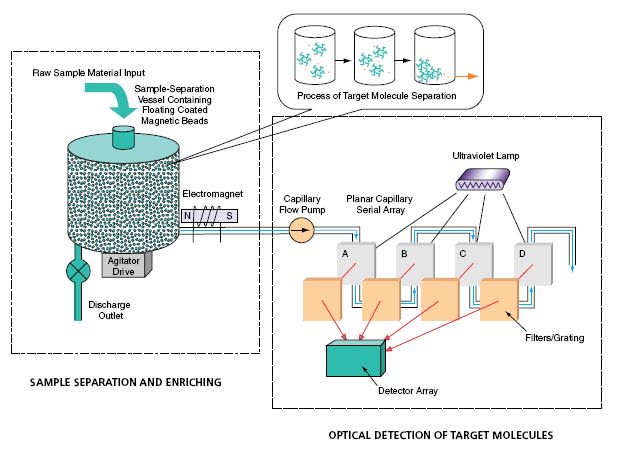
Processing in this system would begin with dissolution of the raw sample material in a sample-separation vessel. The solution in the vessel would contain floating microscopic magnetic beads coated with substances that could engage in chemical reactions with various target functional groups that are parts of target molecules. The chemical reactions would cause the targeted molecules to be captured on the surfaces of the beads.
By use of a controlled magnetic field, the beads would be concentrated in a specified location in the vessel. Once the beads were thus concentrated, the rest of the solution would be discarded. This procedure would obviate the filtration steps and thereby also eliminate the filter-clogging difficulties of typical prior sample-concentration schemes. For ferrous dust/soil samples, the dissolution would be done first in a separate vessel before the solution is transferred to the microbead-containing vessel.
A small amount of a solvent solution would be used to elute the captured target molecules from the surfaces of the beads. The resulting solution would be made to flow through a series of capillary detection channels, which would be coated with probe molecules, each designed to capture a specific functional group. Once the flow had run its course, an instrument yet to be developed (perhaps an integrated optical spectrometer) would be used to detect and analyze molecules of interest that had accumulated in the channels. The outputs of the instrument would be used to construct a matrix of data from which the concentrations of the target molecules would be estimated.
This work was done by Ying Lin and Nan Yu of Caltech for NASA’s Jet Propulsion Laboratory. For further information, access the Technical Support Package (TSP ) free on-line at www.techbriefs.com/tsp under the Bio-Medical category. NPO-40281
This Brief includes a Technical Support Package (TSP).
Miniature Laboratory for Detecting Sparse Biomolecules
(reference NPO-40281) is currently available for download from the TSP library.
Don't have an account?
Overview
The document is a Technical Support Package from NASA's Jet Propulsion Laboratory (JPL) detailing the Miniature Laboratory for Detecting Sparse Biomolecules, identified as NPO-40281. This laboratory is designed to enhance the detection and analysis of biomolecules, which are crucial for various scientific and medical applications. The technology is particularly relevant for space exploration, where the ability to detect and analyze biological materials can provide insights into the potential for life beyond Earth.
The laboratory employs advanced techniques for sample separation and enrichment, utilizing a miniature system that integrates several components. Key features include a capillary flow pump for sample input and discharge, a UV lamp for optical detection, and a planar capillary serial array for efficient processing. The use of optical detection is emphasized due to its capability for "in-situ" probing, allowing for real-time analysis of samples without the need for extensive preparation.
The document also highlights the broader implications of this technology, suggesting that the developments in this miniature laboratory could have significant applications beyond aerospace, including in medical diagnostics and environmental monitoring. The research and technology presented are part of NASA's Commercial Technology Program, which aims to disseminate aerospace-related advancements that can benefit various sectors.
For further inquiries or additional information, the document provides contact details for the Innovative Technology Assets Management at JPL, as well as resources for accessing more research and technology publications through the NASA Scientific and Technical Information (STI) Program Office.
Overall, the Technical Support Package serves as a comprehensive overview of the capabilities and potential applications of the Miniature Laboratory for Detecting Sparse Biomolecules, showcasing NASA's commitment to innovation and the transfer of technology for broader societal benefits.