

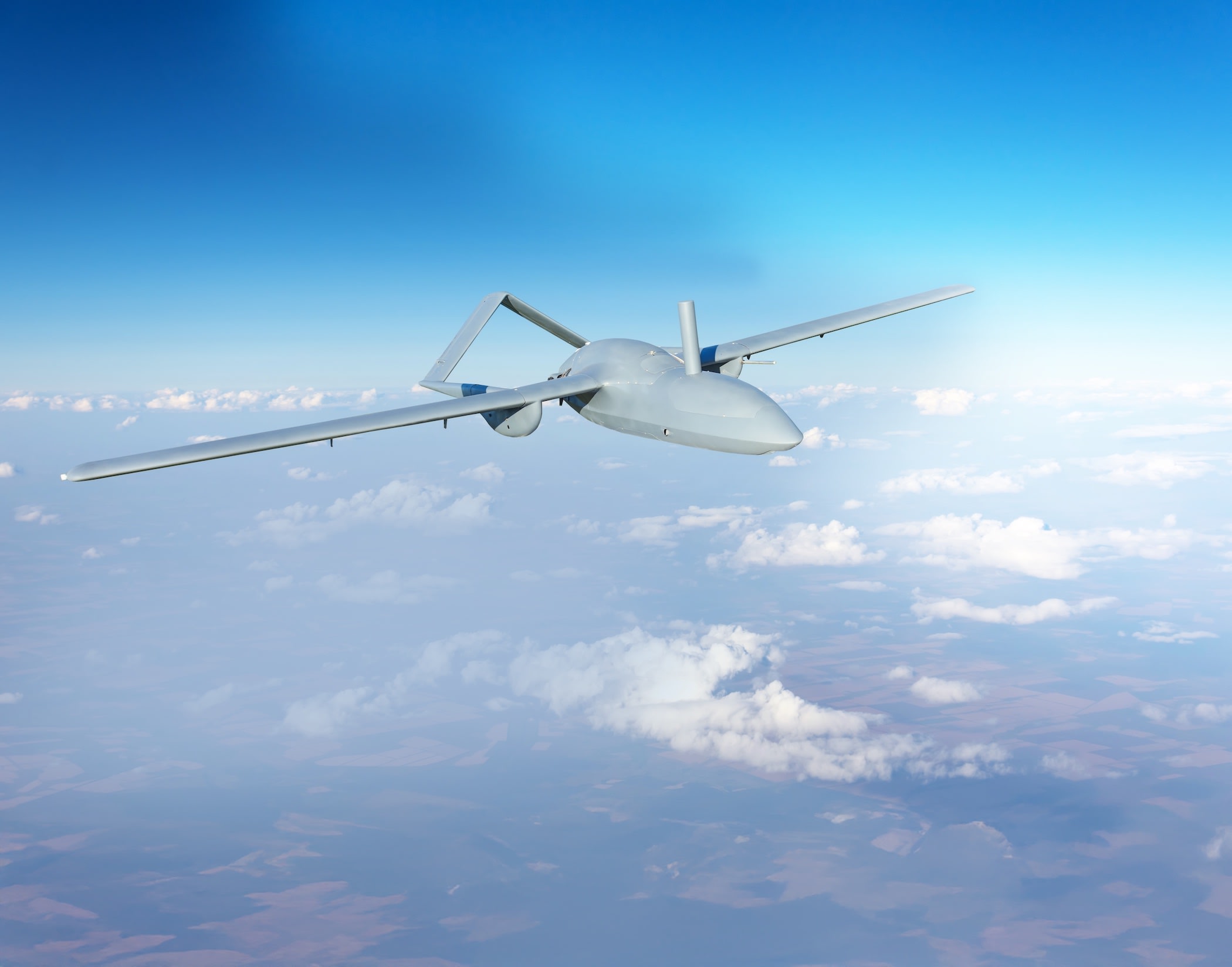
Current world conflicts have proven that drones are now indispensable tools in modern warfare. Whether for reconnaissance, loitering munitions, or asymmetric tactics that exploit vulnerabilities in conventional defenses, unmanned aerial systems (UAS) are redefining the rules of engagement.
But their unique capabilities and adaptability make them a growing threat far beyond the battlefield. Their use can extend to national borders and even within domestic airspace. Plus, their widespread availability means they can be exploited by governments, terrorist groups, criminal organizations, and lone actors alike.
Counter-UAS (C-UAS) platforms are evolving rapidly to meet the drone threat. These utilize a variety of technologies locate and track drones — including radar, RF monitoring, and advanced infrared (IR) optics imaging. This article highlights requirements for an IR imaging C-UAS platform and examines the design of one state-of-the-art lens system for this application.
C-UAS Requirements
C-UAS platforms face a particularly complex challenge. They must detect, identify, and track small, fast-moving drones that often operate at low altitudes and in cluttered environments. This task must be performed under virtually any lighting or weather conditions. The system must be capable of very rapid identification, even across long distances, with a high degree of accuracy.
Mid-wave infrared (MWIR) imaging (3-5μm wavelength regime) is particularly useful for these tasks. MWIR excels over visible or near-infrared (NIR) imaging (0.7-1μm regime) at detecting drone signatures regardless of lighting, camouflage, or obscurants (like haze, fog, or smoke). It provides the ideal balance of resolution, contrast, and atmospheric transmission, especially over long distances.
When utilized with cooled detectors, MWIR also offers superior spatial resolution as compared to long-wave infrared (LWIR, 8-12μm wavelength regime). This makes it especially effective for spotting small, fast-moving aerial threats at long range. While LWIR is more useful in certain scenarios, it can’t deliver the same level of image detail and is less adept at viewing warm targets in hot or humid environments.
Radar may detect movement, but only thermal imaging provides the contrast and optical sharpness needed to visually confirm and classify airborne threats at day and night. That confirmation is critical in situations where false positives carry operational, political, or humanitarian consequences.
MWIR C-UAS Imager Requirements
The imaging requirements for a C-UAS optical system are best understood within the widely used detection, ranging, and identification (DRI) paradigm. Here, “detection” means an object is observed, “recognition” indicates the type of object is determined (e.g. drone or bird), and “identification” indicates that the object is confirmed, based on Johnson Criteria.
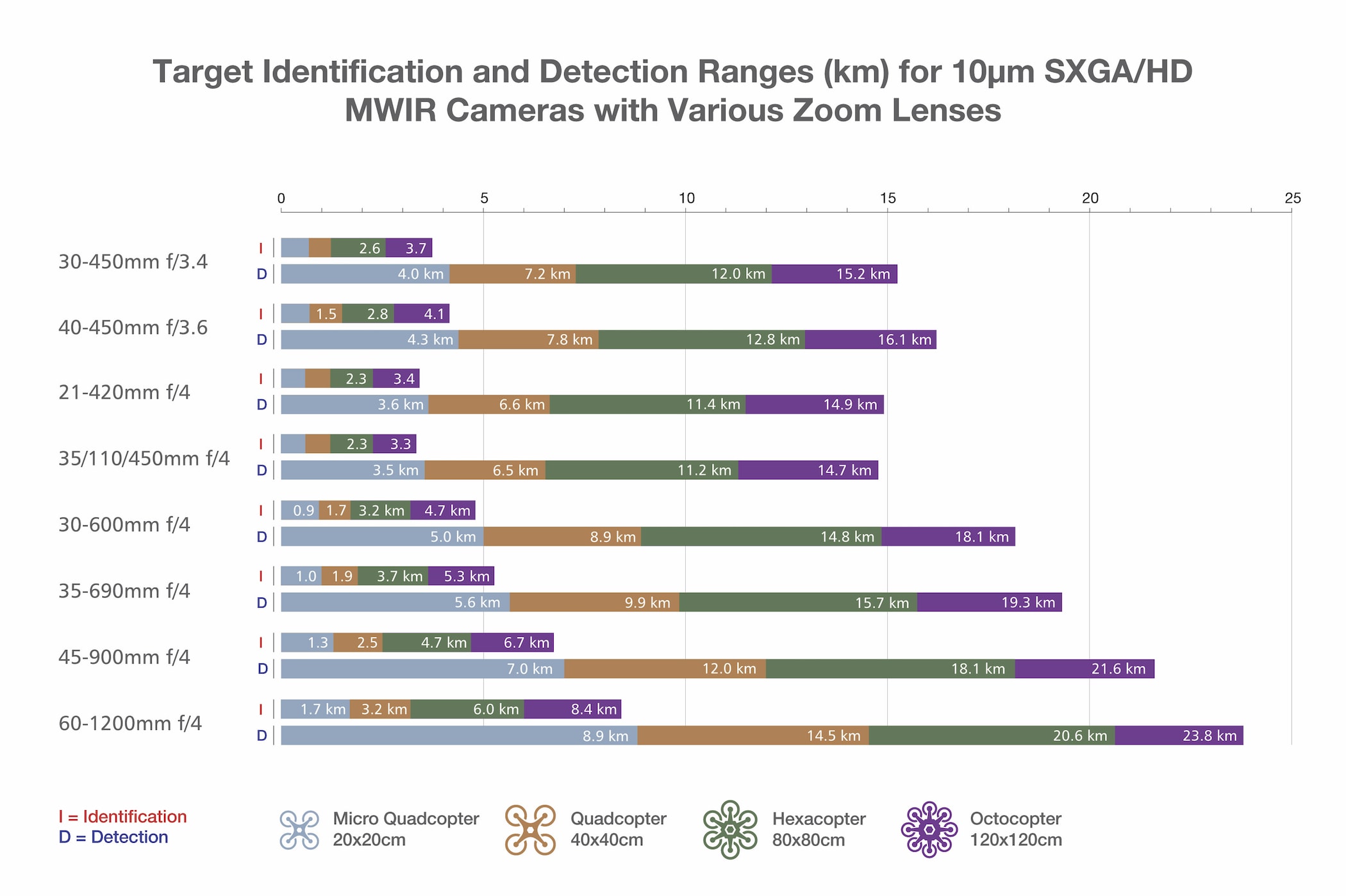
Each step in the DRI hierarchy requires that the image of a target occupy progressively move pixels on the detector. Assuming the distance from camera to target stays fixed, this translates into a longer lens focal length at each step. Thus, the ideal C-UAS lens offers multiple focal lengths to enable it to transition from surveying a wide area (for target detection) to higher magnifications (for positive identification). Figure 1 summarizes the detection and identification ranges of various focal length lenses for four typical C-UAS targets.
A continuous zoom lens is the most efficient and operationally flexible solution for meeting this multi-focal length requirement. Furthermore, a zoom lens that can be automatically controlled with AI software to optimize field-of-view for a specific situation offers faster target identification without close supervision from an operator.
However, zoom lenses are more optomechanically complex than fixed focal length lenses. This leads to several other practical requirements for their use in C-UAS. Specifically, it’s necessary that a zoom lens maintain sharp focus during field-of-view changes, as well as while tracking a fast-moving object. The system must also retain line-of-sight stability and optical boresight alignment throughout the zoom range. Any focus or misalignment errors degrade the ability of the imager to locate and track moving targets.
Focus speed is another critical factor. Small drones move quickly across the field of view, especially when operating at low altitude. An autofocus system must drive from minimum focus to infinity in less than one second, even under temperature extremes or vibration. Finally, the lens must have sufficient back focal length to accommodate mechanical spacing and cold shield interfaces.
The system must also maintain good image contrast over the relevant spatial frequencies. Poor image contrast can reduce effective resolution even if the system technically delivers the required number of pixels on the sensor.
The metric for image quality is MTF (modulation transfer function), the measure of how well an optical system preserves contrast and resolution. A properly designed MWIR lens should deliver MTF near the diffraction limit, particularly at the center of the field. But it must retain strong performance across the full sensor area, without introducing distortion or narcissus effects that interfere with onboard image analytics. All this is necessary to support detection and tracking across the full sensor area.
Case Study: MWIR Optics for C-UAS
What does an optical system that meets all these requirements look like? The Ophir SupIR-X 15 – 300 mm f/4 lens exemplifies the design and construction characteristics needed to meet the specific performance demands just described for high-performance C-UAS imaging applications. It’s useful to review these in detail.
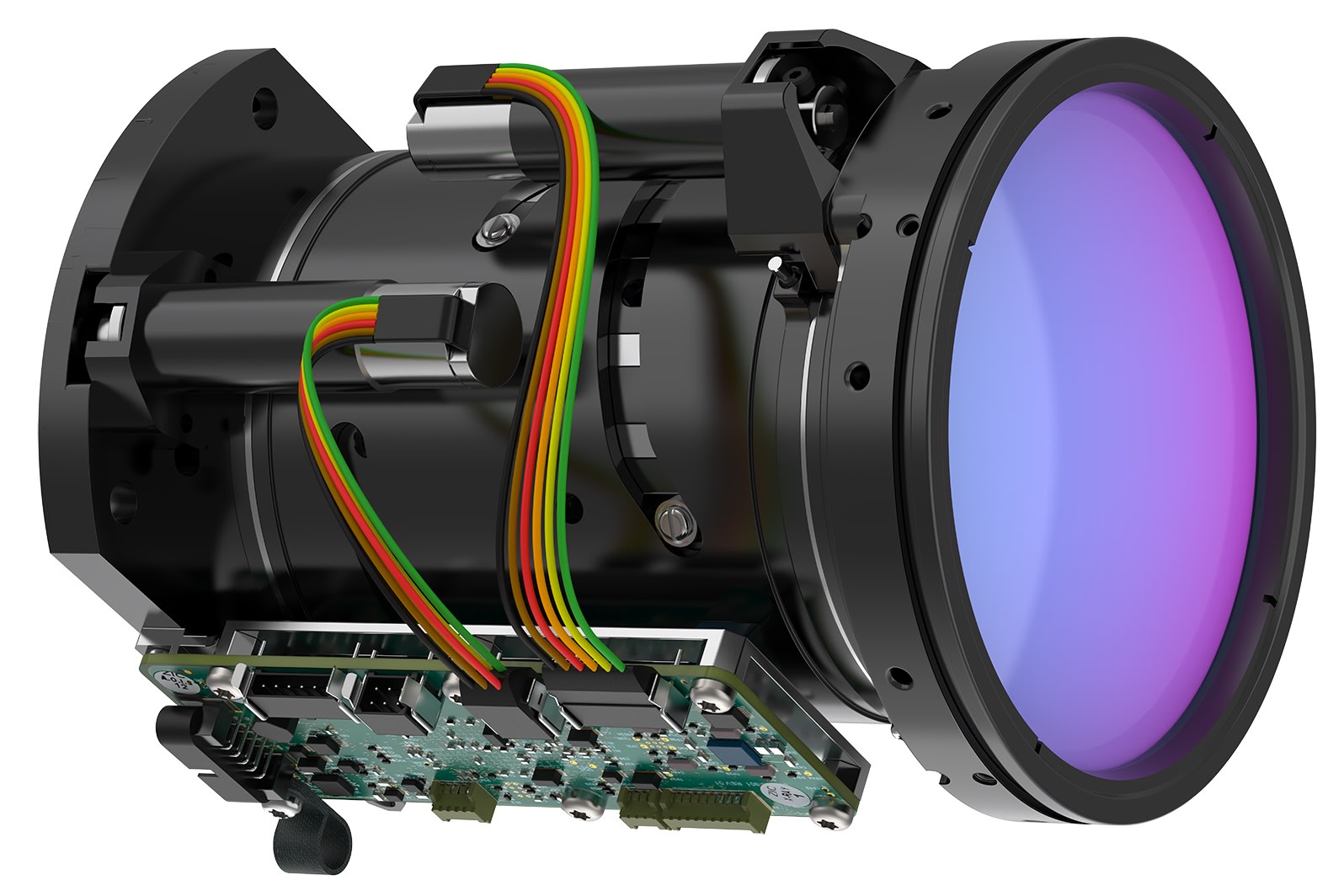
This system is a compact, rugged, motorized zoom and autofocus MWIR imager compatible with 10µm SXGA detectors (Figure 2). It’s intended for long range observation systems where it can achieve vehicle detection at over 15.5 km. Besides excellent imaging performance, its design also provides a high degree of passive athermalization, enabling it to operate successfully over a temperature range of -32 °C to +80 °C. This wide operating range is often necessary in C-UAS systems.
Another important feature of this lens is that it can be paired with a variety of focal length extender modules. Most pertinent for long range C-UAS uses are the x3 and x4 variants. When operating with the x4 at 1200 mm, the system is able to identify a 0.4-m drone at distances up to 4.8 km.
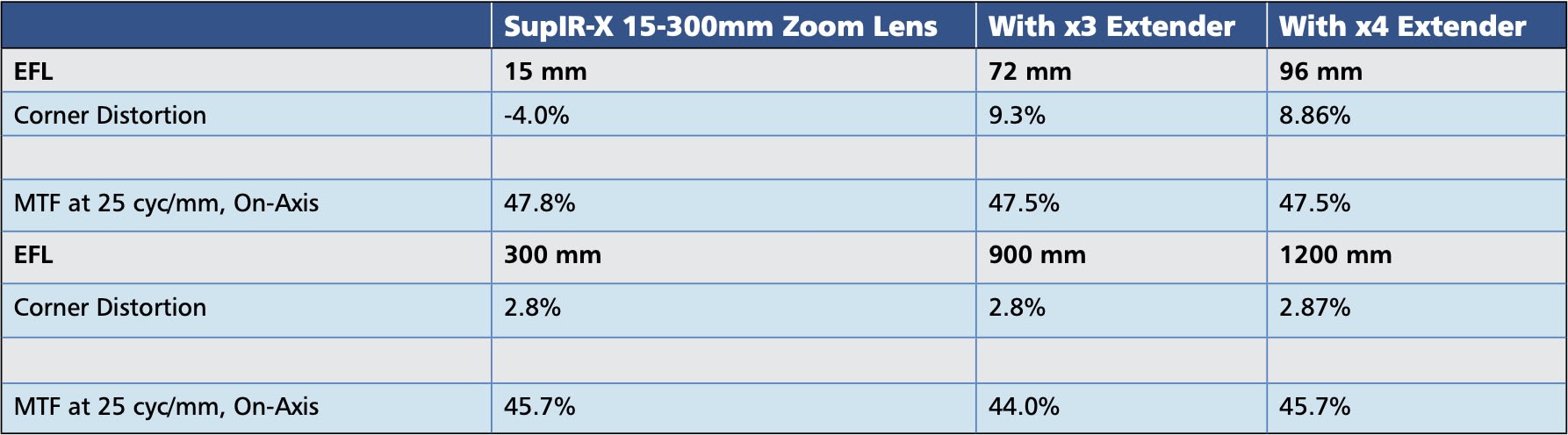
Crucially, the designs of the extenders have been carefully crafted so that they produce almost no degradation in image contrast or stability — a necessity for their use in C-UAS detection. This is demonstrated in Table 1 which compares the on and off-axis performance with and without the extenders. Plus, even with the extenders in use, the lens maintains boresight accuracy, fast focus response (<1 s), and stable line-of-sight throughout the entire zoom range.
Conclusion
As drone threats continue to evolve, C-UAS systems must meet ever more stringent performance criteria across even the most demanding range, speed, and environmental conditions. The SupIR X 15 – 300 mm lens is one example of how Ophir has applied advanced optical engineering and fabrication technology to achieve the precision, reliability, image quality, and optimization required for modern aerial threat detection and identification.
This article was contributed by MKS Ophir (Andover, MA). For more information, visit here .
Transcript
00:00:04 Introducing the SUP IRX 15 to 300 mm F4. Designed for the thermal imaging systems of tomorrow, the Soup IRX is more than an upgrade. It's a generational leap engineered to unlock the full potential of 10 micron SXGA midwave infrared imaging. The Supirx offers enhanced optical performance with improved distortion
00:00:41 control. It consistently delivers highquality imagery and clear thermal perception even in challenging low background environments and diverse thermal conditions. Fully compatible with our optical extenders, the SUP IRX maintains a constant f4 aperture and consistent performance across all zoom levels. It extends effective focal length to
00:01:06 1200 mm without compromising image quality. Whether securing borders, tracking threats, supporting ISR missions, or monitoring critical infrastructure and coastal zones, the SUP IRX 15-300 delivers the precision, reach, and flexibility demanded by today's complex security environments. Opirx
00:01:35 15 to 300 mm F4, a new standard in midwave IR zoom lenses, has arrived. [Music]











