

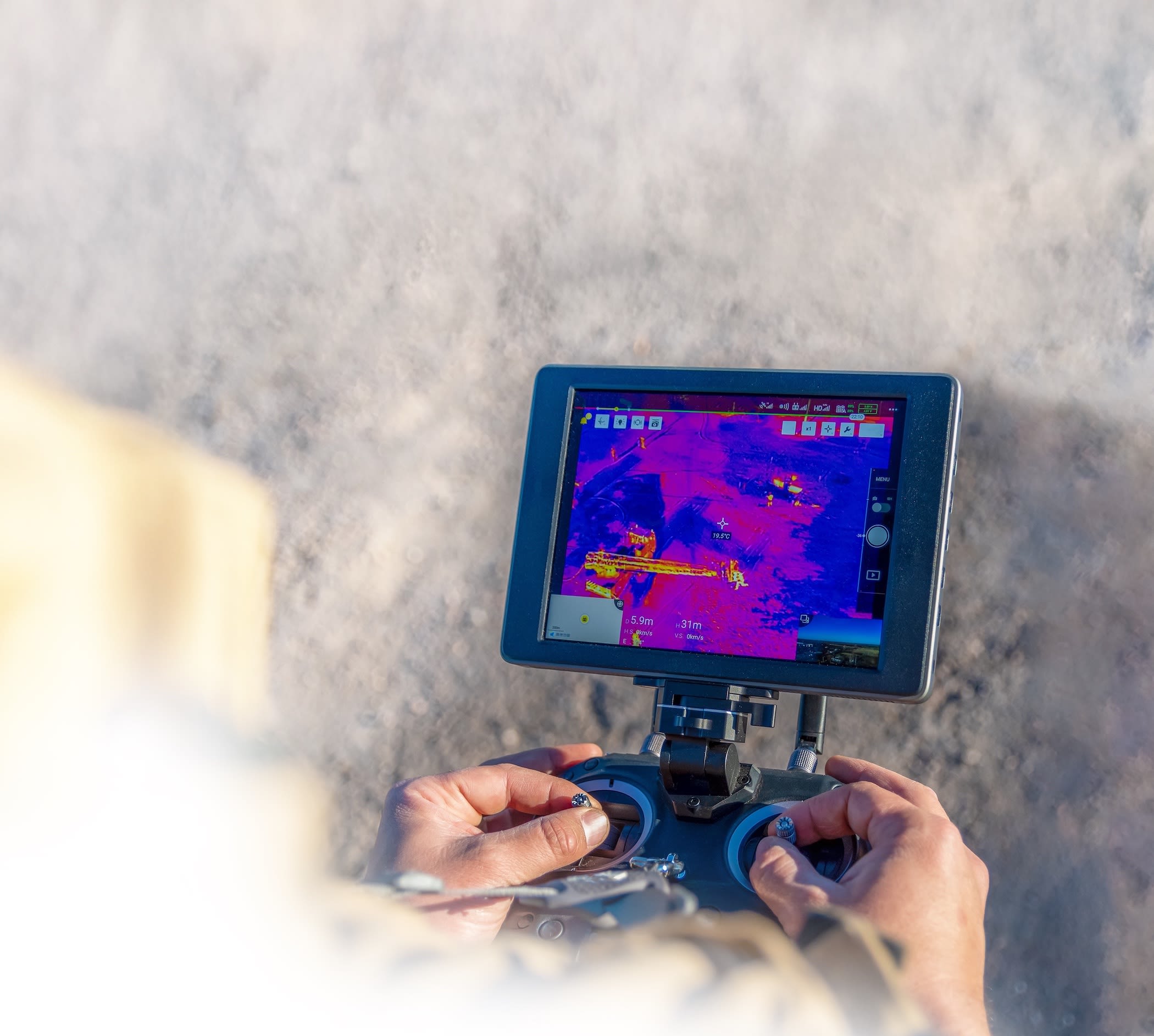
In complete darkness, through smoke, glare and fog, thermal infrared (IR) imaging is indispensable for modern defense and autonomous systems. Enabling autonomous vehicles (AVs) to detect pedestrians or threats at night or providing critical sensing capabilities for unmanned aerial vehicles and counter-UAS operations, thermal imaging has become the essential “eyes” when visible camera systems fail.
When aligning an IR camera system to an application, the careful and proper lens design is crucial. Like visible cameras, the imaging capabilities of a thermal camera rely in large part on the attributes of the lens assembly — it affects cost, production time, and most importantly, performance.
The Role of Optics in IR Image Quality
Visible camera lenses are comprised of multiple elements with different glasses to mitigate aberrations and provide a sharp image under broad conditions. Thermal lenses employ unique lens structures and materials but differ from those used in visible digital cameras due to detector limitations and material constraints.
Mid-wave IR (MWIR) and long-wave IR (LWIR) detectors sense much longer wavelengths emitted by warm objects. IR detector pixels are large and the cost to produce even low-resolution focal plane arrays is far higher than those in visible cameras. Thermal lens design must ensure effective utilization of every pixel so that image quality isn’t compromised by the lens, particularly in defense and AV applications.
Conventional glasses block IR radiation, so thermal systems require specialized lens materials, such as germanium, silicon, zinc selenide, or chalcogenide glass. These materials transmit MWIR and LWIR wavelengths with minimal signal loss, while anti-reflective coatings further reduce surface reflections to maximize IR transmission.

Overall, thermal lenses must be very efficient in collecting light and mitigating the impact of environmental factors, while using a limited set of lens materials to project a high-contrast image onto the detector array (Table 1).
Key Optical Considerations for MWIR and LWIR Cameras
The following are key optical terms for thermal cameras, along with definitions of the optical specifications or requirements critical to right-sizing performance for the application.

Focal Length, FOV, and IFOV: Focal length determines the field of view (FOV), the entirety of a scene a camera can capture on the sensor focal plane array (Figure 1). Shorter focal lengths provide wide-angle views, while longer ones give narrow, zoomed-in views. Instantaneous field of view (IFOV) represents the smallest detectable detail per pixel. Focal length balances scene coverage (FOV) and fine detail resolution (IFOV).

F/Number and Transmission: F-number (f/#) is the ratio of the focal length to the aperture diameter, controlling the amount of light collected (Figure 2). Also, light diffraction, which blurs the image, is proportional to the wavelength multiplied by the f/#. A lower f/# means a larger aperture and better light efficiency, as well as less blurring due to diffraction. Transmission measures the thermal radiation reaching the sensor. Both low f/# and high transmission ensure strong sensor signals, though low f/# increases lens weight, complexity, and cost.
Modulation Transfer Function (MTF): Quantifies contrast reproduction at various spatial frequencies. Higher MTF produces sharper images and better detection of minor temperature differences between adjacent pixels.

Standard or Reimaging Configuration: Some LWIR and nearly all MWIR focal planes are cooled to low temperatures during operation, requiring a dewar enclosure around the focal plane (Figure 3). Thus, the lens stop must be positioned near the dewar window. This usually necessitates a re-imaging lens configuration.
Waveband: While both bands detect thermal radiation, body heat emission peaks in the LWIR. Also, LWIR cameras often operate at room temperature when coupled with a low f/# lens. MWIR cameras require cooled focal planes and are superior for detecting heat sources such as engines or machinery. Their superior sensitivity comes with high complexity and cost, including re-imaging lens configurations. That said, the f/# requirements are relaxed, and more optical materials are available in MWIR.
Three Primary Lens Design Challenges of Thermal Imaging
Thermal systems face three primary design challenges: wavelength effects, thermal management requirements, and supply chain constraints.
Diffraction is the spreading of waves at the lens entry, which impacts image sharpness at the focal plane array. As detector pixels get smaller, the lens f/# required to ensure image contrast between adjacent pixels shrinks. MWIR’s shorter wavelengths exhibit less diffraction, so F/3-F/5 apertures that complement the higher sensitivity of cooled detectors produce acceptable pixel contrast or MTF. Diffraction blurring from LWIR requires wider F/1-F/2 apertures to provide pixel contrast; the larger collection apertures also compensate for the lower photon sensitivity of uncooled sensors.
IR lens materials are sensitive to temperature. Unless controlled, the best focus position can shift with small temperature changes. But thermal cameras must deliver a sharp image over a very wide temperature range. Lenses maintain focus through two design approaches. Passive athermalization utilizes optical and mechanical materials with compensating thermal expansion to stabilize focus, ideal for compact, lightweight systems. Active athermalization employs temperature sensors controlling a motorized focus adjustment. This is suitable for larger systems where motorized focus is employed for range compensation.
IR lens materials are either high-purity industrial crystals or chalcogenide glasses, all with complex international supply chains. Supply chain vulnerabilities compound all the technical challenges outlined above. The supply of Germanium relies upon refining operations in specific countries. Chalcogenide glasses require more broadly commoditized sulfur, selenium, arsenic, and tellurium, but glass-making operations are still geographically limited. With most IR materials subject to supply constraints with geopolitical risks, diversifying sources and developing mitigation strategies are essential for sustainable IR lens production.
Lens Selection Criteria: Fixed Versus Continuous Zoom
The choice of fixed-field-of-view or continuous zoom (CZ) lenses represents a fundamental design decision that affects cost, complexity, and operational capability.

Fixed FOV lenses offer single focal length simplicity, with fewer moving parts, making them lighter, more affordable, and more reliable than zoom lenses (Figure 4). Many of these lenses are passively athermalized, so focus is set at the factory and need never be adjusted by the customer. Wide-angle configurations (>60o) capture broader scenes with reduced detail, while medium focal length designs (10 o-50o) strike a balance between coverage and magnification. Telephoto variants (<8o) offer higher magnification and IFOV capable of identification at long range but require greater stabilization due to increased movement sensitivity.

CZ lenses enable dynamic FOV adjustment through sophisticated movable lens groups that maintain focus while changing focal length across ranges like 14-75mm or 50-1000mm, ideal for a dynamic environment that requires large FOV and minute IFOV. This operational flexibility comes at substantially increased complexity and cost. IR CZ lenses have significantly higher numbers of components as well as motorized zoom and focus actuation requiring control electronics (Figure 5).
In summary, system engineers must assess the application and balance image quality, cost constraints, and flexibility demands in determining the most appropriate lens configuration for an IR camera application.
Optimizing Performance and Sensitivity
Lens light-collecting efficiency directly impacts Noise Equivalent Temperature Difference (NEdT), the key sensitivity metric for MWIR and LWIR cameras. NEdT measures the smallest detectable temperature difference in milli-Kelvin. For example, an f/1.0 LWIR camera with a NEdT of 20 mK is 2.5 times more sensitive compared to an f/1.55 camera at 50 mK, though sensitivity is not strictly linear with NEdT.
Optical design fundamentally impacts camera performance. Lower f/# values allow more energy transmission, improving image clarity, and sensitivity. Element materials and AR-coatings must maximize infrared radiation reaching the detector. High quality lenses with minimal aberrations ensure high MTF, while focal length sets magnification and detection range.
Future Outlook and Integration Considerations
Thermal lens development continues to evolve toward smaller, lighter, and cost-effective designs while reducing dependence on rare materials like germanium for economic sustainability. This progress will expand the use of thermal imaging in AV and defense applications to see through the darkness as well as obscurants such as fog or smoke.
Successful integration requires understanding the fundamental relationships between optical design choices and system performance. Material constraints, wavelength-specific effects, and thermal management requirements create interdependencies that impact every aspect of system capability. Whether developing defense systems, autonomous vehicles, or industrial monitoring solutions, optimal optical design remains crucial for maximizing the effectiveness of thermal imaging.
This article was written by Alan Kathman, Director of Optics – Teledyne FLIR OEM (Goleta, CA). For more information, visit here .
Transcript
No transcript is available for this video.









