From the tragedy of the space shuttle Columbia disaster in 2003 to the now-routine return of commercial spacecraft, heat shields — formally called thermal protection systems — are critical for protecting vehicles from the intense heat and friction of atmospheric reentry or traveling at many times the speed of sound.
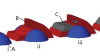
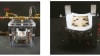
Now, a team of engineers at Sandia National Laboratories has developed ways to rapidly evaluate new thermal protection materials for hypersonic vehicles. Their three-year research project combined computer modeling, laboratory experiments, and flight testing to better understand how heat shields behave under extreme temperatures and pressures, and to predict their performance much faster than before.
Hypersonic flight means traveling at speeds of at least five times faster than the speed of sound, or more than 3,800 miles per hour. Other vehicles, such as ballistic missiles, can travel this fast, but hypersonic vehicles are far more maneuverable and unpredictable, making them harder to intercept. Unlike reusable spacecraft, the thermal protection systems used on U.S. hypersonic missiles — which solely deliver conventional weapons — are designed for a single use.
“This project came about because I was talking with Jon Murray one day and he told me he needed to predict the response of heat shields more rapidly to assist his Department of Defense customers,” said Justin Wagner, an aerospace engineer and the project’s lead researcher. “He said ‘Can we find a way to use the science tools that are being developed here and combine that with our systems integration know-how?’ Ultimately, the project is focused on trying to understand what will happen in flight more quickly. It will limit how many materials we need to qualify and help us understand them better.”

The project tested materials ranging from common graphite — the same carbon used in No. 2 pencils — to more exotic carbon-based and ceramic composites. Hundreds of samples were made by the materials science team led by Sandia researcher Bernadette Hernandez-Sanchez, with contributions from Oak Ridge National Laboratory.
Here is an exclusive Tech Briefs interview, edited for length and clarity, with Wagner.
Tech Briefs: The article I read says the big challenge was determining the best method to identify the most important features in the equations that best describe their behavior. So, my question is: How did you achieve that?
Wagner: It is a combined complex environment, the hypersonic heat shield environment. Figuring out the most important parameters and equations, really requires a broad approach to being able to replicate a lot of the effects on the ground that we want to be able to capture in the model. That includes being able to make material properties measurements of the heat shield, as well as to be able to understand the performance of that heat shield within representative environments.
Tech Briefs: Can you explain in simple terms how it works please?
Wagner: At a very high level, we were attempting to reduce the amount of time it takes to predict the performance of heat shields in hypersonic environments. Historically, that can require some long lead items like testing and facilities, where that can be expensive and have long wait times. So, our approach was to take cheaper, more efficient methods of testing that can replicate some of those important physics, and to be able to build up those experiments to feed modeling and then to feed the overall predictions of each of them.
Tech Briefs: The article I read also says, “Next, the team will test a new tile built with multiple material samples and temperature sensors on the nose of a reentry capsule scheduled to launch in summer 2026.” My question is in two parts: 1) Do you have any set plans for this and 2) what materials will it be built with?
Wagner: It's carbon-based materials and some ceramic-based materials. And, yes, we do have set plans for these experiments.
Tech Briefs: Is there anything else you'd add that I didn't touch upon?
Wagner: This project is a pretty challenging, integrated, multidisciplinary problem. I think what really made it successful was having access to all these experts in the various fields that are required to be able to predict the performance of the heat shield in hypersonic environments. That includes material scientists; folks who are experts in doing experimentation; people who can organize flight tests to get good data out of flight tests. It also includes people who can model these complicated environments in flight. And finally, for this type of information to be really useful, it's important to have those models be able to go quickly so that you can get to that end result fast and make a better prediction of the heat shield performance.
Tech Briefs: Do you have any advice for researchers or engineers aiming to bring their ideas to fruition?
Wagner: Be willing to try things quickly in this type of space and don't be beholden to that final, all-encompassing experiment — learn as you go.