

Projects that utilize large volumes of nonmetallic materials of planetary protection concern pose a challenge to their bioburden budget, as the most conservative value of 30 spores/cm3 is typically used. The standard laboratory procedures do not provide any direction into the methodologies to understand the embedded bioburden within such nonmetallic components such as adhesives, insulation, or paint. A project can elect to conduct a destructive hardware study to experimentally derive a sourcespecific encapsulated microbial density, and the experimental value can be utilized for a project.
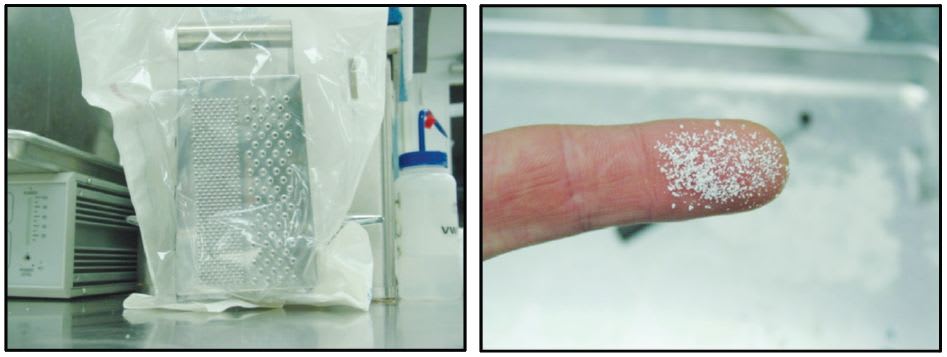
Samples were placed on a sterile tray and cut into three 5×5 cm pieces. The cut piece was wiped with a sterile wipe and 2-propanol. The cleaned material was then grated gently on the smallest grading plane on the box grater into sugar-crystal-sized pieces. The box grater approach is advantageous due to the ease and ability of the entire system to be sterilized, minimal (or negligible) impact to recontamination if performed in a Class 100 flow bench, and controllable heat generation upon material destruction. The recovery percentages of spores seeded on flight or surrogate materials were <10% for surrogate and <50% for flight, and could be applicable along with other chemical or physical technologies.
This work was done by James N. Benardini, Fabian Morales, Wayne W. Schubert, Gayane A. Kazarians, and Robert C. Koukol of Caltech for NASA’s Jet Propulsion Laboratory. NPO-48299
This Brief includes a Technical Support Package (TSP).
Employing a Grinding Technology to Assess the Microbial Density for Encapsulated Organisms
(reference NPO-48299) is currently available for download from the TSP library.
Don't have an account?
Overview
The document is a Technical Support Package (TSP) from NASA's Jet Propulsion Laboratory (JPL), detailing research on employing grinding technology to assess microbial density in encapsulated organisms, identified by the project number NPO-48299. The work was conducted by a team including James N. Benardini, Fabian Morales, Wayne W. Schubert, Gayane A. Kazarians, and Robert C. Koukol.
The primary focus of the research is to develop methods for evaluating microbial density in various materials, which has significant implications for industries such as medical device manufacturing and the commercial paint sector. The document outlines several grinding assays performed on different materials, including cured paint, adhesives, and insulation.
For the Cured Paint Grinding Assay, cured paint samples were aseptically removed from transport bags, cut into smaller pieces, and ground into a powder using a box grater. The ground material was then transferred to a sampling bottle for analysis using a modified NASA Standard Assay (NASA HBK 6022), with appropriate controls to validate the assay's efficacy.
In the Adhesive Grinding Assay, similar procedures were followed. The cured adhesive was cleaned, grated into crystal-sized pieces, and pooled for analysis, again utilizing the modified NASA Standard Assay with controls.
The Insulation Grinding Assay involved cleaning insulation samples, cutting them into manageable pieces, and grinding them into fine particles. The ground insulation was placed in a sampling bottle, and a modified NASA Standard Assay was performed using a French press to ensure thorough analysis.
Throughout these assays, the document emphasizes the importance of maintaining aseptic conditions to prevent contamination and ensure accurate results. The use of negative and positive controls is highlighted as a critical component of validating the assays.
The TSP serves as a resource for understanding the methodologies developed for microbial density assessment and their potential applications in various fields. It is part of NASA's broader initiative to share aerospace-related developments with wider technological, scientific, and commercial implications. The document also includes contact information for further inquiries related to the research and technology discussed.
Overall, this TSP showcases innovative approaches to microbial assessment, emphasizing the intersection of aerospace technology and practical applications in industry.











