

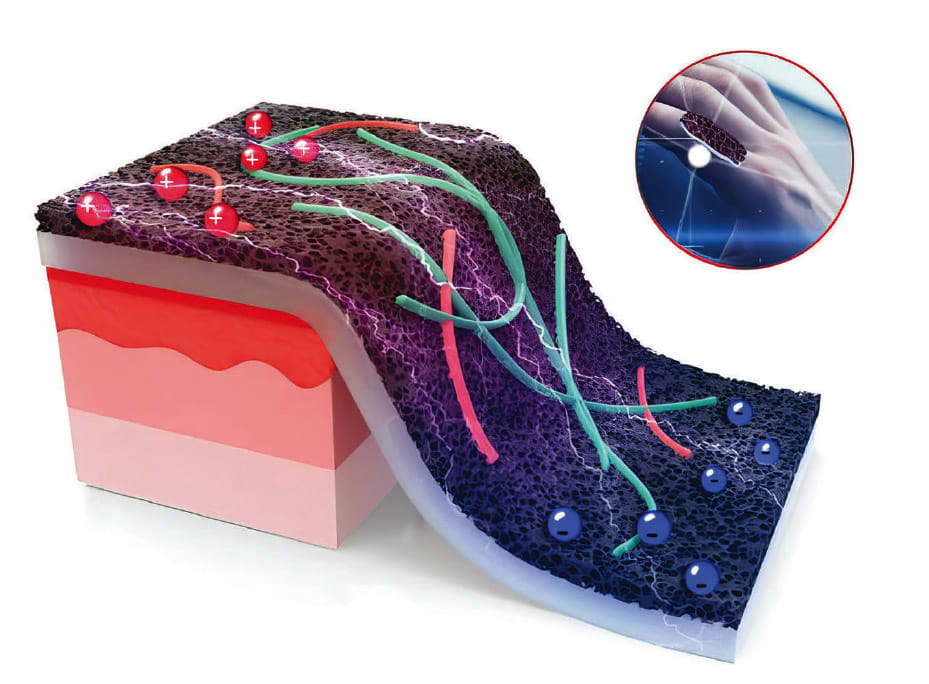
A major challenge in self-powered wearable sensors for health care monitoring is distinguishing different signals when they occur at the same time. Researchers from Penn State and China’s Hebei University of Technology addressed this issue by uncovering a new property of a sensor material, enabling the team to develop a new type of flexible sensor that can accurately measure both temperature and physical strain simultaneously but separately to more precisely pinpoint various signals.
“This unique sensor material we’ve developed has potentially important applications in health care monitoring,” said Co-Corresponding Author Huanyu “Larry” Cheng, James L. Henderson, Jr. Memorial Associate Professor of Engineering Science and Mechanics (ESM) at Penn State. “By accurately measuring both temperature changes and physical deformation or strain created by a healing wound and measure that by separating the two signals, it could revolutionize the tracking of wound healing. Doctors could get a much clearer picture of the healing process, identifying issues like inflammation early on.”
The researchers aimed to accurately measure temperature and strain signals without cross talk by using laser-induced graphene, a 2D material. Like all 2D materials including regular graphene, laser-induced graphene is one to a few atoms thick with unique properties, but with a twist. Laser-induced graphene (LIG) forms when a laser heats certain carbon-rich materials — like plastic or wood — in a way that converts their surface into a graphene structure. The laser essentially “writes” the graphene directly onto the material, making it a simple and scalable way to produce graphene patterns for electronics, sensors and energy devices.
LIG has been used before in various applications. Previously, Cheng and his team have used LIG for gas sensors, electrochemical detectors for sweat analysis, supercapacitors, and more. However, the researchers said they believe they discovered a new property of LIG for the first time that makes it ideal for a multi-purpose and accurate sensor.
“In this particular study, we kind of stumbled upon the fact that this material also has thermoelectric properties,” Cheng said. “We believe this is the first time anyone has reported laser-induced graphene having thermoelectric capabilities. And that’s really important for what we’re trying to do here, which is to separately measure both temperature changes and physical strain or deformation.”
Thermoelectric properties in a material refer to the ability to convert temperature differences into electrical voltage and vice versa, enabling such materials to be used for applications like energy harvesting and temperature sensing. According to Cheng, this newly identified thermoelectric property of LIG makes it easy to separate the two sensor measurements and ideal for health care applications such as a sensor embedded in a bandage.
“When you have materials that are sensitive to both temperature and strain, it can be tricky to tell which signal is causing changes in the material,” Cheng said. “But by using this thermoelectric effect in the laser-induced graphene, we can essentially decouple those two measurements. We can look at the electrical resistance to get information about the strain, while also measuring the thermal voltage to determine the temperature. This is why doctors could use it to track both temperature fluctuations and physical changes in the wound site and give a much clearer picture of how the healing is progressing.”
For more information, contact Adrienne Berard at











