

Aerospace Manufacturing - February 2026
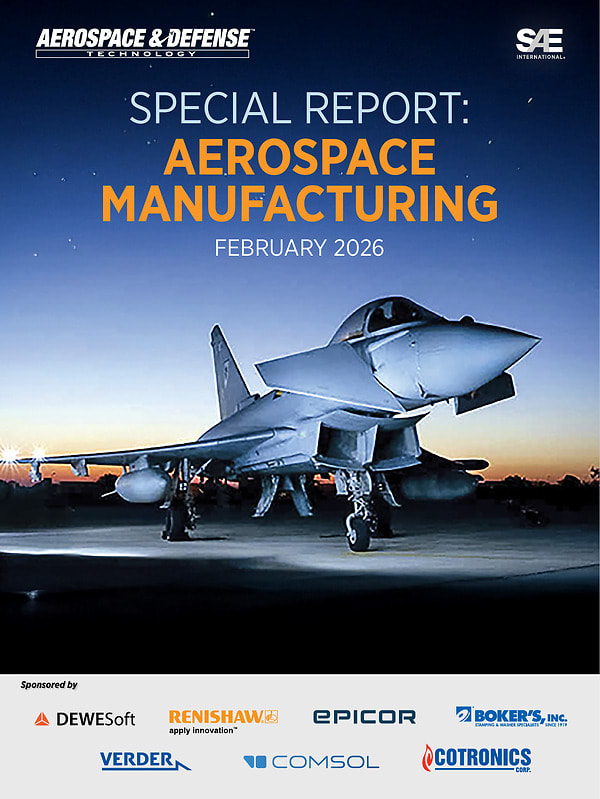
See the future of aerospace and defense manufacturing in this compendium of articles from the editors of Tech Briefs and Aerospace & Defense Technology magazines.
Don't have an account?
Overview
The February 2026 Aerospace Manufacturing Special Report offers a comprehensive overview of cutting-edge advances, challenges, and best practices shaping modern aerospace and defense manufacturing. Highlighting innovations spanning machining, additive manufacturing, materials science, and quality assurance, the report underscores industry efforts to improve precision, reliability, and supply chain resilience in key aerospace components.
A significant feature focuses on machining techniques essential for producing structural aircraft components, exemplified by BAE Systems’ use of advanced wireless ballbar diagnostics to maintain 5-axis CNC machine accuracy and improve production quality of titanium airframe parts. Maintaining precise machine tool performance is vital given the high cost and complexity of aerospace-grade materials and components.
Complementing traditional manufacturing, the report covers emerging technologies such as powder metallurgy-hot isostatic pressing (PM-HIP) at Oak Ridge National Laboratory (ORNL) to revitalize domestic production of very large metal parts needed across aerospace, defense, nuclear, and clean energy sectors. ORNL researchers Jason Mayeur and Soumya Nag innovate through integrating wire-arc additive manufacturing and hybrid processes with computational modeling to overcome PM-HIP challenges like nonuniform shrinkage, enabling more precise, affordable scalable production.
Additive manufacturing’s transformative impact appears in NASA’s development of a one-piece regeneratively cooled liquid rocket thrust chamber assembly. Using large-scale, multi-material 3D printing and composite overwraps reduces weight by over 40% and eliminates complex joints prone to failure, demonstrating advanced integration of design, materials, and manufacturing for space propulsion systems.
Quality by design permeates aerospace and defense manufacturing, emphasizing stringent engineering requirements, rigorous testing, and standards compliance to ensure reliability under extreme environmental and mechanical stresses. Connector technologies illustrate this paradigm, with companies like AirBorn leveraging automated precision manufacturing, multi-point contact designs, radiation-hardened materials, and comprehensive qualification protocols (including MIL-STDs and NASA standards) to deliver dependable, miniaturized, high-speed interconnect solutions essential for mission-critical systems.
Further technological innovations discussed include NASA-developed printable heat shield formulations tailored for planetary entry and increasing space mission demands, offering cost-effective, on-demand production options.
Overall, the Special Report highlights the aerospace manufacturing industry's multifaceted approach to addressing evolving demands: integrating advanced modeling and additive manufacturing to enhance large-scale metal part fabrication; deploying precision diagnostics and automation for quality control; designing for durability, miniaturization, and resilience; and fostering cross-disciplinary collaboration to ensure safety, performance, and supply chain independence. The report demonstrates a forward-looking aerospace sector actively utilizing state-of-the-art science and engineering tools to meet the complex challenges of next-generation aircraft, spacecraft, defense platforms, and clean energy components.







