An apparatus for simulating the environment at the surface of Mars has been developed. Within the apparatus, the pressure, gas composition, and temperature of the atmosphere; the incident solar visible and ultraviolet (UV) light; and the attenuation of the light by dust in the atmosphere can be simulated accurately for any latitude, season, or obliquity cycle over the entire geological history of Mars. The apparatus also incorporates instrumentation for monitoring chemical reactions in the simulated atmosphere. The apparatus can be used for experiments in astrobiology, geochemistry, aerobiology, and aerochemistry related to envisioned robotic and human exploration of Mars. Moreover, the apparatus can be easily adapted to enable similar experimentation under environmental conditions of (1) the surfaces of moons, asteroids, and comets, and (2) the upper atmospheres of planets other than Mars: in particular, it can be made to simulate conditions anywhere in the terrestrial atmosphere at altitudes up to about 100 km.
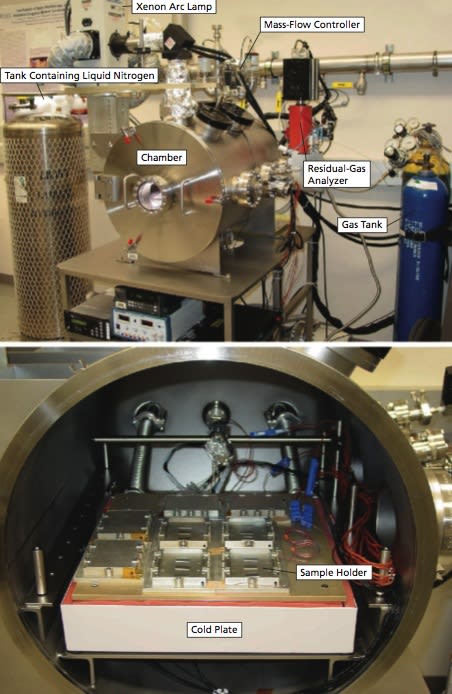
Ultraviolet (UV), visible (VIS), and near-infrared light (IR) are supplied to the inside of the chamber through fused-silica glass ports. In the original Mars version of the apparatus, the UV light is generated by a xenon-arc lamp and can be adjusted to any realistic current or ancient Martian UV flux density. To suppress spurious thermal IR radiation, a water filter between the xenon-arc lamp and the chamber attenuates near- and mid-infrared light. The light-attenuating effects of dust in the atmosphere are simulated by means of a series of neutral-density filters, ranging from an optical depth of 0.1 (representing a dust-free sky) to an optical depth of 3.5 (representing a global dust storm).
This work was done by Andrew C. Schuerger of the University of Florida for Kennedy Space Center. KSC-13190