Quasi-thermostatic gas-gap thermal switches have been proposed. These switches would operate automatically, would contain no moving parts, would not require power supplies or controls, would not consume any materials, and would not create vibrations. The operation of a switch of this type would be based on the increase, with temperature, in the vapor pressure of a condensible fluid in a gap; the effective thermal conductance across the gap would increase with vapor pressure and thus with temperature. The design of the gap and the fluid would be chosen so that the thermal conductance across the gap would increase sharply with temperature in the desired switching temperature range.
In the original intended application, a thermal switch of this type would provide a thermal connection for backup radiative cooling of an infrared detector to a temperature of about 150 K in the event of failure of a refrigerator that would ordinarily provide cooling to 65 K (see figure). The fluid chosen for this application is carbon dioxide, which would condense in solid form on the infrared-detector side of the gap during normal operation at 65 K. Because the vapor pressure of carbon dioxide is only 10 -14 torr ( ≈10-12 Pa) at 65 K, the effective thermal conductance across the gap during normal operation would be negligible; that is, the radiator could be regarded as thermally disconnected from the infrared detector.
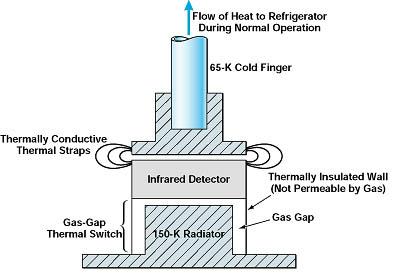
In the event of failure of the refrigerator, the temperature of the infrared detector would rise toward 150 K, causing some of the carbon dioxide to vaporize and fill the gap. At 150 K, the vapor pressure of carbon dioxide is 2.4 torr (320 Pa), and the effective thermal conductance across the gap would be about the same as though the carbon dioxide were at full atmospheric pressure and temperature. This level of thermal conductance would provide an effective thermal connection between the infrared detector and the radiator.
Upon resumption of normal operation, the vapor pressure of the carbon dioxide would decrease along with the temperature. At an intermediate temperature of 125 K, the vapor pressure of carbon dioxide is 1.5 × 10 -2 torr (about 2 Pa), and the resulting effective thermal conductance across the gap would be of the order of 10 -2 times that at 150 K; thus, the infrared detector would be effectively thermally disconnected from the radiator and could therefore be cooled more effectively by the refrigerator to the desired operating temperature of 65 K.
Gas-gap thermal switches based on the same principle could be designed for other temperature ranges, using other fluids. For example, water vapor could be used as the gap fluid for switching between active and passive means for cooling habitable spaces. For another example, mercury could be used as the gap fluid for switching at a temperature of about 450 K.
This work was done by Jack Jones and Dean Johnson of Caltech for NASA's Jet Propulsion Laboratory. NPO-19545
This Brief includes a Technical Support Package (TSP).
Automatic thermal switches with no moving parts
(reference NPO19545) is currently available for download from the TSP library.
Don't have an account?
Overview
The document presents a technical support package from NASA detailing a novel invention: a passive gas gap thermal switch designed for efficient thermal management, particularly in cooling infrared (IR) sensors. Developed by Dean L. Johnson and Jack A. Jones at the Jet Propulsion Laboratory, this technology addresses the challenge of cooling IR detectors to 65 K without relying solely on mechanical refrigeration.
The passive gas gap thermal switch operates automatically, utilizing a condensible fluid whose vapor pressure increases with temperature. This mechanism allows the switch to enhance thermal conductance across a gap as the temperature rises, effectively providing a thermal connection when needed. The design is notable for its lack of moving parts, power requirements, and vibration, making it a reliable solution for thermal management.
In its intended application, the thermal switch serves as a backup cooling system for IR detectors. Under normal conditions, the switch maintains a thermal disconnection at 65 K, as the chosen fluid, carbon dioxide, condenses into a solid state on the detector side, resulting in negligible thermal conductance. However, in the event of a refrigerator failure, the temperature of the IR detector can rise to 150 K. At this temperature, the vapor pressure of carbon dioxide increases significantly, allowing the gas to fill the gap and create a thermal connection comparable to that of atmospheric pressure. This transition enables effective cooling of the IR detector, ensuring continued operation even in the absence of mechanical refrigeration.
The document also discusses potential applications of this technology beyond IR sensors, including various temperature regimes for heating and cooling systems. For instance, it mentions the possibility of using a mercury thermal switch for switching between different heat sinks at higher temperatures.
Overall, the passive gas gap thermal switch represents a significant advancement in thermal management technology, offering a reliable, efficient, and low-maintenance solution for cooling applications in aerospace and other fields. The innovation aligns with NASA's goals of enhancing the performance and reliability of thermal systems in space exploration and other high-tech environments.