A recent addition to the growing class of microelectromechanical systems (MEMS) is a single stage of a Knudsen compressor. This device was fabricated and tested to demonstrate the feasibility of Knudsen compressors as miniature vacuum pumps for future portable scientific instruments. The attributes of Knudsen compressors that make them attractive as miniature vacuum pumps are that they contain no moving parts and operate without need for lubricants or working fluids.
A Knudsen compressor exploits thermal transpiration of a rarefied gas. The principle of thermal transpiration can be described in terms of an example of two volumes of gas at different temperatures T1 and T2 connected by a tube with a radius smaller than the mean free path (λ) of gas molecules. The behavior of this system depends on the Knudsen number (Kn º λ/L, where L is a characteristic linear dimension of the tube): For Kn less than about 0.01 λ/L, the gas flows as a continuum; for Kn between about 0.01 and 10, the flow behavior of the gas is transitional between the continuum and free-molecular regimes; for Kn of about 10 or more, the flow regime is free-molecular. In the free-molecular regime, simple balancing of the equilibrium molecular fluxes leads to the following equation for the equilibrium pressures in the two volumes:
p1/p2 = (T1/T2)1/2.
The pressure differential can be exploited for pumping.
The advent of MEMS fabrication techniques and of nanopore materials with low thermal conductivities has made it possible to exploit thermal transpiration as more than a laboratory curiosity. This is because passages in pumping devices can now be made so narrow that transitional or free-molecular flow conditions can be obtained in these devices, even at pressures as high as atmospheric.
This work was done by Stephen Vargo, E. Phillip Muntz, and Geoff Shiflett of Caltech for NASA's Jet Propulsion Laboratory. For further information, access the Technical Support Package (TSP) free on-line at www.techbriefs.com/tsp under the Physical Sciences category. NPO-21110.
This Brief includes a Technical Support Package (TSP).
Microscale Thermal-Transpiration Gas Pump
(reference NPO-21110) is currently available for download from the TSP library.
Don't have an account?
Overview
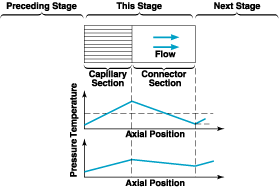
The document discusses the development of a microscale thermal-transpiration gas pump, specifically a Knudsen compressor, created by researchers at NASA's Jet Propulsion Laboratory (JPL). This innovative device operates on the principle of thermal transpiration, which involves the movement of gas molecules through a porous medium in response to temperature differences. The Knudsen compressor consists of multiple stages, each designed to achieve a small net increase in pressure, ultimately resulting in a significant overall pressure increase.
The design features a capillary section and a connector section. The capillary section, made from a silica aerogel membrane, allows gas to flow through tiny pores, while the connector section maintains a constant pressure as the gas temperature decreases before entering the next stage. The temperature gradient is crucial for the operation of the compressor, as it drives the thermal transpiration process. The document highlights that the efficiency of the compressor increases as the flow transitions from the continuum to the free-molecular regime.
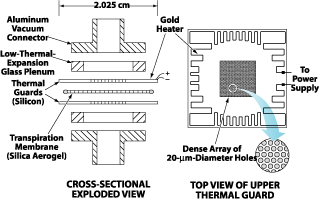
The prototype described includes two silicon chips functioning as thermal guards, which can be heated or cooled to create the necessary temperature differential across the aerogel membrane. The aerogel's low thermal conductivity and small pore size are essential for effective thermal transpiration. The design also incorporates low-thermal-expansion glass plenums and aluminum vacuum connectors, ensuring stability and performance.
The document emphasizes the advantages of this solid-state compressor, particularly its lack of moving parts, which eliminates the need for lubricants and allows for more compact and reliable operation. This technology is particularly suited for applications in environments where traditional pumps may be impractical, such as in space exploration or portable scientific instruments.
In summary, the microscale Knudsen compressor represents a significant advancement in vacuum technology, leveraging the principles of thermal transpiration and micromachining to create an efficient, compact, and reliable gas pump. The work is a collaboration among researchers Stephen Vargo, E. Phillip Muntz, and Geoff Shiflett, and it showcases the potential for future applications in various fields, including aerospace and microelectronics.