

An assembly of sensors, denoted an electronic tongue, is undergoing development as a prototype of compact devices for use in measuring concentrations of contaminants in water. Thus far, the electronic tongue has been tested on ions of Cu, Zn, Pb, and Fe and shown to respond to concentrations as low as about 10 parts per million. This electronic tongue is expected to be capable of measuring concentrations of other metal ions and organic compounds. Potential uses for electronic tongues include monitoring the chemical quality of water in a variety of natural, industrial, and laboratory settings; detecting micro-organisms indirectly by measuring microbially influenced corrosion; and characterizing compounds of interest to the pharmaceutical and food industries.
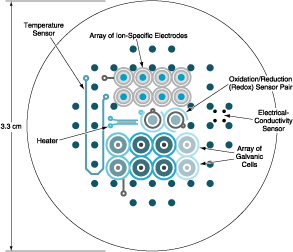
This version of the electronic tongue includes a heater, a temperature sensor, an array of ion-specific electrodes, an oxidation/reduction sensor pair, an electrical-conductivity sensor, and an array of galvanic cells, all on one compact ceramic substrate (see figure). Special-purpose electronic excitation and readout circuitry for the sensors has also been constructed.
The main advantage of the electronic tongue, relative to electrodes of this type used traditionally to assess water quality, is extreme ruggedness.
The types of measurements that can be performed by use of the sensors on the electronic tongue are quite varied. The best combination of types of measurements for a given application depends on the specific contaminants that one seeks to detect. Experimental studies to identify such combinations were in progress at the time of reporting the information for this article.
This work was done by Marlin Buehler and Gregory Kuhlman of Caltech for NASA's Jet Propulsion Laboratory. For further information, access the Technical Support Package (TSP) free on-line at www.techbriefs.com/tsp under the Electronics/Computers category.
In accordance with Public Law 96-517, the contractor has elected to retain title to this invention. Inquiries concerning rights for its commercial use should be addressed to:
Innovative Technology Assets Management
JPL
Mail Stop 202-233
4800 Oak Grove Drive
Pasadena, CA 91109-8099
(818) 354-2240
E-mail: This email address is being protected from spambots. You need JavaScript enabled to view it.
Refer to NPO-30601, volume and number of this NASA Tech Briefs issue, and the page number.
This Brief includes a Technical Support Package (TSP).
Electronic Tongue for Quantitation of Contaminants in Water
(reference NPO-30601) is currently available for download from the TSP library.
Don't have an account?
Overview
The document discusses the development of an innovative device known as the "electronic tongue," created by researchers at NASA's Jet Propulsion Laboratory (JPL). This compact device is designed to measure concentrations of contaminants in water, offering a significant advancement in water quality monitoring technology.
The electronic tongue integrates multiple sensors on a single ceramic substrate, including corrosion sensors, oxidation-reduction sensors, a conductivity sensor, a temperature sensor, and a heater. This unique combination allows for a wide range of measurements, making it capable of detecting various contaminants, including metal ions such as copper (Cu), zinc (Zn), lead (Pb), and iron (Fe), with sensitivity down to approximately 10 parts per million (ppm). The device's ruggedness is highlighted as a key advantage over traditional electrodes used for water quality assessment, making it suitable for diverse applications in natural, industrial, and laboratory settings.
The document outlines the motivation behind the electronic tongue's development, which aims to address the need for reliable and efficient water quality monitoring. The researchers emphasize the simplicity of fabricating the electrodes and the potential for the device to measure not only metal ions but also organic compounds, expanding its applicability in various fields, including environmental monitoring, pharmaceuticals, and food industries.
Experimental studies are mentioned as ongoing efforts to identify the best combinations of sensor types for specific applications, indicating that the technology is still evolving. The work is credited to Martin Buehler and Gregory Kuhlman, with the project being part of a broader initiative under NASA's contract with JPL.
In summary, the electronic tongue represents a significant technological advancement in the field of water quality monitoring, combining multiple sensing capabilities into a single, robust device. Its potential applications and ongoing development suggest that it could play a crucial role in ensuring safe and clean water in various environments. The document serves as a technical report detailing the novelty, problem-solving aspects, and solutions provided by this innovative technology.











