A method of fabricating planar, flexible microinductors that exhibit a relatively high quality factor (Q) between 1 and 10 MHz has been devised. These inductors are targeted for use in flexible, low-profile power-converter circuits. They could also be incorporated into electronic circuits integrated into flexible structures, including flexible antenna and solar-sail structures that are deployable.
Fabrication of inductors on flexible, heat-sensitive substrates is typically limited by the need for high-temperature annealing step of the magnetic material. Highly loaded ceramic/polymer composite films can be seen printed and cured at lower temperatures, but suffer poor adhesion. Thus, a new approach is required to enable the fabrication of high Q inductors (for power applications) on the flex substrates.
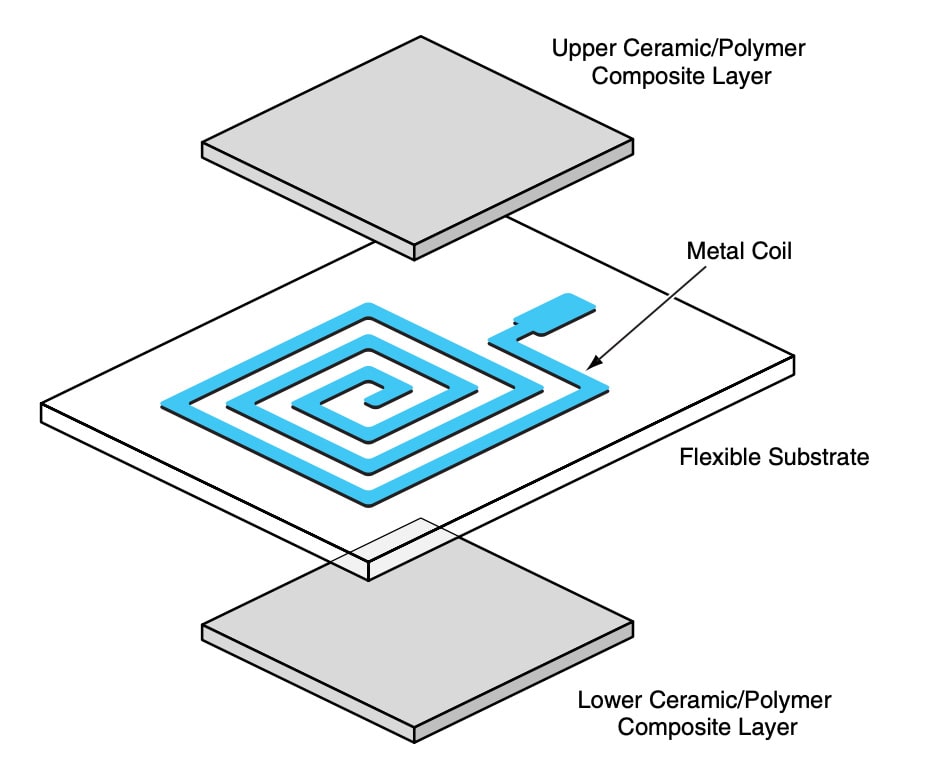
The microinductor comprises a planar spiral metal coil and a high-permeability magnetic thick-film (equivalent to the core of a conventional inductor) in the form of a ceramic/polymer composite. The metal spiral is fabricated by photolithography and etching of a copper-clad flexible polyamide substrate. The ceramic/polymer composite is deposited by stencil and screen printing, both above and below the metal spiral (see figure).
To obtain sufficient permeance and volume magnetization for the required degree of enhancement of inductance, the mass fraction of the ceramic in the ceramic/polymer composite must be about 95 percent, which is greater than the mass fractions of fillers typically incorporated into polymer-matrix thick films. In general, such a high mass fraction of filler can adversely affect printability and adhesion and can make the printed thick films susceptible to mechanical failure and delamination during flexure. These adverse effects can be overcome, to a degree that makes it possible to produce an inductor of both acceptably high Q and acceptable mechanical properties, by (1) proper choice of the polymer resin and the ceramic magnetic powder filler for the thick-film formulation, in conjunction with (2) the use of a hermetic-coating technique.
Of the resins tested, polyester resins demonstrated the best loading and adhesion characteristics. A magnetic powder comprising Mn-Zn ferrite particles about 10 µm in diameter was found to yield good magnetic properties. It was found that improved adhesion could be obtained through coating with vacuum-polymerized parylene.
This work was done by Erik Brandon, Jay Whitacre, and Emily Wesseling of Caltech for NASA’s Jet Propulsion Laboratory. For further information, access the Technical Support Package (TSP) free on-line at www.techbriefs.com/tsp under the Electronics/Computers category.
In accordance with Public Law 96-517, the contractor has elected to retain title to this invention. Inquiries concerning rights for its commercial use should be addressed to:
Innovative Technology Assets Management
JPL
Mail Stop 202-233
4800 Oak Grove Drive
Pasadena, CA 91109-8099
(818) 354-2240
E-mail: This email address is being protected from spambots. You need JavaScript enabled to view it.
Refer to NPO-30657, volume and number of this NASA Tech Briefs issue, and the page number.
This Brief includes a Technical Support Package (TSP).
Printed Microinductors for Flexible Substrates
(reference NPO-30657) is currently available for download from the TSP library.
Don't have an account?
Overview
The document titled "Printed Microinductors for Flexible Substrates" from NASA's Jet Propulsion Laboratory outlines innovative methods for fabricating high-quality flexible inductors suitable for modern microelectronics. The report emphasizes the challenges associated with integrating magnetic components into flexible and heat-sensitive substrates, which are increasingly used in low-cost flexible circuitry.
Key innovations discussed include the use of composite magnetic films that allow for flexibility and the application of hermetic sealing technology to create adhesive, highly loaded films. Traditional inductors, typically made from rigid ceramic cores, require high processing temperatures, making them unsuitable for flexible applications. The report highlights the need for inductors that can be fabricated at lower temperatures to accommodate these new substrates.
The fabrication process involves stencil and screen printing of a high volume fraction magnetic composite above and below a metal spiral pattern, which is etched or deposited on a flexible substrate, such as polyimide. The document notes that achieving a volume fraction greater than 95% in the final cured film is essential for sufficient permeance and volume magnetization, which are critical for the performance of the inductors.
The report also discusses the performance characteristics of the inductors, including their role in energy storage and filtering within power and telecommunications applications. The magnetic properties and quality factor (Q) of the inductors are significantly enhanced by using manganese-zinc (Mn-Zn) ferrite powder in the composite films. For instance, a specific air core inductor was shown to have its inductance increased from 0.584 μH to 1.76 μH at 1 MHz, with a Q factor of 3.49, demonstrating the effectiveness of the new materials and methods.
Additionally, the document highlights the importance of adhesion and mechanical properties, noting that parylene-coated films exhibited superior adhesion compared to non-coated films, which suffered from delamination under stress. This advancement allows for greater flexibility and durability in the inductors, making them more suitable for various applications in microelectronics.
Overall, the report presents a promising approach to developing flexible inductors that can meet the demands of modern electronic devices, paving the way for further advancements in the integration of magnetic components with flexible circuitry.