A computer program facilitates the analysis and design of a radio-communication system for transmitting data from an orbiting spacecraft to ground stations. Input data provided by the user include primarily (1) parameters of the spacecraft orbit (including parameters that specify its position and orientation with respect to a coordinate system that translates with, but does not rotate with, the Earth); (2) either a specification of the gain pattern or else parameters needed to calculate the gain pattern of the antenna aboard the spacecraft; (3) type of spacecraft antenna aiming (nadir-pointed or articulated); (4) locations of the ground stations; (5) downlink bit rates and frequencies; (6) spacecraft instrument data rates; and (7) the angle (relative to the horizon) below which the line of sight from the spacecraft to each ground station is deemed to be blocked. The program calculates the spacecraft trajectory, the times when the spacecraft is visible from each ground station, the times (as functions of visibility and the antenna gain pattern) when radio communication is possible, the number of bits that a ground station can receive from the spacecraft during a given orbit, and the spacecraft data-storage capacity needed to hold data that are generated between communication intervals.
This work was done by Anil Kantak and Faiza Lansing of Caltech for NASA's Jet Propulsion Laboratory. For further information, access the Technical Support Package (TSP) free on-line at www.nasatech.com/tsp under the Software category.
This software is available for commercial licensing. Please contact Don Hart of the California Institute of Technology at (818) 393-3425. Refer to NPO-20672
This Brief includes a Technical Support Package (TSP).
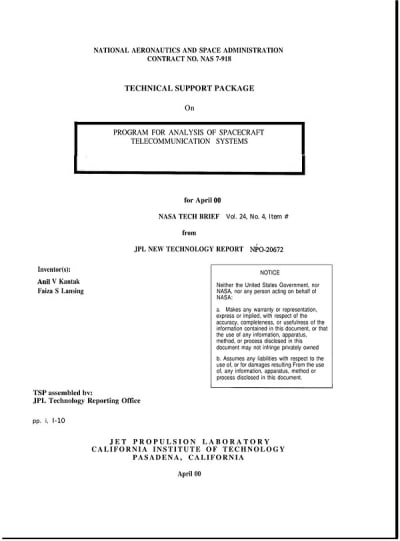
Program for Analysis of Spacecraft Telecommunication Systems
(reference NPO-20672) is currently available for download from the TSP library.
Don't have an account?
Overview
The document is a technical support package from NASA's Jet Propulsion Laboratory (JPL) detailing a program for the analysis of spacecraft telecommunication systems. It is associated with contract number NAS 7-918 and was developed by inventors Anil V. Kantak and Faiza S. Lansing. The primary focus of the program is to facilitate long-range communications between satellites and ground stations, optimizing the transmission of data generated either onboard the satellites or received from other sources.
The document outlines various types of satellites, including Low Earth Orbiters (LEO), Medium Earth Orbiters (MEO), Highly Elliptical Orbiters (HEO), and Geosynchronous satellites (GEO). Each type serves the purpose of efficiently transmitting data to designated ground stations. The program addresses critical aspects of satellite communication, such as data storage capabilities, downlink strategies, and the visibility of satellites from ground stations. It emphasizes the importance of predicting satellite positions and the need for multiple ground stations to ensure successful data throughput.
Key features of the software include the ability to plot ground tracks on a global map, position ground stations accurately, compute total data received, and assess the necessary storage capacity for spacecraft. The software is designed to run on a PC with Windows and Microsoft Excel, and it has been tested to perform effectively in its intended applications.
The document also discusses the rationale behind developing this software, highlighting the absence of existing solutions that meet the specific needs of the telecommunications design process. The program is noted for producing essential results that are not available through other software options.
Additionally, the document includes disclaimers regarding the accuracy and completeness of the information provided, stating that neither NASA nor JPL assumes liability for any damages resulting from the use of the information disclosed. It also mentions the potential for the software to be featured in NASA Tech Briefs, which would require sufficient supporting materials.
Overall, this technical support package serves as a comprehensive overview of a specialized software tool aimed at enhancing the efficiency and effectiveness of satellite communication systems, contributing to advancements in space exploration and data transmission technologies.