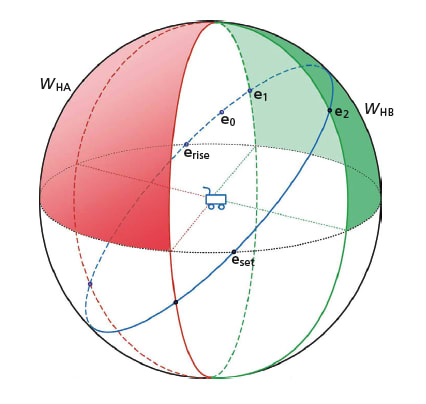
The High Gain Antenna Pointing and Obstruction Avoidance software performs computations for pointing a Mars Rover high-gain antenna for communication with Earth while (1) avoiding line-of-sight obstructions (the Martian terrain and other parts of the Rover) that would block communication and (2) taking account of limits in ranges of motion of antenna gimbals and of kinematic singularities in gimbal mechanisms. The software uses simplified geometric models of obstructions and of the trajectory of the Earth in the Martian sky(see figure). It treats all obstructions according to a generalized approach, computing and continually updating the time remaining before interception of each obstruction. In cases in which the gimbalmechanism design allows two aiming solutions, the algorithm chooses the solution that provides the longest obstruction-free Earth-tracking time. If the communication session continues until an obstruction is encountered in the current pointing solution and the other solution is now unobstructed, then the algorithm automatically switches to the other position. This software also notifies communication-managing software to cease transmission during the switch to the unobstructed position, resuming it when the switch is complete.
This program was written by Khaled Ali and Charles Vanelli of Caltech for NASA's Jet Propulsion Laboratory. For further information, access the Technical Support Package (TSP) free on-line at www.techbriefs.com/tsp under the Software category.
This software is available for commercial licensing. Please contact Karina Edmonds of the California Institute of Technology at (626) 395-2322. Refer to NPO-42960.
This Brief includes a Technical Support Package (TSP).
Avoiding Obstructions in Aiming a High-Gain Antenna
(reference NPO-42960) is currently available for download from the TSP library.
Don't have an account?
Overview
The document titled "Avoiding Obstructions in Aiming a High-Gain Antenna" is a technical support package prepared by NASA's Jet Propulsion Laboratory. It focuses on the challenges and solutions related to the communication systems of the Mars Exploration Rovers (MER), particularly the high-gain antenna (HGA) used for direct-to-Earth communication at high data rates.
The document outlines the operational context of the MER communication system, which consists of three main components: a low-gain antenna (LGA) for low data rate communication, a UHF-band antenna for short-range communication with orbiters, and the HGA for high-rate data transmission. The experience from the Mars Pathfinder mission highlighted vulnerabilities in the HGA gimbal, which was prone to "flops"—disruptions in communication caused by the gimbal's inability to maintain a line of sight with Earth when it was positioned high in the Martian sky.
To address these issues, the document presents the HGA pointing algorithm developed for the MERs. This algorithm maximizes communication time while adhering to various pointing constraints, thereby enhancing the operational capabilities of the rovers and increasing their scientific return. The algorithm has been validated in flight, with no communication interruptions (flops) reported during the mission, which lasted over 18 months.
The document also discusses the mechanical design of the MERs, which includes a vertically mounted gimbal axis to mitigate flop occurrences. However, the placement of the gimbal on the rover's deck introduces additional challenges, such as obstructions from equipment like the camera mast. The algorithm allows for the selection of alternate gimbal positions to avoid these obstructions, ensuring continuous communication.
In conclusion, the document emphasizes the importance of effective communication systems in space exploration and the innovative solutions developed to overcome the challenges faced by the MERs. It serves as a valuable resource for understanding the technical advancements in aerospace technology and the operational strategies employed to enhance mission success. The document is part of NASA's broader effort to share aerospace-related developments with potential applications in various fields.