

Advanced unicouples that contain carefully tailored combinations of thermoelectric materials are being investigated in an effort to develop thermoelectric power generators that would operate with relatively high energy-conversion efficiencies between heat-source temperatures of about 1,000 K and heat-sink temperatures of about 300 K. [A thermoelectric unicouple is a part of a thermoelectric generator; a unicouple comprises one electron-conduction (n-type) leg and one hole-conduction (p-type) leg thermally connected in parallel and electrically connected in series.] Thermoelectric generators have no moving parts, are reliable, can operate unattended in hostile environments, and are environmentally benign; because of these characteristics, they are particularly attractive for extracting electric power from waste heat from such diverse sources as geothermal power plants, industrial heat-generating processes, and automobile exhausts.
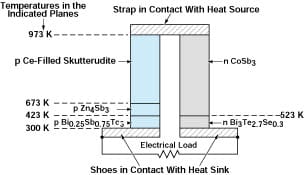
The figure schematically depicts a thermoelectric unicouple of the present type optimized for a source temperature of 973 K and a sink temperature of 300 K. This unicouple is made of high-performance thermoelectric materials, including (1) previously known state-of-the-art materials, (2) novel p-type alloys based on Zn4Sb3 and CeFe4Sb12, and (3) novel n-type alloys based on CoSb3. Each of the p and n legs comprises segments of the various materials joined both thermally and electrically in series.
In general, the relative positions and lengths of the segments in each leg of a unicouple like this one must be chosen, taking account of the thermal conductivities of the materials, so that each segment is exposed to that portion of the source-to-sink temperature range for which the material of that segment exhibits its maximum thermoelectric performance. In addition, the ratio between the cross sections of the n and p legs must be chosen to optimize overall performance in the face of differences between the thermal and electrical conductivities in the two legs. To a first approximation (ignoring contact resistances and other relatively small effects), the energy-conversion efficiency of the unicouple depends on the ratios among the lengths of the segments but not on the overall length of the legs. However, the overall electrical and thermal resistances and the output electric power do depend on the overall length of the legs.
This work was done by Thierry Caillat, Alex Borshchevsky, Jeff Snyder, Jean-Pierre Fleurial, Andrew Zoltan, and Leslie Zoltan of Caltech for NASA's Jet Propulsion Laboratory. For further information, access the Technical Support Package (TSP) free on-line at www.nasatech.com/tsp under the Electronics & Computers category.
In accordance with Public Law 96-517, the contractor has elected to retain title to this invention. Inquiries concerning rights for its commercial use should be addressed to
Technology Reporting Office
JPL
Mail Stop 122-116
4800 Oak Grove Drive
Pasadena, CA 91109
(818) 354-2240
Refer to NPO-20872, volume and number of this NASA Tech Briefs issue, and the page number.
This Brief includes a Technical Support Package (TSP).
Highly Efficient Thermoelectric Unicouples
(reference NPO-20872) is currently available for download from the TSP library.
Don't have an account?
Overview
The document is a technical support package from NASA detailing the development of highly efficient thermoelectric unicouples, primarily authored by researchers from the Jet Propulsion Laboratory (JPL) and the California Institute of Technology. The focus of the research is on enhancing the efficiency of thermoelectric generators, which convert thermal energy into electrical energy, a process that is particularly valuable in applications where waste heat can be harnessed.
The abstract highlights the challenges faced in achieving high thermal-to-electric energy conversion efficiency. It notes that no single thermoelectric material is optimal across a wide temperature range (from -300 K to 1000 K). To address this, the researchers propose two strategies: multistage thermoelectric generators, where each stage operates over a specific temperature difference and is electrically insulated but thermally connected, and segmented generators, which utilize different materials for the p-type and n-type legs, joined in series.
The document outlines the novelty of the developed unicouple, which is designed to operate efficiently over a temperature difference of 300 K to 973 K. It employs advanced segmented thermoelectric legs made from a combination of state-of-the-art materials, including novel p-type Zn4Sb3 and CeFe1-xSbx-based alloys, as well as n-type CoSb3-based alloys. The predicted thermal-to-electrical conversion efficiency for this new unicouple is approximately 15%, which represents a significant improvement over previous designs.
Additionally, the document emphasizes the importance of optimizing thermal contact and minimizing heat losses during testing, which is crucial for accurate performance evaluation. A thermal shield is also being designed to reduce radiation losses during experiments.
The research is conducted under NASA's contract, and the findings are presented in the context of the XVIII International Conference on Thermoelectrics held in Baltimore in 1999. The work is positioned as a significant advancement in thermoelectric technology, with potential applications in various fields, including aerospace and automotive industries, where efficient energy conversion from waste heat can lead to improved energy sustainability.
Overall, the document serves as a comprehensive overview of the innovative approaches being explored to enhance thermoelectric power generation, highlighting both the technical challenges and the promising solutions being developed by the research team.











