

A software library has been developed for adaptive refinement of unstructured (that is, irregular) tetrahedral or triangular meshes that define two- or three-dimensional coordinates or volume elements used in parallel (that is, multiprocessor) finite-element or finite-volume computations. This library contains a suite of well-designed and efficiently implemented software modules that perform the operations of typical parallel adaptive-mesh-refinement (AMR) processes. An especially notable one of these operations is mesh quality control, typically guided by a local-error estimator, during successive parallel adaptive refinements. Another is balancing of computational loads among parallel processors. The library is robust and is scalable to different numbers of processors. The software in this library was developed in Fortran 90, plus a message-passing interface (MPI) sublibrary. The design of this library supports code efficiency, modularity, and portability. At present, the library is in use on a Cray T3E and SGI Origin computers and on a Beowulf-class cluster of personal computers.
This program was written by John Z. Lou and Charles Norton of Caltech for NASA's Jet Propulsion Laboratory. For further information, access the Technical Support Package (TSP) free on-line at www.techbriefs.com/tsp under the Software category.
This software is available for commercial licensing. Please contact Don Hart of the California Institute of Technology at (818) 393-3425. Refer to NPO-20948.
This Brief includes a Technical Support Package (TSP).
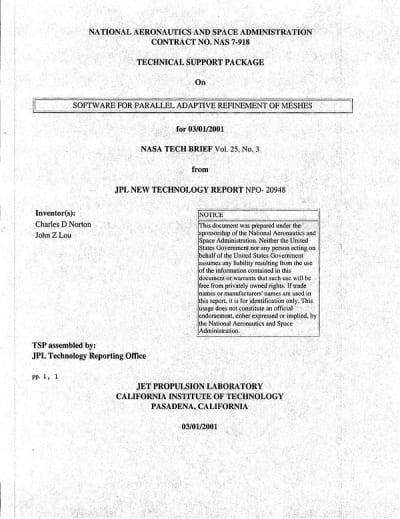
Software for Parallel Adaptive Refinement of Meshes
(reference NPO-20948) is currently available for download from the TSP library.
Don't have an account?
Overview
The document describes a software library developed for adaptive refinement of unstructured tetrahedral and triangular meshes, which are essential for two- and three-dimensional finite-element and finite-volume computations in parallel processing environments. This library is particularly designed for use on multiprocessor systems, making it suitable for complex simulations in engineering and scientific applications.
Key features of the software include a suite of well-designed and efficiently implemented modules that facilitate typical operations in parallel adaptive mesh refinement (AMR) processes. Notable functionalities include mesh quality control, guided by a local-error estimator, and load balancing among parallel processors to optimize computational efficiency. The library is robust and scalable, accommodating various numbers of processors, which enhances its versatility in different computational environments.
The software is implemented in Fortran 90 and utilizes a message-passing interface (MPI) sublibrary, ensuring code efficiency, modularity, and portability. It has been successfully tested and is currently in use on high-performance computing systems, including Cray T3E, SGI Origin computers, and Beowulf-class clusters of personal computers. The document also mentions that the software has been applied to selected engineering finite element applications, with performance results demonstrating its effectiveness.
The development of this software was a collaborative effort by John Z. Lou and Charles Norton from Caltech, specifically for NASA’s Jet Propulsion Laboratory. The library is available for commercial licensing, and interested parties are directed to contact Don Hart at Caltech for further information.
Additionally, the document includes a section on eligibility for a public release award, which recognizes software of commercial quality. It specifies that the software does not need to be publicly available to qualify for the award, as long as it meets certain criteria, such as being well-documented, nearly bug-free, and performing its intended purpose effectively.
Overall, this document highlights the significance of the software library in advancing computational techniques for adaptive mesh refinement, showcasing its capabilities, development background, and potential applications in various scientific and engineering fields.











