

The Wireless Augmented Reality Prototype (WARP) is a system for personal access to a local area network with video, audio, and sensor data services. The center of the WARP system is a lightweight, unobtrusive heads-up display with a wireless wearable control unit, called the Remote Access Unit (RAU). Data services to the RAU are provided through a high-rate radio link from the WARP RAU to a stationary base-station interface unit which sits on an ordinary local area network. The RAU-to-interface unit radio link has been engineered to operate within the high-interference, high-multipath environment of a space shuttle or space station module.
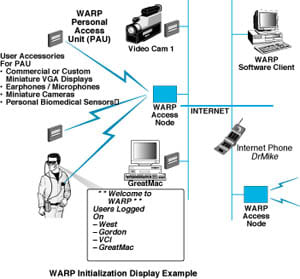
One of the major technology challenges with this concept has been to provide wireless high-rate information in the environment of a space module. Tight confines, metal walls, and lack of radio absorbers create an enormous potential for destructive self-interference. The development of this radio technology is synergistic with the development of technology for efficient and high-quality video data compression; the WARP communications channel contains video, audio, and sensor data simultaneously.
In the space station applications, a virtual terminal is provided by a RAU and headset pair. The user will be able to view and manipulate imagery, text or video, using voice commands to control the terminal operations. WARP hands-free access to computer-based instruction texts, diagrams, and checklists replaces juggling manuals and clipboards, and tetherless computer system access allows free motion throughout a cabin while monitoring and operating equipment.
Along with information provided to the astronaut, WARP also allows external observation of the astronaut's situation; personal biosensors connected to the RAU can send back continuous telemetry and a miniature camera integrated into the headset provides real-time video of the wearer's field of view. In this way, for example, a principal investigator located on Earth may consult with a payload specialist on the operation or troubleshooting of the equipment. Using this same mechanism, WARP RAUs may also be used with stand-alone wireless sensor packages that send data, from low-rate environmental sensors or high-rate cameras, back through the existing WARP wireless network to the base station. Packetized data may be sent to various monitor computers for logging or alarm.
Future applications of WARP are in any environment where heads-up, hands-free information retrieval — and remote situational awareness — improves efficiency, including field operations, tetherless operations/monitor consoles, remote consultations in medical or maintenance procedures, and hazardous or confined-space activities. The extension of WARP system and RAUs into a wireless SensorNet is a novel approach to space or air vehicle infrastructures, saving mass and providing flexibility over hard-wired sensor or camera installations.
The WARP program has built and integrated several Phase II WARP systems. The Phase II system supports single, independent RAU-to-base station connections to a single PC. Phase II WARP is under evaluation at Johnson Space Center. Development is now underway on Phase III WARP, which will allow each interface unit to network multiple RAUs, and will allow individual RAUs to be supported dynamically by multiple interface units which are installed in a cellular network type model throughout an extended area.
This work was done by Martin Agan, Ann S. Devereaux, and Thomas Jedrey of Caltech for NASA's Jet Propulsion Laboratory. For further information, access the Technical Support Package (TSP) free on-line at www.nasatech.com/tsp under the Electronics & Computers category.
In accordance with Public Law 96-517, the contractor has elected to retain title to this invention. Inquiries concerning rights for its commercial use should be addressed to
Intellectual Property group
JPL
Mail Stop 202-233
4800 Oak Grove Drive
Pasadena, CA 91109
(818) 354-2240
Refer to NPO-20621, volume and number of this NASA Tech Briefs issue, and the page number.
This Brief includes a Technical Support Package (TSP).
The Wireless Augmented Reality Prototype Concept
(reference NPO-20621) is currently available for download from the TSP library.
Don't have an account?
Overview
The document outlines NASA's Wireless Augmented Reality Prototype (WARP), a cutting-edge technology designed to enhance communication and information access for astronauts in space. Developed in collaboration with the Jet Propulsion Laboratory (JPL), the University of California at Los Angeles (UCLA), and McDonnell Douglas Aerospace, WARP aims to integrate advanced technologies to support the health and safety of personnel aboard the Space Station and Space Shuttle.
WARP features a lightweight head-mounted display (HMD) that allows astronauts to view critical biosensor data, such as heart rate and oxygen saturation, as well as imagery and text transmitted from the Space Station or Mission Control on Earth. The system includes a miniature camera worn by the astronaut, enabling real-time video conferencing and environmental observation. Control of these features is facilitated through voice commands and speech recognition software, allowing for hands-free operation.
The motivation behind WARP's development stems from the need to provide astronauts with real-time access to vital information while they are untethered and floating in space. By advancing and integrating existing commercial technologies—such as video/audio codecs, wireless LANs, head-mounted displays, and biosensors—WARP offers capabilities that were previously unavailable in space environments.
The document also mentions that a paper detailing WARP was presented at the Space Technology & Applications International Forum (STAIF-98) in January 1998. It highlights the novelty of the WARP system, emphasizing its ability to facilitate high-bandwidth wireless communication in enclosed, high-interference environments. The system's design allows for seamless operation and full access to remote computing resources, enhancing the astronaut's ability to perform tasks effectively.
Additionally, the document discusses the potential for public disclosure of the technology and the importance of forums like NASA Tech Briefs for disseminating information about WARP. It notes that while the technology has not yet been commercially sold or offered, there is significant interest in its applications.
In summary, WARP represents a significant advancement in augmented reality and communication technology for space exploration, aiming to improve the operational efficiency and safety of astronauts in challenging environments.











