A computer program implements an adaptive problem-solving (APS) algorithm for real-time development, refinement, and maintenance of the control strategy of an autonomous system that must operate in an environment about which little or no detailed information is available in advance. In the initial application for which the APS software was developed, the autonomous system would be an exploratory spacecraft that would feature a flexible control architecture and would be equipped with planning and scheduling software, which the APS software would complement. Given a generic set of control strategies, the APS software evaluates the strategies, performs "what-if" analyses, and utilizes statistical methods to rank each strategy or generate a more appropriate strategy in face of current information about the environment. In an iterative process of reinforcement learning, the highest-ranked strategies are passed back and forth between the APS algorithm and a search algorithm until a stopping criterion is satisfied. The user can specify the allowable error in the choice of the best control strategy. In this choice, other things being equal, strategies that can be evaluated accurately by use of fewer data points are favored over those for which more data points are needed.
This program was written by Steve Chien, Barbara Engelhardt, Darren Mutz, and Robert Sherwood of Caltech for NASA's Jet Propulsion Laboratory. For further information, access the Technical Support Package (TSP) free on-line at www.nasatech.com/tsp under the Software category.
This software is available for commercial licensing. Please contact Don Hart of the California Institute of Technology at (818) 393-3425. Refer to
NPO-21071.
This Brief includes a Technical Support Package (TSP).
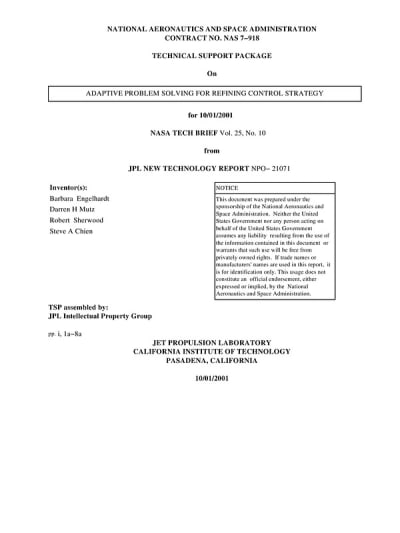
Adaptive Problem Solving for Refining Control Strategy
(reference NPO-21071) is currently available for download from the TSP library.
Don't have an account?
Overview
The document presents a technical support package detailing an innovative adaptive problem-solving (APS) algorithm developed for real-time development, refinement, and maintenance of control strategies in autonomous systems, particularly exploratory spacecraft. Created by a team from the Jet Propulsion Laboratory (JPL) at the California Institute of Technology, the APS software is designed to operate effectively in environments where detailed prior information is scarce or unavailable.
The APS algorithm functions by evaluating a generic set of control strategies, performing "what-if" analyses, and utilizing statistical methods to rank these strategies. This iterative process involves reinforcement learning, where the highest-ranked strategies are exchanged between the APS algorithm and a search algorithm until a predetermined stopping criterion is met. Users can specify the allowable error in selecting the best control strategy, with a preference for strategies that require fewer data points for accurate evaluation.
The initial application of this software is aimed at enhancing the control architecture of autonomous exploratory spacecraft, complementing existing planning and scheduling software. The flexibility of the APS software allows it to adapt to changing environmental conditions, making it a valuable tool for missions where uncertainty is a significant factor.
The document also includes a disclaimer stating that references to specific commercial products or services do not imply endorsement by the U.S. Government or JPL. It emphasizes that the work was conducted under NASA's sponsorship and outlines the liability limitations associated with the use of the information provided.
For those interested in commercial licensing of the APS software, contact information for Don Hart at Caltech is provided, along with a reference to the specific technology report (NPO-21071).
Overall, this document highlights the advancements in adaptive problem-solving techniques for autonomous systems, showcasing the potential for improved decision-making and operational efficiency in space exploration missions. The APS algorithm represents a significant step forward in the ability to navigate and operate in unknown environments, ultimately contributing to the success of future exploratory endeavors.