A Raman lidar system for measuring the vertical distribution of water vapor in the atmosphere is located at the Table Mountain Facility (TMF) in California. Raman lidar systems for obtaining vertical water-vapor profiles in the troposphere have been in use for some time. The TMF system incorporates a number of improvements over prior such systems that enable extension of the altitude range of measurements through the tropopause into the lower stratosphere.
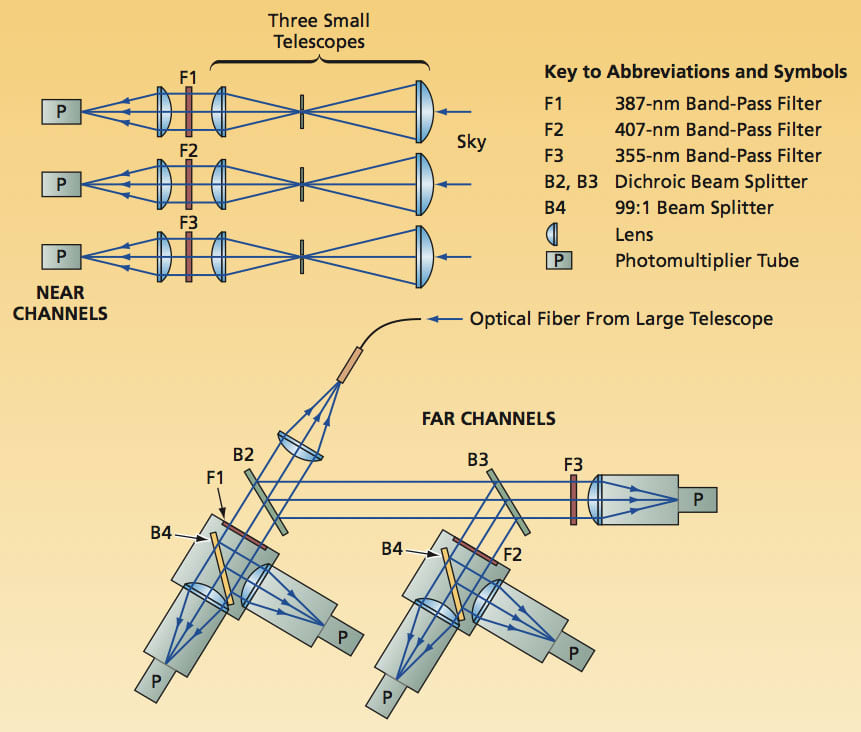
The receiver portion of this lidar system has a total of eight channels (see figure). These include three channels for the water-vapor Raman returns at a wavelength of 407 nm, three channels for the nitrogen Raman returns at a wavelength of 387 nm, and two channels for elastics-cattering returns at the laser wavelength of 355 nm. Three of the channels (a 387-, a 407-, and a 355-nm channel), denoted the near channels, process the Raman and elastic returns collected by the three smaller telescopes. The remaining five channels, denoted the far channels, process the Raman and elastic returns collected by the large telescope. The elastic-scattering returns are used primarily for deriving temperature profiles. The light in each channel is measured by use of a photomultiplier tube, the output of which is fed to a commercially available optical-transient recorder operating as a photon-counting multi-channel scaler. The altitude interval of each bin of the scaler is 7.5 m, but typically, bins are summed together in groups of 10, yielding discretization of altitude in increments of 75 m.
The light collected by the large telescope is focused into an optical fiber, which delivers the light to a lens that collimates the light into a series of beam splitters. Among the beam splitters are a 99:1 beam splitter for each of the two Raman wavelength bands. In addition to extending the dynamic range of the photon counting system, this arrangement enables better corrections for pulse pile-up saturation effects than could otherwise be made. The arrangement is such as to make the 387- and 407-mm Raman signals in the large-telescope 1-percent splitter outputs approximately equal in magnitude to the corresponding signals from the smaller telescopes; this makes it possible to use the signals from the small telescopes to correct for effects of overlap of photon pulses in signals from the large telescope collected from low altitudes.
This work was done by Thierry Leblanc and I. Stewart McDermid of Caltech for NASA’s Jet Propulsion Laboratory. For more information, download the Technical Support Package (free white paper) at www.techbriefs.com/tsp under the Physical Sciences category. NPO-45007
This Brief includes a Technical Support Package (TSP).
Water-Vapor Raman Lidar System Reaches Higher Altitude
(reference NPO-45007) is currently available for download from the TSP library.
Don't have an account?
Overview
The document outlines the advancements and capabilities of a Water-Vapor Raman Lidar System developed at the Jet Propulsion Laboratory (JPL) to measure water vapor profiles in the troposphere and lower stratosphere. Recognizing the critical role of water vapor in the Earth's radiative budget and climate system, the lidar system aims to enhance the accuracy of water vapor measurements, which are essential for understanding climate change and atmospheric processes.
The lidar system is designed to achieve measurement accuracies better than 5% up to altitudes of 12 km, with the capability to detect water vapor mixing ratios as low as 1 to 10 parts per million (ppm) near the tropopause. The system has already demonstrated promising results, retrieving water vapor profiles up to 18 km. The development of this lidar was motivated by the need to validate water vapor profiles obtained from instruments aboard the AURA satellite and to support long-term atmospheric monitoring efforts.
To maximize the signal-to-noise ratio, the lidar employs high laser pulse energies (up to 900 mJ/pulse at 355 nm), a large aperture telescope (91 cm in diameter), and narrow spectral bandwidth filters. The receiver comprises eight channels, including three for water vapor and nitrogen Raman returns, and two for elastic returns, facilitating accurate temperature profile derivation.
The document also details a preliminary intercomparison campaign conducted in June 2005, where the JPL lidar's water vapor profiles were compared with data from Vaisala RS-92K PTU radiosondes and other lidar systems from the Goddard Space Flight Center (GSFC). The results showed excellent agreement among the different instruments, validating the performance of the JPL lidar.
Future plans include a large-scale intercomparison campaign to further assess the lidar's performance near the tropopause and lower stratosphere, involving additional instruments and measurement techniques. This ongoing research is crucial for improving our understanding of water vapor's impact on climate and for enhancing the accuracy of atmospheric measurements.
Overall, the document emphasizes the importance of high-accuracy water vapor measurements in addressing unresolved questions about the climate system and the need for continued technological advancements in atmospheric monitoring.