The automotive industry has faced hardships in recent times, but it can and will survive by renewing itself through innovation. After enduring a $14.6 billion loss in 2008, Ford reported a $2.7 billion profit in 2009 and applied for a total of 119 patents for the 2010 Ford Fusion and Fusion Hybrid. Clearly, now more than ever, inventive thinking is key to any automaker’s success. In the process, automotive engineers have not gone it alone — collaborations with various scientific disciplines continue to inspire and reinvent the design of safer and more efficient vehicles.
Aerospace and Automotive Partnerships

NASA’s Johnson Space Center (Houston, TX) and GM recently teamed up through a Space Act Agreement to build a humanoid robot, dubbed Robonaut 2, or R2. The robot’s hands are capable of performing more complicated work than previous humanoid machines, and it is able to work safely alongside humans to serve both space and Earth applications. GM plans to implement the robot in manufacturing plants to help decrease health and safety risks for workers. Meanwhile, NASA plans to use the robot to assist astronauts during hazardous space missions.
“For GM, this is about safer cars and safer plants,” said Alan Taub, GM’s vice president for global research and development. “When it comes to future vehicles, the advancements in controls, sensors, and vision technology can be used to develop advanced vehicle safety systems. The partnership’s vision is to explore advanced robots working together in harmony with people, building better, higher quality vehicles in a safer, more competitive manufacturing environment.”
The idea of using dexterous, human-like robots capable of using their hands to do intricate work is not new to the aerospace industry. The original Robonaut, a humanoid robot designed for space travel, was built by the software, robotics, and simulation division at NASA Johnson in a collaborative effort with the Defense Advanced Research Projects Agency (DARPA) ten years ago.
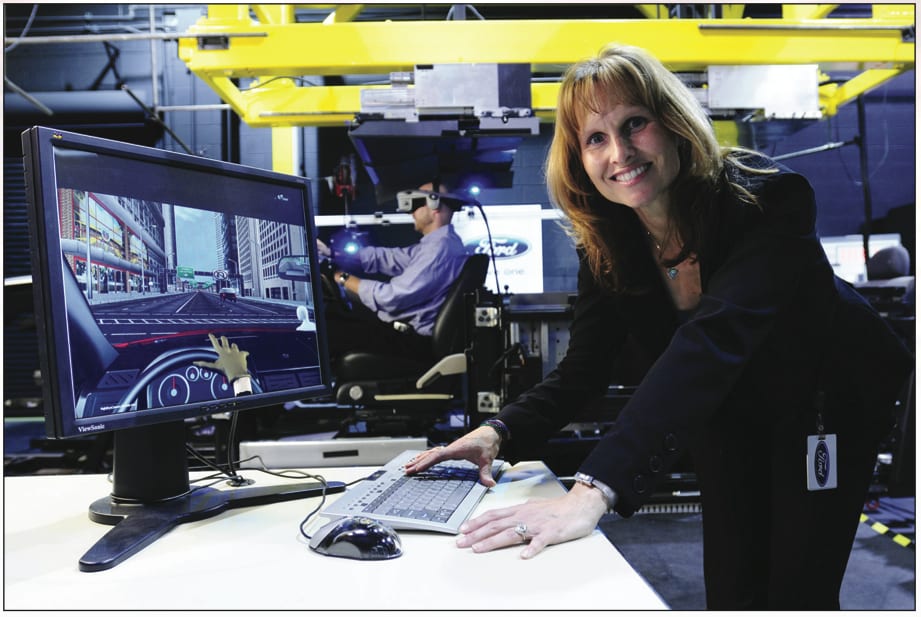
The aerospace and automotive engineers at Ford Motor Co. and United Space Alliance (USA) use the same kind of virtual reality animation software to evaluate real-life scenarios involving their vehicles. While USA engineers use the technology to track and characterize launch debris during ascent, Ford uses it to test the overall feel of a vehicle before building a prototype. The two organizations recently pooled their expertise, as USA advised Ford on how to improve response time to create a more realistic environment, while Ford assisted USA with human simulation software for simulation of spacecraft repairs.
Thermoelectric Generators
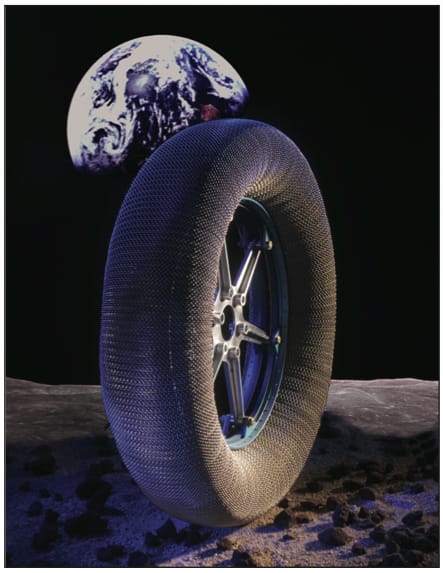
In 2005, the U.S. Department of Energy (DoE) began funding efforts to develop commercially viable prototypes that generate electricity from heat in automotive exhaust. One of the teams, including GM and the University of Michigan, is researching the implementation of shape memory alloys into exhaust systems to use wasted heat to help power both hybrid and conventional vehicles. The implications of such research are far-reaching — a thermoelectric module that increases fuel efficiency by 10 percent would save more than 100 million gallons of fuel a year for GM vehicles in the U.S. alone.
Accelerator Force Feedback Pedal

Insect Night Camera
Although only a quarter of traffic takes place at night, it is estimated that a disproportionate 40 percent of fatal and serious car accidents occur during this time period. Today’s most advanced night vision systems incorporate infrared lighting to detect obstacles on dark roads, but this technology still leaves much room for improvement.
For example, drivers could benefit from a new type of camera that imitates the visual mechanisms of insects. Toyota engineers teamed up with biologists and mathematicians at Lund University in Sweden to uncover the science behind the multiple-lens vision of nocturnal insects such as moths and dung beetles. The findings were converted into mathematical algorithms that produce digital images in a way that mirrors how the nocturnal insects enhance sight in the dark. A prototype of this insect-inspired camera is currently being tested at Toyota’s developmental facility in Brussels, Belgium.
Conclusion
Collaboration can inspire the kind of innovation needed to revive the automotive industry when it needs it the most. “The days are gone when we would do this kind of groundbreaking work on our own,” said GM’s Taub, referring to the company’s thermoelectric research. “We need to continue to find ways to combine our deep technical knowledge with others who can help take our ideas from concept to commercialization.”
Scientific research and collaboration with other fields will continue to bring exciting applications to the automotive industry, including, but not limited to, anti-fogging windshields from researchers in China, and sensors that use infrared light to expertly gauge traction available for braking on icy or snowy roads. Whether automotive innovation stems from NASA or Mother Nature, one thing is certain: the sky, and even outer space, is no limit.