

Two image-data-processing algorithms are essential to the successful operation of a system of electronic hardware and software that noninvasively tracks the direction of a person’s gaze in real time. The system was described in “High-Speed Noninvasive Eye-Tracking System” (NPO-30700) NASA Tech Briefs, Vol. 31, No. 8 (August 2007), page 51.
The video camera in the present system includes a charge-coupled-device (CCD) image detector plus electronic circuitry capable of implementing an advanced control scheme that effects readout from a small region of interest (ROI), or subwindow, of the full image. Inasmuch as the image features of interest (the cornea and pupil) typically occupy a small part of the camera frame, this ROI capability can be exploited to determine the direction of gaze at a high frame rate by reading out from the ROI that contains the cornea and pupil (but not from the rest of the image) repeatedly.
One of the present algorithms exploits the ROI capability. The algorithm takes horizontal row slices and takes advantage of the symmetry of the pupil and cornea circles and of the grayscale contrasts of the pupil and cornea with respect to other parts of the eye. The algorithm determines which horizontal image slices contain the pupil and cornea, and, on each valid slice, the end coordinates of the pupil and cornea. Information from multiple slices is then combined to robustly locate the centroids of the pupil and cornea images.
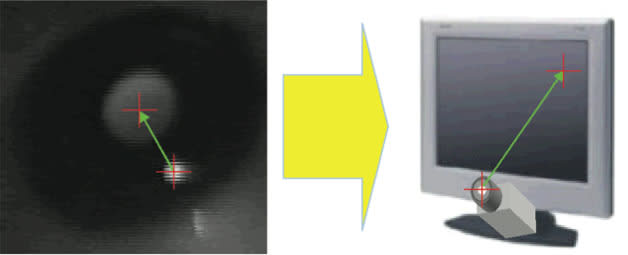
The other of the two present algorithms is a modified version of an older algorithm for estimating the direction of gaze from the centroids of the pupil and cornea. The modification lies in the use of the coordinates of the centroids, rather than differences between the coordinates of the centroids, in a gaze-mapping equation. The equation locates a gaze point, defined as the intersection of the gaze axis with a surface of interest, which is typically a computer display screen (see figure). The expected advantage of the modification is to make the gaze computation less dependent on some simplifying assumptions that are sometimes not accurate.
This work was done by Ashit Talukder, John-Michael Morookian, and James Lambert of Caltech for NASA’s Jet Propulsion Laboratory. For more information, download the Technical Support Package (free white paper) at www.techbriefs.com/tsp under the Information Sciences category.
In accordance with Public Law 96-517, the contractor has elected to retain title to this invention. Inquiries concerning rights for its commercial use should be addressed to:
Innovative Technology Assets Management JPL Mail Stop 202-233 4800 Oak Grove Drive
Pasadena, CA 91109-8099 E-mail:
Refer to NPO-30699, volume and number of this NASA Tech Briefs issue, and the page number.
This Brief includes a Technical Support Package (TSP).
Algorithms for High-Speed Noninvasive Eye-Tracking System
(reference NPO-30699) is currently available for download from the TSP library.
Don't have an account?
Overview
The document titled "Algorithms for High-Speed Noninvasive Eye-Tracking System" (NPO 30699) from NASA's Jet Propulsion Laboratory outlines advancements in eye-tracking technology aimed at overcoming the limitations of traditional methods. Historically, eye-tracking solutions have been invasive, requiring users to wear devices that hinder their normal activities. These methods typically operate at a maximum rate of 60 Hz, which restricts their application in fast-paced environments.
The primary focus of this research is to develop a non-invasive, real-time eye-tracking system that utilizes a novel, fast image processing technique. This technique allows for the accurate location of eye features from a distance and enables the estimation of gaze points through a new mapping algorithm. By achieving non-invasive and remote gaze point determination at significantly higher rates than existing solutions, this technology opens up a wide array of applications that were previously unattainable.
The document emphasizes the potential benefits of faster eye-tracking systems in various fields, including human-computer interaction (HCI), biomedical applications, and automated disease diagnosis. For instance, in HCI, faster eye-tracking can enhance user experience and interaction efficiency. In biomedical contexts, it can facilitate non-invasive monitoring of patients, allowing for timely and accurate health assessments without the need for cumbersome tests. Additionally, the technology could be instrumental in astronaut health monitoring, providing critical data in real-time during space missions.
The novelty of this approach lies in its ability to process images rapidly, leveraging the camera image acquisition procedure to enhance performance. This advancement not only improves the speed of eye-tracking but also maintains accuracy, which is crucial for applications requiring precise gaze point determination.
The document serves as a technical support package under NASA's Commercial Technology Program, aiming to disseminate aerospace-related developments with broader technological, scientific, or commercial implications. It encourages further exploration and collaboration in this innovative field, highlighting the potential for significant advancements in both research and practical applications.
In summary, the document presents a groundbreaking approach to eye-tracking technology that promises to enhance various applications through non-invasive, high-speed methods, paving the way for future innovations in multiple domains.











