
Stories
44
6
0
150
30
Briefs: Power
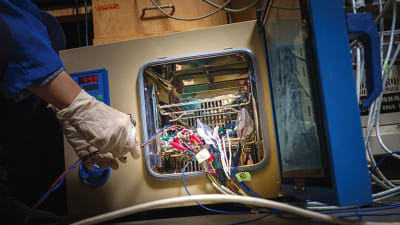
In tests, the proof-of-concept batteries retained 87.5 percent and 115.9 percent of their energy capacity at -40 °C and 50 °C (-40 °F and 122 °F), respectively.
Briefs: Energy
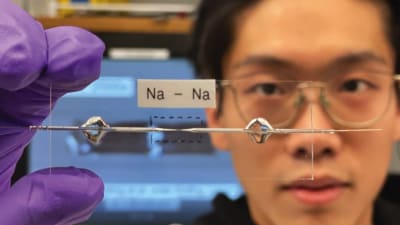
Have we found a better alternative to lithium-ion batteries?

Briefs: Energy
The material remains effective as an energy harvester or sensor at temperatures to well above 572°F.

Briefs: Energy
The device uses a thermoelectric module to generate voltage and current from the temperature gradient between the cell and the air.

Briefs: Electronics & Computers
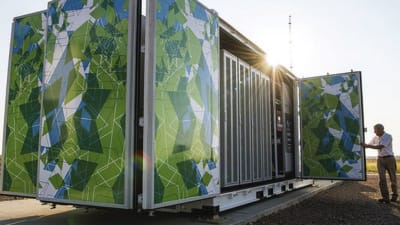
The National Renewable Energy Laboratory is leading the development of new lithium-ion (Li-ion) battery designs specific to the stationary storage requirements.
Briefs: Energy
Hydrogen has emerged as an important carrier to store energy generated by renewable resources, as a substitute for fossil fuels used for transportation, in the production of ammonia, and for other industrial applications.

Articles: Mechanical & Fluid Systems
This column presents technologies that have applications in commercial areas, possibly creating the products of tomorrow. To learn more about each technology, see the contact information provided for that innovation.

INSIDER: Test & Measurement
In a new study, researchers at the U.S. Department of Energy’s (DOE) Argonne National Laboratory have turned to machine learning to predict the lifetimes of a wide range of different battery...
Products: Connectivity
Battery Management Solution
InnovationLab (Heidelberg, Germany) has launched BaMoS, its battery monitoring solution for automotive applications. BaMoS uses ultra-thin printed pressure and temperature sensors to capture...

Briefs: Energy
Researchers from the University of Waterloo, Canada, who are members of the Joint Center for Energy Storage Research (JCESR), headquartered at the U.S. Department of Energy's (DOE) Argonne...

Question of the Week: Wearables
Would You Wear a Microgrid?
Our April issue of Tech Briefs highlighted a wearable microgrid that powers electronics by harvesting energy from the wearer’s body. The wearable (shown here) has three components: sweat-powered biofuel cells, motion-powered devices called triboelectric generators, and energy-storing supercapacitors. All parts are...
Blog: Sensors/Data Acquisition
Dropped by a drone, the battery-free devices hover 100 meters in the air.

Facility Focus: Propulsion
Established in 1961, PPPL's primary mission is research into and development of fusion as an energy source.

Briefs: Energy
The method enhances the battery's safety while it is being used, without opening the battery cell.

Briefs: Energy
Pyroelectric energy generates energy from heat that would otherwise be wasted in a catalytic chemical reaction.

Briefs: Manufacturing & Prototyping
The battery is smaller than a traditional lithium-ion battery due to the elimination of dendrites.
Briefs: Materials
The material enables lithium-ion batteries to be safely recharged within minutes for thousands of cycles.

Briefs: Materials
The flexible, washable microgrid uses the human body to sustainably power small electronics.

Blog: Energy
An MIT team has a water-free way to charge up dust on solar panels and repel it away.

Question of the Week: Electronics & Computers
Can 'Charging Rooms' Catch On?
One of the Tech Briefs highlighted in the second section of today’s INSIDER is a “charging room” from the University of Michigan and University of Tokyo that provides electricity over the air. The aluminum test area uses magnetic fields to deliver 50 watts and power-up devices, no matter their location within...
Blog: Energy
A reader asks how to check the longevity and capacity of vehicle batteries.

INSIDER: Energy
Renewable energy has an intermittency problem — the sun provides no power at night, while winds can stop suddenly.

Question of the Week: Energy
Will Battery Recycling Efforts Take Off?
Have you listened to the latest episode of our podcast series Here’s an Idea?
Special Reports: Propulsion

Engine Technology - March 2022
From diesel to electric to hydrogen, SAE's Truck & Off-Highway Engineering magazine reports on the latest advances in commercial vehicle engines. Stay up to date with this compendium of recent articles...Application Briefs: Energy
The grid’s growing size and complexity increases vulnerability to cyberattacks.

Briefs: Energy
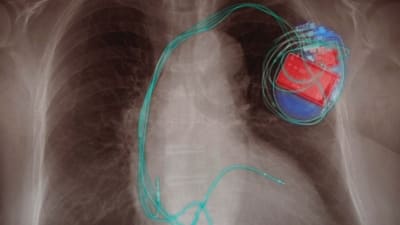
The nanothin material could advance self-powered electronics, wearable technologies, and even deliver pacemakers powered by heartbeats.
Briefs: Materials
Applications include power and energy, communications, and sensors.

Briefs: Energy
Carbon nanotubes are used to create solar cells with unprecedented flexibility and resistance.

Briefs: Electronics & Computers
In-wall capacitors power lights, phones, and laptops without wires.

Top Stories
 Blog: Robotics, Automation & Control

Aerial Microrobots That Can Match a Bumblebee's Speed
 Blog: Electronics & Computers

Turning Edible Fungi into Organic Memristors
 Blog: Manufacturing & Prototyping

Revolutionizing the Production of Semiconductor Chips
 News: Energy

 INSIDER: Electronics & Computers

World’s Smallest Programmable, Autonomous Robots
 INSIDER: Manufacturing & Prototyping

Webcasts
 On-Demand Webinars: Power

E/E Architecture Redefined: Building Smarter, Safer, and Scalable Vehicles
 Upcoming Webinars: Energy

Hydrogen Engines Are Heating Up for Heavy Duty
 Upcoming Webinars: Electronics & Computers

Advantages of Smart Power Distribution Unit Design for Automotive...
 Upcoming Webinars: Automotive

Quiet, Please: NVH Improvement Opportunities in the Early Design...
 Upcoming Webinars: Power

A FREE Two-Day Event Dedicated to Connected Mobility
 Podcasts: Defense

How Sift's Unified Observability Platform Accelerates Drone Innovation