
Stories
38
51
0
270
30
Briefs: Test & Measurement
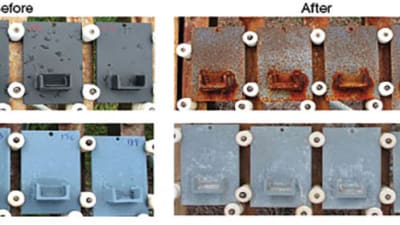
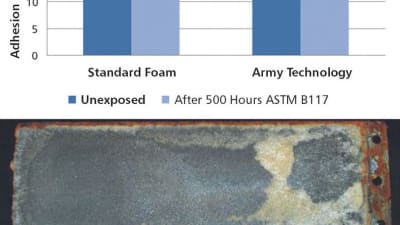
Aircraft coatings are the first line of defense when it comes to mitigating structural corrosion of an air platform. As new coatings are developed — particularly those that contain non-chrome primers...

Briefs: Energy
Commercial buildings in the United States account for nearly 40% of the total energy consumption. Among them, electricity is the largest energy source for buildings....

Articles: Materials
This column presents technologies that have applications in commercial areas, possibly creating the products of tomorrow. To learn more about each technology, see the contact information provided for that innovation.

Blog: Materials
Professor Paul Steen helped to create a beetle-inspired adhesive. Now it's about finding applications for it.

Briefs: Aerospace
Large-scale liquid rocket engines with regeneratively cooled nozzles will enable reliable and reduced-cost access to space. The coolant that circulates through the internal...

Briefs: Materials
Printing Ink Removes Oxygen in Sealed Packages
Oxygen adversely impacts food flavor and nutrition. NASA’s proposed five-year shelf life for astronaut food requires aggressive measures to minimize oxygen. Previously, NASA packaged foods in containers with a high oxygen and moisture barrier. These materials have limiting properties. They contain a...
Briefs: Manufacturing & Prototyping
A “4D printing” method was developed for a smart gel that could lead to the development of living structures in human organs and tissues, soft robots, and targeted drug delivery.

Briefs: Manufacturing & Prototyping
This technology uses extracts produced from yeast transformed with a new anti-UV DNA construct to block ultraviolet (UV) radiation.

Blog: Manufacturing & Prototyping
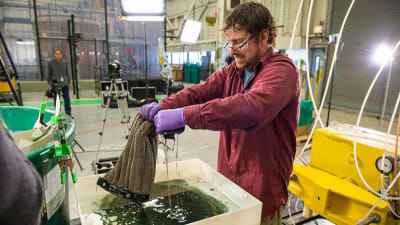
A reusable sponge from the U.S. Department of Energy’s Argonne National Laboratory cleans up spills – not in the kitchen, but on the coast.
Briefs: Mechanical & Fluid Systems
Every complex human tool has contained multiple materials wedged, tied, screwed, glued, or soldered together. But the next generation of tools, from autonomous squishy robots to flexible...

Briefs: Manufacturing & Prototyping
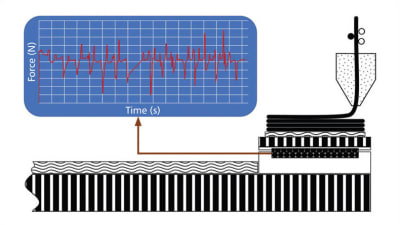
NASA Langley Research Center has developed a test station capable of in-situ testing of material deposition and layer adhesion in an extrusion additive manufacturing process. The technology addresses the problem of...
Briefs: Robotics, Automation & Control
A small robot with the ability to hoist large loads could have countless applications, not only as a small, inexpensive, disposable, mobile sensor in the realms of search and rescue,...

Briefs: Energy
Researchers have developed a lithium-ion battery that uses a water-salt solution as its electrolyte — reaching the 4.0- Volt mark for electronics such as laptops — without the fire and explosive...

Technology Leaders: Sensors/Data Acquisition
Exciting new technological innovations are making the planet cleaner, people healthier, food more plentiful, transportation speedier, communication more accessible, and...

Products: Mechanical & Fluid Systems
Product of the Month
Keysight Technologies, Santa Rosa, CA, introduced the PathWave software platform that integrates design, test, measurement, and analysis to enable product development from concept to...

Briefs: Energy
Superalloy Surface Treatment for Improved Performance of Power Turbines
To produce power more efficiently and cleanly, the next generation of power turbines will have to operate at extreme temperatures and pressures. Currently, single-crystal, nickel-based superalloys are used in such extreme environments. MCrAlY coatings (where M = Co, Ni, or...
Briefs: Manufacturing & Prototyping
Conductive, High-Toughness Oxides Deposited by Plasma Spray-Physical Vapor Deposition (PS-PVD)
Oxide coatings deposited in Glenn Research Center's Plasma Spray-Physical Vapor Deposition (PS-PVD) facility can be processed to be mechanically tough (erosion-resistant) and electrically conductive at room temperature. The electrically conductive phase...
INSIDER: Materials
Researchers at the U.S. Department of Energy’s Ames Laboratory have developed germanium nanoparticles with improved photoluminescence, making them potentially better materials for...

NASA Spinoff: Materials
Spinoff is NASA’s annual publication featuring successfully commercialized NASA technology. This commercialization has contributed to the development of products and services in the fields of health and...
Articles: RF & Microwave Electronics
This column presents technologies that have applications in commercial areas, possibly creating the products of tomorrow. To learn more about each technology, see the contact information provided for that innovation.

News: Materials
A reversible fabric from Stanford University could warm up or cool down its wearers, depending on their preference – and which side of the material faces out.

Sound-Off: Materials
Conformal coatings like Parylene protect a variety of components, including LEDs, sensors, and circuit card assemblies. If a board component needs to be replaced, however, how easily can the Parylene...

Question of the Week: Manufacturing & Prototyping
Our lead INSIDER story today showcased a new Kapton-like material, developed by a team at Virginia Tech. The researchers hope that the 3D-printed polymer will support new applications,...

News: Materials
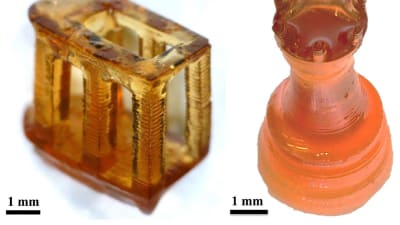
Kapton, a material used in electronics and aerospace applications, has only been available in sheet form. Researchers from Virginia Tech have found a way to 3D-print a polymer with Kapton's structural...
Articles: Electronics & Computers
This column presents technologies that have applications in commercial areas, possibly creating the products of tomorrow. To learn more about each technology, see the contact information provided for that innovation.

Briefs: Materials
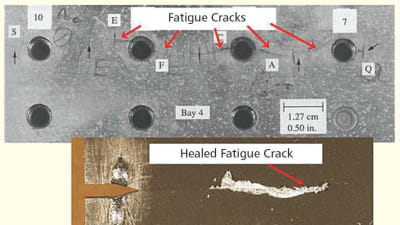
NASA’s Langley Research Center has developed an innovative coating to heal cracks in metal components, such as in aircraft and bridges. Currently, the coating is used for in-laboratory repairs of...
Application Briefs: Materials
LumiShield Pittsburgh, PA For more info click here
Corrosion-related issues cost the U.S. economy $276 billion a year. The Energy Department’s National Energy Technology Laboratory (NETL)...

Briefs: Materials
Surfaces such as metal and other corrodible surfaces are often exposed to extreme weathering, temperatures, moisture, impurities, and otherwise damaging external forces that accelerate corrosion....
INSIDER: Energy
A team from Australia’s RMIT University created a “solar paint” that generates its own energy. The sunlight-absorbing substance absorbs and splits water atoms, resulting in hydrogen that...

Top Stories
 Blog: Robotics, Automation & Control

Aerial Microrobots That Can Match a Bumblebee's Speed
 Blog: Electronics & Computers

Turning Edible Fungi into Organic Memristors
 Blog: Manufacturing & Prototyping

Revolutionizing the Production of Semiconductor Chips
 News: Energy

 INSIDER: Electronics & Computers

World’s Smallest Programmable, Autonomous Robots
 INSIDER: Manufacturing & Prototyping

Webcasts
 On-Demand Webinars: Power

E/E Architecture Redefined: Building Smarter, Safer, and Scalable Vehicles
 Upcoming Webinars: Energy

Hydrogen Engines Are Heating Up for Heavy Duty
 Upcoming Webinars: Electronics & Computers

Advantages of Smart Power Distribution Unit Design for Automotive...
 Upcoming Webinars: Automotive

Quiet, Please: NVH Improvement Opportunities in the Early Design...
 Upcoming Webinars: Power

A FREE Two-Day Event Dedicated to Connected Mobility
 Podcasts: Defense

How Sift's Unified Observability Platform Accelerates Drone Innovation