
Stories
38
49
0
2370
30
Briefs: Materials
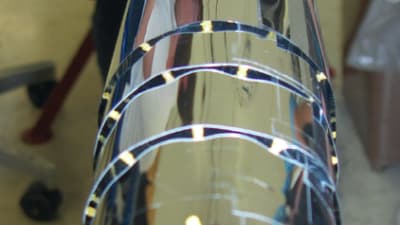
NASA vehicles using cryogenic propellants and systems need improved cryogenic storage and transfer, including insulation for cryogenic transfer/feed lines. Wrapped...
Briefs: Materials
Compliant Electrode and Composite Materials for Piezoelectric Wind and Mechanical Energy Conversion
Thin film, piezoelectric materials generate a small voltage whenever they are deformed, suggesting that they are suitable for tapping energy from freely available resources, such as the wind. Yet their low-energy production levels and lack of...
Briefs: Materials
Development of a Novel, Regenerable Microlith Catalytic Reactor for CO2 Reduction via Bosch Process
Utilization of CO2 to produce life support consumables, such as water and oxygen, offers a potential advance for NASA’s cabin atmosphere revitalization system and in-situ resources utilization concepts for long-term manned space missions. Toward...
INSIDER: Mechanical & Fluid Systems
'Snap' Design Mimics Venus Flytrap
A team led by physicist Christian Santangelo at the University of Massachusetts Amherst uses curved creases to give thin shells a fast, programmable snapping motion. The technique – inspired by the natural "snapping systems" like Venus flytrap leaves and hummingbird beaks – avoids the need for complicated...
Who's Who: Materials
After a 2013 wildfire led to the loss of 19 elite Arizona firefighters, Langley Research...

News: Software
One of the largest composites manufacturing robots created in America will help NASA build the biggest lightweight composite parts ever made for space vehicles. The robot will build...

INSIDER: Test & Measurement
'Electron Camera' Reveals Nature's Fastest Processes
Using a method known as ultrafast electron diffraction (UED), a scientific instrument from the Department of Energy’s SLAC National Accelerator Laboratory reveals nature's fastest processes, including the rapid motions of atoms and molecules.
INSIDER: Aerospace
Simulations Reveal Material with Record-Setting Melting Point
Using advanced computers and a computational technique to simulate physical processes at the atomic level, researchers at Brown University have predicted that a material made from hafnium, nitrogen, and carbon would have the highest known melting point: 4,400 kelvins (7,460 degrees...
Briefs: Materials
Lightweight, Flexible, Energy-Manageable Polymer Nanocomposites
Solar energy has attracted keen attention because it is a unique, clean, and sustainable energy resource. It is also widely utilized as a power source in space exploration. A lightweight, durable, deployable, and highly efficient all polymer-based solar power panel was developed...
Briefs: Materials
Nanocomposites for Radiation Shielding
Currently, lead and lead-based materials are used to fabricate shields not only for X-rays, but also for other types of radiation. With the growing environmental concern about the toxicity of lead, and the high costs associated with transporting heavy lead-based shields in spacecraft, alternatives are needed...
Briefs: Materials
Lightweight, High-Strength Nanocomposite Magnesium for Radiators
The next generation of radiators will be designed using a composite with the combination of the lowest density, highest thermal conductivity, and highest strength. A scalable, low-cost process was developed to advance state-of-the-art metal matrix thermal conductors to reach a...
Briefs: Materials
Advanced Protective Coatings for Graphite Substrates
The purpose of this innovation is to develop advanced multilayered coating architectures to protect graphite substrates from hot hydrogen attack. The concept consists of coating the graphite substrate with metallic and non-metallic layers consisting of ZrC; Nb, Mo, and/or Nb-Mo alloy; and/or...
Briefs: Materials
Plasma Extraction of Oxygen from the Martian Atmosphere
Extraction of oxygen from the abundant carbon dioxide present on Mars (96% atmospheric composition) is an important objective in preparation for missions to the planet. Oxygen is not only a fundamental reactant with high-specific-energy chemical fuels such as hydrogen and methane, but, along...
Briefs: Materials
Application of Carbon Nanotube Hold-Off Voltage for Determining Gas Composition
In this innovation, a method and associated system have been created to vary a voltage applied to an exposed end of a carbon nanotube for a selected time interval to promote gas discharge, and to estimate a gas component involved in the discharge. Each component of a...
Briefs: Materials
Solar-Powered Carbon Dioxide Conversions with Thin-Film Devices
A nanomaterial thin-film device provides a low-cost, facile fabrication pathway to commercialize the technology to the sustainable energy market. Metal oxide thin films have been fabricated to a photoelectrochemical cell by solar energy. The prototype device uses both low energy cost...
INSIDER: Mechanical & Fluid Systems
The high cost to manufacture nanofibers has relegated them to just a few niche industries. MIT researchers developed a new technique for producing nanofibers that increases the rate...
INSIDER: Mechanical & Fluid Systems
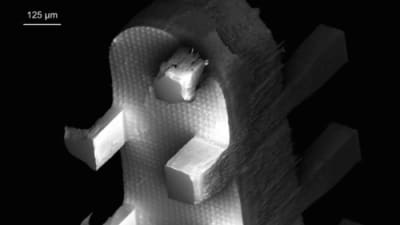
Silicon micromirrors can guide laser beams at extremely high speeds, allowing operators to dose heat input to workpieces with absolute precision. But to date, they have not been robust enough to be...

INSIDER: Manufacturing & Prototyping
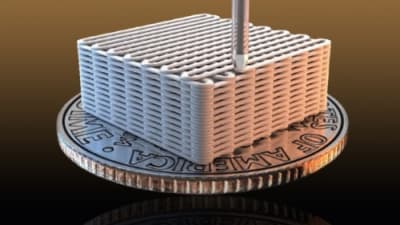
A new type of graphene aerogel will make for better energy storage, sensors, nanoelectronics, catalysis, and separations. Lawrence Livermore National Laboratory made graphene aerogel microlattices with...
INSIDER: Motion Control
Tiny Origami Robot Folds Itself Up
MIT researchers have developed a printable origami-inspired robot that, when heated, folds itself up from a flat sheet of plastic. The robot weighs a third of a gram and measures about a centimeter from front to back.
INSIDER: Materials
Flexible optoelectronic devices that can be produced roll-to-roll – much like newspapers are printed – are a highly promising path to cheaper devices such as solar cells...

INSIDER: Materials
New Etching Method Boosts Nanofiber Production
A new technique from MIT researchers boosts production of nanofibers fourfold, while cutting energy consumption by more than 90 percent. Potential nanofiber applications include solar cells, water filtration, and fuel cells.
INSIDER: Semiconductors & ICs
Researchers Develop Biodegradable Computer Chip
In an effort to alleviate the environmental burden of electronic devices, a team of University of Wisconsin-Madison researchers has collaborated with the Madison-based U.S. Department of Agriculture Forest Products Laboratory (FPL) to develop a semiconductor chip made almost entirely of wood.
Briefs: Materials
Regenerable Trace-Contaminant Sorbent for the Primary Life Support System (PLSS)
The NASA objective of expanding the human experience into the far reaches of space requires the development of regenerable life support systems. This work addresses the development of a regenerable air-revitalization system for trace-contaminant (TC) removal for the...
Briefs: Materials
Lithium Fluoride as a Polysulfide Shuttle Inhibitor for Lithium Sulfur Chemistry
In a lithium sulfur cell, the reduction of sulfur to lithium sulfide is a critical series of reactions that provides a large theoretical capacity of 1,672 mAh/g sulfur. One of many challenges in this system is the solubility of generated lithium polysulfides during the...
Briefs: Materials
Fibers of Aligned Single-Wall Carbon Nanotubes and Process for Making the Same
Single-wall carbon nanotubes (SWNTs) are fullerenes of closed-cage carbon molecules typically arranged in hexagons and pentagons. Commonly known as “buckytubes,” these cylindrical carbon structures have extraordinary properties, including high electrical and thermal...
Briefs: Materials
Enhancing MRI Contrast by Geometrical Confinement of Small Imaging Agents Within Nanoporous Particles
Magnetic resonance imaging (MRI) has evolved into one of the most powerful, non-invasive diagnostic imaging techniques in medicine and biomedical research. The superior resolution and in-depth anatomical details provided by MRI are essential for...
INSIDER: Test & Measurement
Visual Microphone Identifies Structural Defects
A new technique from Massachusetts Institute of Technology researchers estimates material properties of physical objects, such as stiffness and weight, from video.
INSIDER: Manufacturing & Prototyping
Researchers Create Shape-Shifting Plastic
Researchers from Washington State University and the Department of Energy's Oak Ridge Laboratory have created a tunable shape-memory polymer. The shape-shifting plastic can “remember” its original shape and return to it after being deformed with heat or other forces.
INSIDER: Materials
New Nanomaterials Mimic Bird Feathers
Inspired by the way iridescent bird feathers play with light, UC San Diego scientists have created thin-film materials in a wide range of pure colors: red, orange, yellow, and green. The hues are determined by physical structure rather than pigments.
Top Stories
 Blog: Robotics, Automation & Control

Aerial Microrobots That Can Match a Bumblebee's Speed
 Blog: Electronics & Computers

Turning Edible Fungi into Organic Memristors
 Blog: Manufacturing & Prototyping

Revolutionizing the Production of Semiconductor Chips
 News: Energy

 INSIDER: Electronics & Computers

World’s Smallest Programmable, Autonomous Robots
 INSIDER: Manufacturing & Prototyping

Webcasts
 On-Demand Webinars: Power

E/E Architecture Redefined: Building Smarter, Safer, and Scalable Vehicles
 Upcoming Webinars: Energy

Hydrogen Engines Are Heating Up for Heavy Duty
 Upcoming Webinars: Electronics & Computers

Advantages of Smart Power Distribution Unit Design for Automotive...
 Upcoming Webinars: Automotive

Quiet, Please: NVH Improvement Opportunities in the Early Design...
 Upcoming Webinars: Power

A FREE Two-Day Event Dedicated to Connected Mobility
 Podcasts: Defense

How Sift's Unified Observability Platform Accelerates Drone Innovation