
Stories
38
49
0
2700
30
Briefs: Materials
Iridium-Doped Ruthenium Oxide Catalyst for Oxygen Evolution
NASA requires a durable and efficient catalyst for the electrolysis of water in a polymer-electrolyte-membrane (PEM) cell. Ruthenium oxide in a slightly reduced form is known to be a very efficient catalyst for the anodic oxidation of water to oxygen, but it degrades rapidly, reducing...
Briefs: Materials
Dispersion-strengthened molybdenum-rhenium alloys for vacuum plasma spraying (VPS) fabrication of high-temperature-resistant components are undergoing development. In comparison with otherwise...

Briefs: Materials
Polymerization Initiated at the Sidewalls of Carbon Nanotubes
A process has been developed for growing polymer chains via anionic, cationic, or radical polymerization from the side walls of functionalized carbon nanotubes, which will facilitate greater dispersion in polymer matrices, and will greatly enhance reinforcement ability in polymeric...
Briefs: Materials
Piezoelectrically Enhanced Photocathodes
Doping of photocathodes with materials that have large piezoelectric coefficients has been proposed as an alternative means of increasing the desired photoemission of electrons. Treating cathode materials to increase emission of electrons is called “activation” in the art. It has been common practice to...
Tech Needs: Materials
Non-Smoke, Non-Halogenated Fire Retardants
A company needs non-halogenated polymeric mix additives that provide non-smoke fire retardance for wiring jackets and cables. The additive must have low enough loadings so that product performance and flexibility are maintained. Wires and cables must meet a variety of requirements, some imposed by...
Briefs: Materials
Low-Outgassing Photogrammetry Targets for Use in Outer Space
A short document discusses an investigation of materials for photogrammetry targets for highly sensitive optical scientific instruments to be operated in outer space and in an outer-space-environment-simulating thermal vacuum chamber on Earth. A key consideration in the selection of...
Articles: Test & Measurement
The Hall effect can be observed when the combination of a magnetic field through a sample and a current along the length of the sample create an...

Articles: Aerospace
In direct response to the National Research Council’s report “Capabilities for the Future: An Assessment of NASA Laboratories for Basic Research, 2010,” the Space Technology program was born and formally approved by...
Briefs: Materials
Separation of Single-Walled Carbon Nanotubes with DEP-FFF
A process using a modified dielectrophoresis device separates single-walled carbon nanotubes (SWNTs) according to their polarizability in electric fields. This depends on the size and dielectric constant of individual nanotubes and easily separates metallic from semiconducting nanotubes....
Briefs: Materials
Self-Cleaning Coatings and Materials for Decontaminating Field-Deployable Land and Water-Based Optical Systems
This technology exploits the organic decomposition capability and hydrophilic properties of the photocatalytic material titanium dioxide (TiO2), a non-toxic and non-hazardous substance, to address contamination and biofouling issues in...
Briefs: Materials
Li Anode Technology for Improved Performance
A novel, low-cost approach to stabilization of Li metal anodes for high-performance rechargeable batteries was developed. Electrolyte additives are selected and used in Li cell electrolyte systems, promoting formation of a protective coating on Li metal anodes for improved cycle and safety performance.
Briefs: Materials
Optical Coating Performance for Heat Reflectors of the JWST-ISIM Electronic Component
A document discusses a thermal radiator design consisting of lightweight composite materials and low-emittance metal coatings for use on the James Webb Space Telescope (JWST) structure. The structure will have a Thermal Subsystem unit to provide passive cooling to...
Briefs: Materials
Measuring Moisture Levels in Graphite Epoxy Composite Sandwich Structures
Graphite epoxy composite (GEC) materials are used in the construction of rocket fairings, nose cones, interstage adapters, and heat shields due to their high strength and light weight. However, they absorb moisture depending on the environmental conditions they are exposed to...
Briefs: Materials
Optimized Li-Ion Electrolytes Containing Triphenyl Phosphate as a Flame-Retardant Additive
A number of future NASA missions involving the exploration of the Moon and Mars will be “human-rated” and thus require high-specific-energy rechargeable batteries that possess enhanced safety characteristics. Given that Li-ion technology is the most...
Briefs: Materials
Real-Time Deposition Monitor for Ultrathin Conductive Films
A device has been developed that can be used for the real-time monitoring of ultrathin (2 Å or more) conductive films. The device responds in less than two microseconds, and can be used to monitor film depositions up to about 60 Å thick. Actual thickness monitoring capability will vary...
Briefs: Materials
Marshall Convergent Spray Formulation Improvement for High Temperatures
The Marshall Convergent Coating-1 (MCC-1) formulation was produced in the 1990s, and uses a standard bisphenol A epoxy resin system with a triamine accelerator. With the increasing heat rates forecast for the next generation of
vehicles, higher-temperature sprayable coatings...
Techs for License: Materials
Soft-Feel Grain Surface Treatment for Hard Plastic Mimics Sensation on Fingertips
This technology gives hard-surface plastics a soft and moist feel by imposing a “grain” or texturing onto the surface. It has application in automotive interiors, household utensils, electronics, mobile phones, and other locations where a hard plastic surface...
Techs for License: Physical Sciences
Development of Organic Materials that Melt by Light Irradiation
AIST has developed organic materials that melt from solid to liquid with only the irradiation of light, without heating, and can be restored to their original solid state. Unlike irreversible photosensitive resins, which cannot be restored to their original state after their state has...
Briefs: Manufacturing & Prototyping
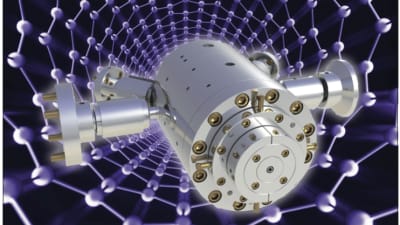
Although the concept of nanotechnology (controlling matter on an atomic scale) dates back to 1959, it is only now becoming more commercially realized. It has the potential to challenge...
Briefs: Materials
Commercialization of LARC™-SI Polyimide Technology
LARC™-SI, Langley Research Center-Soluble Imide, was developed in 1992, with the first patent issuing in 1997, and then subsequent patents issued in 1998 and 2000. Currently, this polymer has been successfully licensed by NASA, and has generated revenues, at the time of this reporting, in...
Briefs: Materials
Novel Low-Density Ablators Containing Hyperbranched Poly(azomethine)s
An ablative composite is low-density (0.25 to 0.40 g/cm3), easy to fabricate, and superior to the current state-of-the-art ablator (phenolic impregnated carbon ablator, PICA) in terms of decomposition temperature, char yield, and mechanical strength. Initial ablative testing with...
Briefs: Materials
Carbon Nanotubes on Titanium Substrates for Stray Light Suppression
A method has been developed for growing carbon nanotubes on a titanium substrate, which makes the nanotubes ten times blacker than the current state-of-the-art paints in the visible to near infrared. This will allow for significant improvement of stray light performance in...
Briefs: Materials
Fire-Retardant Polymeric Additives
Polyhydroxyamide (PHA) and polymethoxyamide (PMeOA) are fire-retardant (FR) thermoplastic polymers and have been found to be useful as an additive for imparting fire retardant properties to other compatible, thermoplastic polymers (including some elastomers). Examples of compatible flammable polymers include...
Briefs: Materials
A lift-gas cracker (LGC) is an apparatus that generates a low-molecular-weight gas (mostly hydrogen with smaller amounts of carbon monoxide and/or carbon dioxide) at low gauge pressure by methanol...

Briefs: Materials
Ionic Liquids to Replace Hydrazine
A method for developing safe, easy-to-handle propellants has been developed based upon ionic liquids (ILs) or their eutectic mixtures. An IL is a binary combination of a typically organic cation and anion, which generally produces an ionic salt with a melting point below 100 °C. Many ILs have melting points near,...
Briefs: Materials
Variable Emittance Electrochromics Using Ionic Electrolytes and Low Solar Absorptance Coatings
One of the last remaining technical hurdles with variable emittance devices or skins based on conducting polymer electrochromics is the high solar absorptance of their top surfaces. This high solar absorptance causes overheating of the skin when facing...
Briefs: Materials
A Model of Reduced Kinetics for Alkane Oxidation Using Constituents and Species for N-Heptane
The reduction of elementary or skeletal oxidation kinetics to a subgroup of tractable reactions for inclusion in turbulent combustion codes has been the subject of numerous studies. The skeletal mechanism is obtained from the elementary mechanism by...
Briefs: Materials
Thermally Conductive Tape Based on Carbon Nanotube Arrays
To increase contact conductance between two mating surfaces, a conductive “tape” has been developed by growing dense arrays of carbon nanotubes (CNTs, graphite layers folded into cylinders) on both sides of a thermally conductive metallic foil. When the two mating surfaces are brought...
Briefs: Materials
Lightweight, Ultra-High-Temperature, CMC-Lined Carbon/Carbon Structures
lished engineering material used extensively in aerospace. The beneficial properties of C/C include high strength, low density, and toughness. Its shortcoming is its limited usability at temperatures higher than the oxidation temperature of carbon — approximately 400 °C....
Top Stories
 Blog: Robotics, Automation & Control

Aerial Microrobots That Can Match a Bumblebee's Speed
 Blog: Electronics & Computers

Turning Edible Fungi into Organic Memristors
 Blog: Manufacturing & Prototyping

Revolutionizing the Production of Semiconductor Chips
 News: Energy

 INSIDER: Electronics & Computers

World’s Smallest Programmable, Autonomous Robots
 INSIDER: Manufacturing & Prototyping

Webcasts
 On-Demand Webinars: Power

E/E Architecture Redefined: Building Smarter, Safer, and Scalable Vehicles
 Upcoming Webinars: Energy

Hydrogen Engines Are Heating Up for Heavy Duty
 Upcoming Webinars: Electronics & Computers

Advantages of Smart Power Distribution Unit Design for Automotive...
 Upcoming Webinars: Automotive

Quiet, Please: NVH Improvement Opportunities in the Early Design...
 Upcoming Webinars: Power

A FREE Two-Day Event Dedicated to Connected Mobility
 Podcasts: Defense

How Sift's Unified Observability Platform Accelerates Drone Innovation