
Stories
38
49
0
2760
30
Briefs: Materials
Database for Safety-Oriented Tracking of Chemicals
SafetyChem is a computer program that maintains a relational database for tracking chemicals and associated hazards at Johnson Space Center (JSC) by use of a Web-based graphical user interface. The SafetyChem database is accessible to authorized users via a JSC intranet. All new chemicals pass...
Briefs: Materials
Optimized Li-Ion Electrolytes Containing Fluorinated Ester Co-Solvents
A number of experimental lithium-ion cells, consisting of MCMB (meso-carbon microbeads) carbon anodes and LiNi0.8Co0.2O2 cathodes, have been fabricated with increased safety and expanded capability. These cells serve to verify and demonstrate the reversibility, low-temperature...
Briefs: Materials
Probabilistic Multi-Factor Interaction Model for Complex Material Behavior
Complex material behavior is represented by a single equation of product form to account for interaction among the various factors. The factors are selected by the physics of the problem and the environment that the model is to represent. For example, different factors...
Briefs: Materials
Electroceramic Actuators for Operation at Low Temperatures
Electrostrictive ceramic actuators that can function at low temperatures have been developed for controlling the shapes of mirrors in the Next Generation Space Telescope (NGST). On Earth, electrostrictive ceramic actuators may be useful for fine control of the positions of objects in...
Briefs: Materials
Improved Low-Temperature Performance of Li-Ion Cells Using New Electrolytes
As part of the continuing efforts to develop advanced electrolytes to improve the performance of lithiumion cells, especially at low temperatures, a number of electrolyte formulations have been developed that result in improved low-temperature performance (down to –60...
Briefs: Energy
An improved class of formulations for PMR polyimide resins retards the imidization that undesirably occurs during handling and storage. While imidization is desired at the final...

Briefs: Materials
Silica-Filled EPDM Rubbers as Ablative Insulating Materials
Silica-filled polymers made from ethylene propylene diene monomer (EPDM) have been found to be useful as ablative thermal-insulation materials. These polymers have been investigated as candidates to replace some previously developed polymeric ablative rocket-engine insulating materials...
Briefs: Materials
Wider-Opening Dewar Flasks for Cryogenic Storage
Dewar flasks have been proposed as containers for relatively long-term (25 days) storage of perishable scientific samples or other perishable objects at a temperature of –175 °C. The refrigeration would be maintained through slow boiling of liquid nitrogen (LN2). For the purposes of the...
Briefs: Materials
Supercapacitor Electrolyte Solvents With Liquid Range Below –80 °C
A previous NASA Tech Brief [“Low-Temperature Supercapacitors” (NPO-44386) NASA Tech Briefs, Vol. 32, No 7 (July 2008), page 32] detailed ongoing efforts to develop non-aqueous supercapacitor electrolytes capable of supporting operation at temperatures below commercially...
Briefs: Materials
Silicon Oxycarbide Aerogels for High-Temperature Thermal Insulation
A high-performance, silicon oxycarbide (SiOC) aerogel material is suitable for use as thermal insulation at temperatures approaching 1,200 °C. These aerogel composites were created using cost-effective and commercially available polymeric precursors (the polymethylsiloxane resin,...
Briefs: Materials
New designs, and materials appropriate for such designs, are under investigation in an effort to develop coronagraph occulting masks having broad-band spectral characteristics...

Techs for License: Materials
Xyloy™ Injection-Molded Zinc/Aluminum Alloy
Cool Polymers
Xyloy™ is an injection-molded zinc/aluminum alloy processed in conventional plastic injection-molding equipment and molds. The Xyloy technology enables 3D netshaped metal parts right from the mold. Xyloy requires no carriers or binders, and — unlike die-cast metal parts — imposes no...
Who's Who: Aerospace
Dr. Luz Marina Calle earned her Ph.D. in chemistry from Ohio University and shortly thereafter became a professor of...

Briefs: Materials
Statistical Sampling of Tide Heights Study
The goal of the study was to determine if it was possible to reduce the cost of verifying computational models of tidal waves and currents. Statistical techniques were used to determine the least number of samples required, in a given situation, to remain statistically significant, and thereby reduce...
Application Briefs: Electronics & Computers
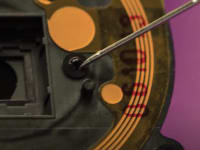
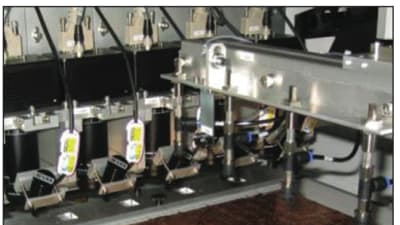
Process Photonics (Ottawa, ON, Canada) builds processing systems for the PCB, electronics assembly, and medical device markets. Their ProVisionTM series is a solution that uses...
Briefs: Materials
Magnetic-Field-Tunable Superconducting Rectifier
Superconducting electronic components have been developed that provide current rectification that is tunable by design and with an externally applied magnetic field to the circuit component. The superconducting material used in the device is relatively free of pinning sites with its critical current...
Briefs: Materials
Films made of certain polymer/carbon composites have been found to be potentially useful as sensing films for detecting airborne elemental mercury at concentrations on the order of tens...

Briefs: Materials
A further improvement has been made to reduce the high-temperature thermal conductivities of the aerogel-matrix composite materials described in “Improved Silica Aerogel Composite Materials”...

Briefs: Materials
Multiplexed Colorimetric Solid-Phase Extraction
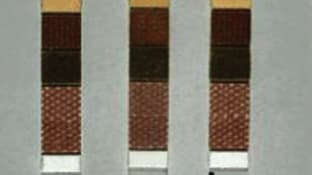
Multiplexed colorimetric solid-phase extraction (MC-SPE) is an extension of colorimetric solid-phase extraction (CSPE) — an analytical platform that combines colorimetric reagents, solid phase extraction, and diffuse reflectance spectroscopy to quantify trace analytes in water. In C-SPE, analytes...
Briefs: Medical
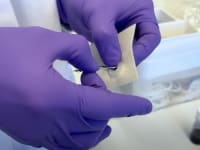
The separation of serum or plasma from whole blood is of overriding importance in clinical chemistry. In particular, many diagnostic detection reactions of blood components...
Briefs: Materials
Self-Assembling, Flexible, Pre-Ceramic Composite Preforms
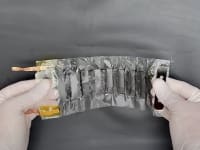
In this innovation, light weight, high temperature, compact aerospace structures with increased design options are made possible by using self-assembling, flexible, pre-ceramic composite materials. These materials are comprised of either ceramic or carbon fiber performs, which are...
Briefs: Photonics/Optics
Mercuric Iodide Anticoincidence Shield for Gamma-Ray Spectrometer
A film-growth process was developed for polycrystalline mercuric iodide that creates cost-effective, large-area detectors for high-energy charged-particle detection. A material, called a barrier film, is introduced onto the substrate before the normal mercuric iodide film growth...
Briefs: Materials
Using Ozone To Clean and Passivate Oxygen-Handling Hardware
A proposed method of cleaning, passivating, and verifying the cleanliness of oxygen-handling hardware would extend the established art of cleaning by use of ozone. As used here, “cleaning” signifies ridding all exposed surfaces of combustible (in particular, carbon-based) contaminants....
Briefs: Materials
Two-Piece Screens for Decontaminating Granular Material
Two-piece screens have been designed specifically for use in filtering a granular material to remove contaminant particles that are significantly wider or longer than are the desired granules. In the original application for which the two-piece screens were conceived, the granular material is...
Briefs: Materials
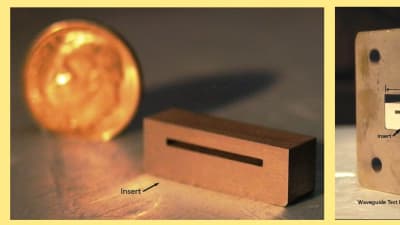
Rectangular-waveguide inserts that are made of non-ferromagnetic metals and are sized and shaped to function as notch filters have been conceived as reference standards for use in the...
Techs for License: Materials
Microscopically Reinforced Polymers Without Fibers or Fillers
This micro-reinforcement technology enables new applications where existing thermoplastics, elastomers, thermosets, and reinforcing technologies have not had sufficient toughness or fracture strength, particularly at elevated temperatures. The new reinforcement technology does not...
Briefs: Materials
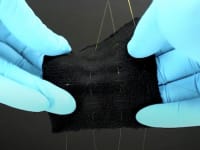
Carbon nanotube (CNT) sheets, yarns, and their derivative products are beginning to emerge in the marketplace. A productive and scalable manufacturing method...

Briefs: Physical Sciences
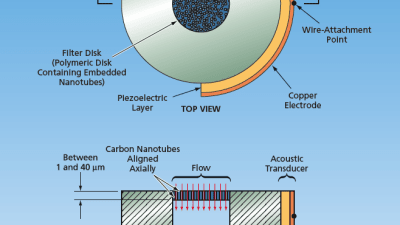
Devices that could be characterized as acoustically driven molecular sieves have been proposed for filtering water to remove all biological contaminants and all molecules larger than...
Briefs: Nanotechnology
Improvements in Production of Single-Walled Carbon Nanotubes
A continuing program of research and development has been directed toward improvement of a prior batch process in which single-walled carbon nanotubes are formed by catalytic disproportionation of carbon monoxide in a fluidized-bed reactor. The overall effect of the improvements has been...
Top Stories
 Blog: Robotics, Automation & Control

Aerial Microrobots That Can Match a Bumblebee's Speed
 Blog: Electronics & Computers

Turning Edible Fungi into Organic Memristors
 Blog: Manufacturing & Prototyping

Revolutionizing the Production of Semiconductor Chips
 News: Energy

 INSIDER: Electronics & Computers

World’s Smallest Programmable, Autonomous Robots
 INSIDER: Manufacturing & Prototyping

Webcasts
 On-Demand Webinars: Power

E/E Architecture Redefined: Building Smarter, Safer, and Scalable Vehicles
 Upcoming Webinars: Energy

Hydrogen Engines Are Heating Up for Heavy Duty
 Upcoming Webinars: Electronics & Computers

Advantages of Smart Power Distribution Unit Design for Automotive...
 Upcoming Webinars: Automotive

Quiet, Please: NVH Improvement Opportunities in the Early Design...
 Upcoming Webinars: Power

A FREE Two-Day Event Dedicated to Connected Mobility
 Podcasts: Defense

How Sift's Unified Observability Platform Accelerates Drone Innovation