Prototype transducers based on integrated optical ring resonators have been demonstrated to be useful for detecting the protein avidin in extremely dilute solutions. In an experiment, one of the transducers proved to be capable of indicating the presence of avidin at a concentration of as little as 300 pM in a buffer solution — a detection sensitivity comparable to that achievable by previously reported protein-detection techniques. These transducers are serving as models for the further development of integrated-optics sensors for detecting small quantities of other proteins and protein like substances.
The basic principle of these transducers was described in “Chemical Sensors Based on Optical Ring Resonators” (NPO-40601), NASA Tech Briefs, Vol. 29, No. 10 (October 2005), page 32. The differences between the present transducers and the ones described in the cited prior article lie in details of implementation of the basic principle. As before, the resonator in a transducer of the present type is a closed-circuit dielectric optical waveguide. The outermost layer of this waveguide, analogous to the optical cladding layer on an optical fiber, consists of a layer comprising sublayers having indices of refraction lower than that of the waveguide core. The outermost sublayer absorbs the chemical of interest (in this case, avidin). The index of refraction of the outermost sublayer changes with the concentration of absorbed avidin. The resonator is designed to operate with relatively strong evanescent wave coupling between the outer sublayer and the electromagnetic field propagating along the waveguide core. By virtue of this coupling, the chemically induced change in the index of refraction of the outermost sublayer causes a measurable change in the spectrum of the resonator output.
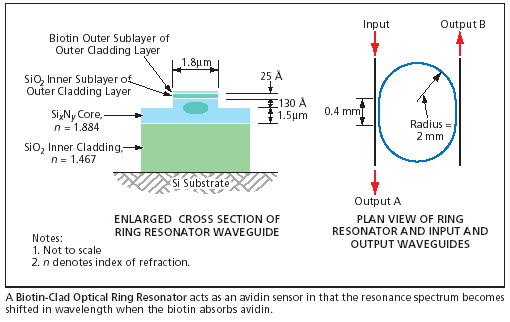
The figure depicts one of the prototype transducers, wherein the ring resonator is a dielectric optical waveguide laid out along a closed path resembling a racetrack. The waveguide includes a core of SixNy formed on an inner cladding layer of SiO2 on a substrate of Si. The outer cladding layer comprises an inner sublayer of SiO2 and an outer sublayer of biotin. (The SiO2 sublayer is needed for binding the biotin to the SixNy core.) The selectivity of the sensor depends on the use of biotin, which binds specifically to avidin, immobilizing avidin on the outer surface and thereby changing the index of refraction. The portion of the cross section occupied by the propagating electromagnetic mode is confined laterally by the rib portion of the core and is shown in the figure as an oval. In addition to the ring resonator, there are straight input and output waveguides separated from the straight segments of the ring resonator by an evanescent-wave-coupling gap of 1.6 µm.
In operation, the transducer is mounted in a flow cell on a copper chuck. The temperature of the chuck (and, thus, of the transducer) is monitored by use of a thermistor and controlled by use of a thermoelectric cooler. A solution containing avidin is pumped through the flow cell. Through the straight input waveguide, the resonator is illuminated at a wavelength of 633 nm by a He-Ne laser. The length of the closed optical path of the resonator ring varies with the temperature, and the temperature is adjusted to keep the path length an integer multiple of a wavelength: that is, the temperature is adjusted to maintain operation at one of the resonances. As the biotin coating absorbs avidin, the resulting change in the index of refraction manifests itself as a change in the resonance wavelength and, hence, in the temperature needed to maintain the chosen resonance. Hence, further, the change in the controlled temperature can be taken as an indication of the amount of dissolved avidin to which the transducer has been exposed.
This work was done by Ying Lin and Alexander Ksendzov of Caltech for NASA’s Jet Propulsion Laboratory. For further information, access the Technical Support Package (TSP) free on-line at www.techbriefs.com/tsp under the Physical Sciences category.
In accordance with Public Law 96-517, the contractor has elected to retain title to this invention. Inquiries concerning rights for its commercial use should be addressed to:
Innovative Technology Assets Management
JPL
Mail Stop
202-233 4800
Oak Grove Drive Pasadena, CA 91109-8099
(818) 354-2240 E-mail: This email address is being protected from spambots. You need JavaScript enabled to view it.
Refer to NPO-41585, volume and number of this NASA Tech Briefs issue, and the page number.
This Brief includes a Technical Support Package (TSP).
Protein Sensors Based on Optical Ring Resonators
(reference NPO-41585) is currently available for download from the TSP library.
Don't have an account?
Overview
The document presents a Technical Support Package from NASA's Jet Propulsion Laboratory, detailing the development and testing of an integrated optics ring-resonator biosensor designed for protein detection. The primary focus is on the sensor's ability to detect avidin, a protein, at remarkably low concentrations, achieving a detection limit of 93 pM (6.1 ng/ml). This performance is comparable to the best results reported in other protein detection techniques.
The biosensor operates using SiON/SiO2 waveguides, which leverage evanescent field interactions to change the effective refractive index when target molecules, such as avidin, are immobilized on the sensor's surface. The sensor's selectivity is enhanced by a biotin coating, which facilitates specific binding and immobilization of avidin.
The document includes experimental results demonstrating the sensor's response to varying concentrations of avidin solutions (3 nM, 0.3 nM, and 0.6 nM) in a buffer. The experiments involved alternating flows of pure buffer and avidin solutions through a flow cell at a controlled rate of 0.5 ml/min. The data showed that the sensor's signal during avidin flow could be modeled by a saturating exponential curve, with linear approximations being valid at low surface coverage. The time constants for saturation were significantly longer for lower concentrations of avidin, indicating the sensor's sensitivity.
Additionally, the document discusses the challenges faced during measurements, such as signal variations due to fiber-to-waveguide misalignment caused by thermal cycling. The authors implemented a solution by widening the scanning range to ensure that at least one full resonance was always included, allowing for effective tracking of resonance shifts.
Overall, the integrated optics ring-resonator biosensor represents a significant advancement in biosensing technology, with potential applications in various fields, including biomedical research and diagnostics. The document emphasizes the importance of these developments in enhancing the capabilities of protein detection, paving the way for future innovations in sensor technology. Further information and support are available through NASA's Scientific and Technical Information Program Office.