

A multichannel dielectric-resonator oscillator (DRO), built as a prototype of a local oscillator for an X-band transmitter or receiver, is capable of being electrically tuned among and within 26 adjacent frequency channels, each 1.16 MHz wide, in a band ranging from ≈7,040 to ≈7,070 GHz. The tunability of this oscillator is what sets it apart from other DROs, making it possible to use mass-produced oscillator units of identical design in diverse X-band applications in which there are requirements to use different fixed frequencies or to switch among frequency channels.
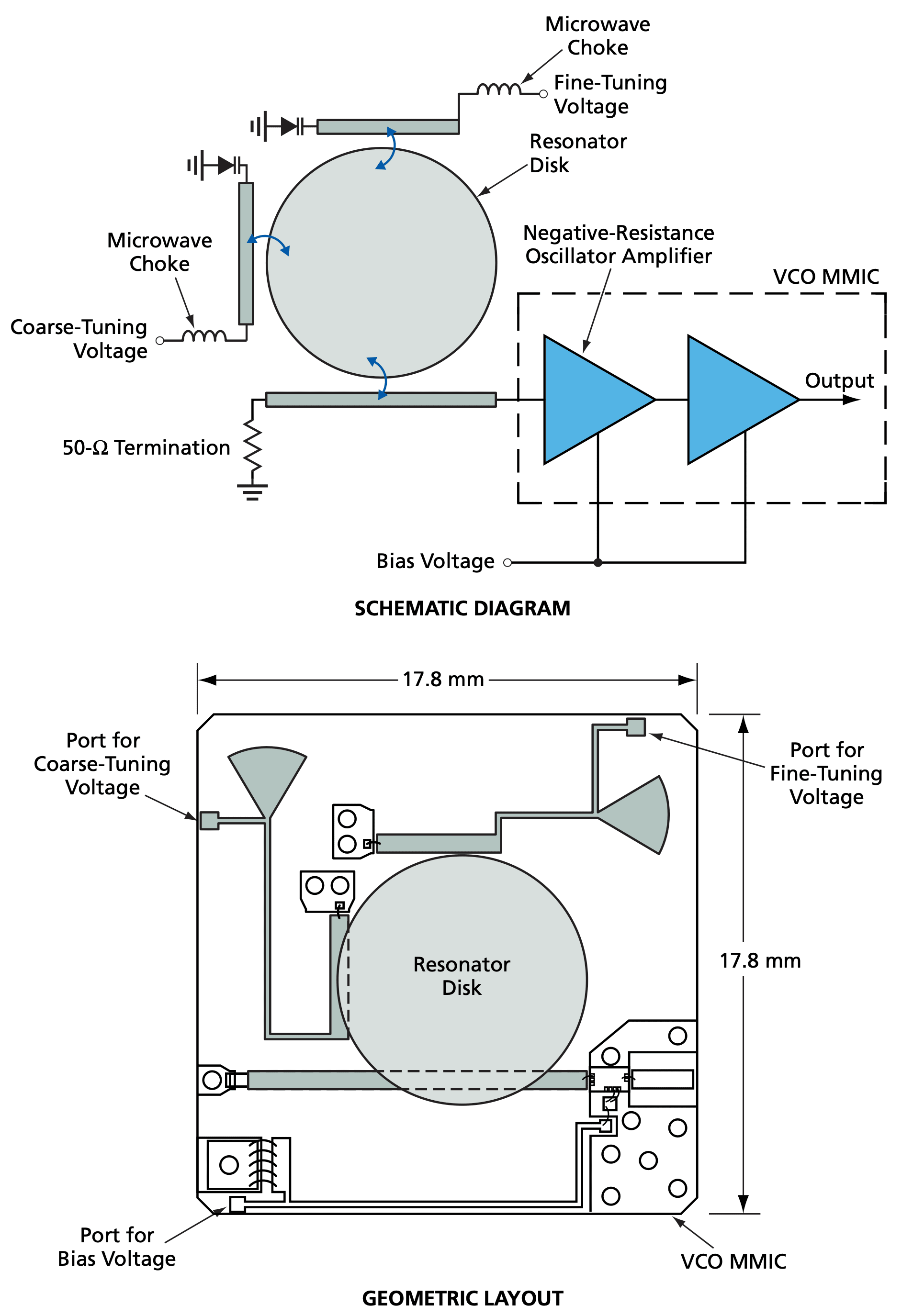
The oscillator (see figure) includes a custom-designed voltage-controlled-oscillator (VCO) monolithic microwave integrated circuit (MMIC), a dielectric resonator disk ("puck"), and two varactor coupling circuits, all laid out on a 25-mil (0.635-mm)-thick alumina substrate having a length and width of 17.8 mm. The resonator disk has a diameter of 8.89 mm and a thickness of 4.01 mm. The oscillator is mounted in an 8.9-mm-deep cavity in a metal housing.
The VCO MMIC incorporates a negative- resistance oscillator amplifier along with a buffer amplifier. The resonator disk is coupled to a microstrip transmission line connected to the negative-resistance port of the VCO MMIC. The two varactor coupling circuits include microstrip lines, laid out orthogonally to each other, for coupling with the resonator disk. Each varactor microstrip line is DC-coupled to an external port via a microwave choke. One varactor is used for coarse tuning to select a channel; the other varactor is used (1) for fine tuning across the 1.16-MHz width of each channel and (2) as a feedback port for a phase-lock loop. The resonator disk is positioned to obtain (1) the most desirable bandwidth, (2) relatively tight coupling with the microstrip connected to the coarse-tuning varactor, and (3) relatively loose coupling with the microstrip connected to the fine-tuning varactor.
Measurements of performance showed that the oscillator can be switched among any of the 26 channels and can be phase-locked to a nominal frequency in any channel. The degree of nonlinearity of tuning was found not to exceed 2.5 percent. The tuning sensitivity was found to be 6.15 MHz/V at a bias offset of –2 V on the phase-lock-loop varactor. The phase noise of the oscillator in free-running operation was found to be –107 dBc/Hz (where "dBc" signifies decibels relative to the carrier signal) at 100 kHz away from the carrier frequency.
This work was done by Narayan Mysoor, Matthew Dennis, and Brian Cook of Caltech for NASA's Jet Propulsion Laboratory. For further information, access the Technical Support Package (TSP) free on-line at www.techbriefs.com/tsp under the Semiconductors & ICs category. NPO-41275
This Brief includes a Technical Support Package (TSP).
Multichannel X-Band Dielectric-Resonator Oscillator
(reference NPO-41275) is currently available for download from the TSP library.
Don't have an account?
Overview
The document is a Technical Support Package from NASA's Jet Propulsion Laboratory (JPL) detailing the development of a Multi-channel X-Band Dielectric Resonator Oscillator (DRO) for space communication applications. The DRO is a critical component in spacecraft telecommunications, designed to enhance communication capabilities in space missions.
The document includes several figures that illustrate the design and layout of the multi-channel DRO. Figure 1 presents a schematic of the oscillator, highlighting key components such as the RFET buffer amplifier, tuning voltages (Vtune for fine and coarse adjustments), and output power (Pout) with a 50Ω termination. Figures 2 and 3 provide a circuit layout and a photograph of the multi-channel DRO, respectively, showcasing its physical design and construction on alumina substrate.
The DRO technology is particularly significant for its application in X-band communication, which is essential for transmitting data between spacecraft and ground stations. The document emphasizes the DRO's potential to improve the reliability and efficiency of space communication systems, making it a valuable innovation for future space missions.
The Technical Support Package is part of NASA's Commercial Technology Program, aimed at disseminating aerospace-related developments that have broader technological, scientific, or commercial implications. It encourages collaboration and partnerships through the NASA Innovative Partnerships Program, providing avenues for further assistance and information.
Additionally, the document includes a notice regarding the proprietary nature of the information and the importance of complying with U.S. export regulations. It also provides contact information for the NASA Scientific and Technical Information (STI) Program Office, where further research and technology information can be accessed.
Overall, this document serves as a comprehensive overview of the Multi-channel X-Band Dielectric Resonator Oscillator, highlighting its design, functionality, and significance in advancing space communication technologies. It reflects NASA's commitment to innovation and the development of technologies that can benefit both space exploration and commercial applications.











