

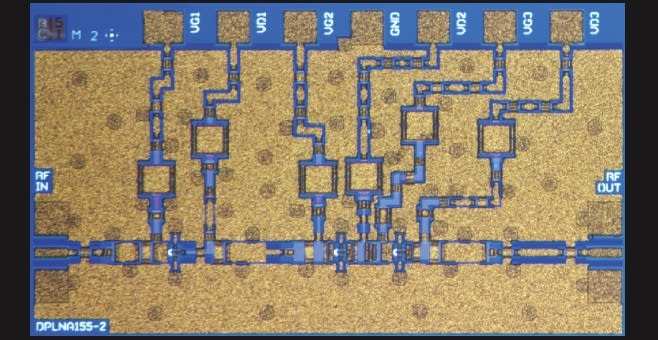

This work was done by David Pukala, Lorene Samoska, and Alejandro Peralta of Caltech and Brian Bayuk, Ron Grundbacher, Patricia Oliver, Abdullah Cavus, and Po-Hsin Liu of Northrop Grumman Corporation for NASA’s Jet Propulsion Laboratory. NPO-42783
This Brief includes a Technical Support Package (TSP).
Low-Noise MMIC Amplifiers for 120 to 180 GHz
(reference NPO-42783) is currently available for download from the TSP library.
Don't have an account?
Overview
The document is a Technical Support Package from NASA's Jet Propulsion Laboratory (JPL) concerning Low-Noise MMIC (Monolithic Microwave Integrated Circuit) Amplifiers designed for operation in the frequency range of 120 to 180 GHz. It is identified by the NASA Tech Briefs number NPO-42783 and is part of the Commercial Technology Program aimed at disseminating aerospace-related technological advancements with broader applications.
The document outlines the development and performance characteristics of these low-noise amplifiers, which are critical components in various high-frequency applications, including telecommunications, radar systems, and space exploration. The amplifiers are fabricated using advanced InP (Indium Phosphide) technology, specifically utilizing 70 nm HEMT (High Electron Mobility Transistor) devices, which are known for their superior performance at microwave frequencies.
Key features of the amplifiers include their low noise figure, which is essential for maintaining signal integrity in high-frequency applications. The document also discusses the measurement and simulation data associated with these devices, indicating that the data is categorized into three types: ADS (Advanced Design System) simulations, measured in-module data, and on-wafer measurements. This comprehensive approach ensures that the performance of the amplifiers is thoroughly validated through both theoretical and practical means.
The document emphasizes the importance of these amplifiers in enhancing the capabilities of various systems, particularly in aerospace and defense sectors. It also provides contact information for further inquiries, directing interested parties to the Innovative Technology Assets Management office at JPL for additional resources and support.
Overall, this Technical Support Package serves as a valuable resource for understanding the advancements in low-noise amplifier technology, showcasing NASA's commitment to innovation and collaboration in the field of aerospace technology. It highlights the potential applications of these amplifiers and encourages further exploration and utilization of the research findings presented.











