

A waveguide power-amplifier module capable of operating over the frequency range from 80 to 150 GHz has been constructed. The module comprises a previously reported power amplifier packaged in a waveguide housing that is compatible with WR-8 waveguides. (WR-8 is a standard waveguide size for the nominal frequency range from 90 to 140 GHz.) Because the amplifier in its unpackaged form was a single, fragile InP chip, it was necessary to use special probes to make electrical connections between the amplifier and test equipment in order to measure the power gain and other aspects of amplifier performance. In contrast, the waveguide poweramplifier module is robust and can be bolted to test equipment and to other electronic circuits with which the amplifier must be connected for normal operation. The amplifier in its unpackaged form was reported in "Power Amplifier With 9 to 13 dB of Gain from 65 to 146 GHz" (NPO-20880), NASA Tech Briefs, Vol. 25, No. 1 (January 2001), page 44.
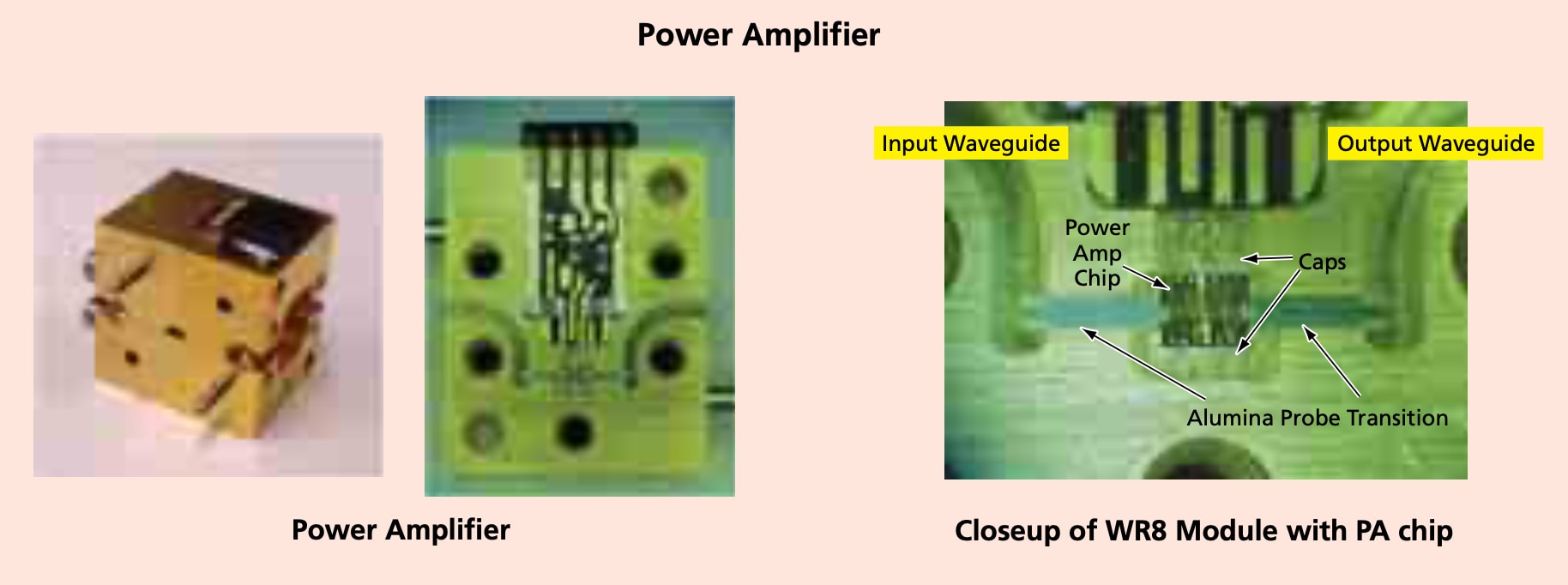
To recapitulate: the amplifier provides three stages of amplification, implemented by means of four InP high-electron- mobility transistors in a grounded coplanar waveguide circuit with lumped-element interstage and shunt capacitors. The circuit also features a unique coplanar waveguide powercombining structure in the output stage. The output radio-frequency power was measured to be 25 to 40 mW from 106 to 140 GHz. The figure shows selected aspects of the amplifier in its present packaged form. In addition to packaging in a waveguide housing, the amplifier was modified to suppress lowfrequency oscillations, to which the amplifier was previously susceptible because it had high gain at DC. The modifications consisted mostly of special placement of bypass capacitors and radio-frequency chokes within the package. The packaged amplifier was found to operate stably, and to produce a gain of at least 7 dB while producing output power of at least 10 mW at frequencies from 80 to 150 GHz.
This work was done by Lorene Samoska, Sander Weinreb, and Alejandro Peralta of Caltech for NASA's Jet Propulsion Laboratory. For further information, access the Technical Support Package (TSP) free online at www.techbriefs.com/tsp under the Semiconductors & ICs category. NPO-30576
This Brief includes a Technical Support Package (TSP).
Waveguide Power-Amplifier Module for 80 to 150 GHz
(reference NPO-30576) is currently available for download from the TSP library.
Don't have an account?
Overview
The document is a Technical Support Package detailing NASA's Waveguide Power-Amplifier Module designed for operation within the frequency range of 80 to 150 GHz. It is part of the NASA Tech Briefs, specifically referenced as NPO-30576, and aims to disseminate information about aerospace-related technological advancements that may have broader scientific, commercial, or technological applications.
The Waveguide Power Amplifier Module is compatible with WR8 waveguides and is engineered to deliver significant performance in high-frequency applications. Key specifications include an output power (Pout) of approximately 20 mW at frequencies of 83, 94, and 100 GHz, with a nominal large signal gain of 6 dB for the chip and around 4-5 dB for the module itself. The design allows for cascading multiple modules to achieve higher gain and facilitates easy power combination within the waveguide structure.
The document includes measured S-parameters and RF power data from the waveguide amplifier module, showcasing its performance across the specified frequency range. The graphical data illustrates the relationship between input power (Pin) and output power (Pout) across various frequencies, providing insights into the amplifier's efficiency and operational capabilities.
Additionally, the document features a close-up view of the WR8 module, highlighting its components, including the alumina probe transition, input and output waveguides, and the power amplifier chip. This visual representation aids in understanding the module's construction and functionality.
The Technical Support Package emphasizes compliance with U.S. export regulations and notes that the information may contain proprietary data from Caltech/JPL. It also provides contact information for the NASA Scientific and Technical Information (STI) Program Office, encouraging further inquiries into research and technology in this field.
Overall, the document serves as a comprehensive resource for understanding the capabilities and applications of the Waveguide Power-Amplifier Module, reflecting NASA's commitment to advancing technology for aerospace and beyond.











