

The first solid-state amplifier capable of producing gain at a frequency >215 GHz has been demonstrated. This amplifier is an intermediate product of a continuing effort to develop amplifiers having the frequency and gain characteristics needed for a forthcoming generation of remote-sensing instruments for detecting water vapor and possibly other atmospheric constituents. There are also other potential uses for such amplifiers in wide-band communications, automotive radar, and millimeter- wave imaging for inspecting contents of opaque containers.
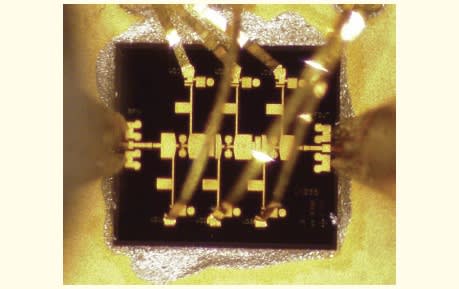
This amplifier was fabricated as a monolithic microwave integrated- circuit (MMIC) chip containing InP high-electron-mobility transistors (HEMTs) of 0.07-μm gate length on a 50-μm-thick InP substrate. The passive components on the chip are of the microstrip type and were designed by use of advanced electromagnetic- behavior-simulating software. The amplifier contains three stages of HEMTs with matching networks that comprise microstrip transmission lines and metal/insulator/metal capacitors. Bias is supplied via transmission-line networks with bypass capacitors on the gate and drain sides of the HEMTs.
The performance of the amplifier was measured by use of the instrumentation system described in "Equipment for On-Wafer Testing From 220 to 325 GHz" (NPO-40955), NASA Tech Briefs, Vol. 30, No. 1 (January 2006), page 38. This instrumentation system, equivalent to a two-port vector network analyzer, was equipped with custom wafer probes (see figure) designed for the noted frequency band, which is that of WR-3 waveguides [waveguides having a standard rectangular cross section of 0.0340 by 0.0170 in. (0.8636 by 0.4318 mm)]. Among other things, the measurements showed a peak gain of 10 dB at a frequency of 235 GHz.
This work was done by Douglas Dawson, King Man Fung, Karen Lee, Lorene Samoska, Mary Wells, Todd Gaier, and Pekka Kangaslahti of Caltech; and Ronald Grundbacher, Richard Lai, Rohit Raja, and Po-Hsin Liu of NGST for NASA's Jet Propulsion Laboratory. For more information, download the Technical Support Package (free white paper) at www.techbriefs.com/tsp under the Semiconductors & ICs category. NPO-42202
This Brief includes a Technical Support Package (TSP).
MMIC Amplifier Produces Gain of 10 dB At 235 GHz
(reference NPO-42202) is currently available for download from the TSP library.
Don't have an account?
Overview
The document outlines a significant technological advancement developed by NASA's Jet Propulsion Laboratory (JPL), specifically focusing on a World Record MMIC (Monolithic Microwave Integrated Circuit) amplifier that produces a gain of 10 dB at a frequency of 235 GHz. This innovation is cataloged under NTR Number 42202 and is featured in NASA Tech Briefs, which disseminates information about aerospace-related developments with potential wider technological, scientific, or commercial applications.
The MMIC amplifier represents a notable achievement in microwave technology, which is crucial for various applications, including telecommunications, radar systems, and space exploration. The ability to achieve a gain of 10 dB at such a high frequency is particularly impressive, as it enhances the performance and efficiency of electronic systems that operate in the microwave spectrum.
The document serves as a Technical Support Package, providing essential information about the MMIC amplifier and its implications for future technological advancements. It emphasizes NASA's commitment to sharing innovative technologies through its Commercial Technology Program, which aims to make aerospace-related developments accessible for broader use beyond governmental applications.
For those interested in further details or potential collaborations, the document provides contact information for the Innovative Technology Assets Management office at JPL, including a mailing address, telephone number, and email. This facilitates inquiries regarding research and technology in the field of microwave amplification and related areas.
Additionally, the document includes a notice regarding the proprietary nature of the information and the importance of complying with U.S. export regulations. It clarifies that the United States Government does not assume liability for the use of the information contained within the document, nor does it endorse any specific trade names or manufacturers mentioned.
In summary, this document highlights a cutting-edge MMIC amplifier developed by NASA, showcasing its potential impact on various technological fields while also providing avenues for further exploration and collaboration in the realm of advanced microwave technologies.











