

The concept of the active state model (ASM) is an architecture for the development of advanced integrated fault-detection- and-isolation (FDI) systems for robotic land vehicles, pilotless aircraft, exploratory spacecraft, or other complex engineering systems that will be capable of autonomous operation. An FDI system based on the ASM concept would not only provide traditional diagnostic capabilities, but also integrate the FDI system under a unified framework and provide mechanism for sharing of information between FDI subsystems to fully assess the overall "health" of the system.
The ASM concept begins with definitions borrowed from psychology, wherein a system is regarded as active when it possesses self-image, self-awareness, and an ability to make decisions itself, such that it is able to perform purposeful motions and other transitions with some degree of autonomy from the environment. For an engineering system, self-image would manifest itself as the ability to determine nominal values of sensor data by use of a mathematical model of itself, and self-awareness would manifest itself as the ability to relate sensor data to their nominal values. The ASM for such a system may start with the closed-loop control dynamics that describe the evolution of state variables. As soon as this model was supplemented with nominal values of sensor data, it would possess self-image. The ability to process the current sensor data and compare them with the nominal values would represent self-awareness. On the basis of self-image and self-awareness, the ASM provides the capability for self-identification, detection of abnormalities, and self-diagnosis.
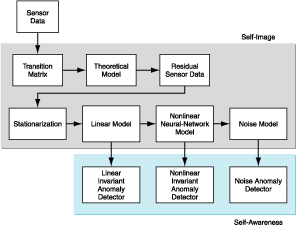
Another essential component of the ASM is the active system exchange (ASE), which includes a flexible database that stores all relevant FDI and other information to synthesize data and data-driven models sufficient for intelligent decision-making. The ASE would provide crucial information from all FDI subsystems and would allow an intelligent agent such as planning software to make decisions based on summarized understanding of the system health. When the full ASM architecture is implemented, it will provide a framework for a fully autonomous system that would be able to monitor and predict equipment failures, reconfigure the control subsystem of the system in response to an equipment failure, take appropriate action in response to unexpected events, and replan the mission of the system, as needed, in real time.
This work was done by Han Park, Steve Chien, Michail Zak, Mark James, Ryan Mackey, and Forest Fisher of Caltech for NASA's Jet Propulsion Laboratory. For further information, access the Technical Support Package (TSP) free on-line at www.techbriefs.com/tsp under the Information Sciences category. NPO-21243.
This Brief includes a Technical Support Package (TSP).
Active State Model for Autonomous Systems
(reference NPO-21243) is currently available for download from the TSP library.
Don't have an account?
Overview
The document discusses the Active State Model (ASM) for Autonomous Systems, developed by NASA’s Jet Propulsion Laboratory. The ASM is an advanced architecture aimed at enhancing the capabilities of autonomous systems, such as robotic land vehicles, pilotless aircraft, and exploratory spacecraft. It focuses on integrating fault-detection-and-isolation (FDI) systems to enable these systems to diagnose their own conditions and respond autonomously to various situations.
The ASM is built on concepts borrowed from psychology, where an "active" system is characterized by self-image, self-awareness, and decision-making capabilities. In engineering terms, self-image refers to the system's ability to determine nominal values of sensor data using a mathematical model of itself, while self-awareness involves comparing current sensor data to these nominal values. This dual capability allows the ASM to perform self-identification, detect abnormalities, and conduct self-diagnosis.
A key feature of the ASM is the "gray-box" approach, which combines deterministic and stochastic models. This method maximizes the use of available sensory information and mathematical models, allowing the system to filter known information and focus on residual, unknown components. By monitoring the residual against nominal values, the system can effectively assess its health and functionality.
Another essential component of the ASM is the Active System Exchange (ASE), a flexible database that stores relevant FDI information. The ASE synthesizes data and data-driven models to facilitate intelligent decision-making. It provides crucial insights from all FDI subsystems, enabling planning software to make informed decisions based on a comprehensive understanding of the system's health.
When fully implemented, the ASM architecture will empower autonomous systems to monitor and predict equipment failures, reconfigure control subsystems in response to failures, take appropriate actions during unexpected events, and replan missions in real-time. This capability represents a significant advancement in the field of autonomous systems, allowing for greater autonomy and reliability in complex engineering applications.
The work on the ASM was conducted by a team from Caltech for NASA’s Jet Propulsion Laboratory, highlighting the collaborative effort in advancing autonomous technology. Overall, the ASM aims to create a framework for fully autonomous systems capable of sophisticated self-management and operational resilience.











