

Autonomous environment-monitoring networks (AEMNs) are artificial neural networks that are specialized for recognizing familiarity and, conversely, novelty. Like a biological neural network, an AEMN receives a constant stream of inputs. For purposes of computational implementation, the inputs are vector representations of the information of interest. As long as the most recent input vector is similar to the previous input vectors, no action is taken. Action is taken only when a novel vector is encountered. Whether a given input vector is regarded as novel depends on the previous vectors; hence, the same input vector could be regarded as familiar or novel, depending on the context of previous input vectors. AEMNs have been proposed as means to enable exploratory robots on remote planets to recognize novel features that could merit closer scientific attention. AEMNs could also be useful for processing data from medical instrumentation for automated monitoring or diagnosis.
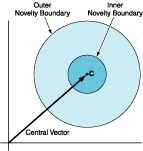
The construction of a spindle involves four vital parameters: setup size, spindle-population size, and the radii of two novelty boundaries. The setup size is the number of vectors that are taken into account before computing C. The spindle-population size is the total number of input vectors used in constructing the spindle — counting both those that arrive before and those that arrive after the computation of C. The novelty-boundary radii are distances from C that partition the neighborhood around C into three concentric regions (see Figure 1). During construction of the spindle, the changing spindle radius is denoted by h. It is the final value of h, reached before beginning construction on the next spindle, that is denoted by r.

An AEMN comprises a collection of spindles that represent a typical history or range of behaviors of a system that one seeks to monitor. An AEMN can be represented as a familiarity map, on which successive spindles are represented by adjacent circles that are added as construction proceeds. A familiarity map could be simple or complex, depending on the monitored system. For example, the range of behaviors of a complex system might be represented by a networklike familiarity map that could even include dead-end branches that lead to the demise of the system. An automated monitoring system based on the AEMN corresponding to the familiarity map could recognize that the system was progressing along a dead-end branch and respond by generating an alarm or triggering control action to move the system away from the dead-end condition.
This work was done by Charles Hand of Caltech for NASA's Jet Propulsion Laboratory.
This software is available for commercial licensing. Please contact Don Hart of the California Institute of Technology at (818) 393-3425. Refer to NPO-30408.
This Brief includes a Technical Support Package (TSP).
Autonomous Environment-Monitoring Networks
(reference NPO30408) is currently available for download from the TSP library.
Don't have an account?
Overview
The document discusses Autonomous Environment Monitoring Networks (AEMNs), a concept developed by Charles Hand at the Jet Propulsion Laboratory (JPL), California Institute of Technology. AEMNs are designed to process continuous streams of input data, identifying and responding to novel features while ignoring familiar ones. This capability is particularly useful for exploratory robots on other planets, where detecting signs of life or environmental changes is crucial.
The AEMNs operate by recognizing patterns in data vectors. When a new, unfamiliar vector is encountered, the network triggers an action, which is essential for exploration and monitoring tasks. The document emphasizes the importance of novelty detection in various applications, including space exploration and medical monitoring. For instance, in a medical context, AEMNs could monitor blood parameters, identifying deviations from normal ranges that may indicate health issues.
The document contrasts Artificial Neural Networks (ANNs) with Biological Neural Networks (BNNs). While ANNs rely on predefined training and testing datasets, BNNs learn continuously from experiences throughout an organism's life. This distinction highlights the adaptive nature of biological systems, which can respond to novel stimuli based on a lifetime of experiences.
In the context of medical applications, the document describes how the human body constantly monitors blood solutes, maintaining homeostasis through feedback mechanisms. AEMNs could automate the construction of a "blood map" by tracking changes in blood parameters over time, allowing for early detection of potential health problems.
The document also touches on the broader implications of AEMNs beyond robotics and medicine, suggesting their potential use in closed environments like experimental planetary habitats. The ability to monitor and respond to environmental changes autonomously could enhance the safety and effectiveness of long-term space missions.
Overall, the document presents AEMNs as a promising technology with diverse applications, emphasizing their role in advancing our understanding of both extraterrestrial environments and human health. The research was conducted under the auspices of NASA, highlighting the agency's commitment to exploring innovative technologies for future missions.











