

Inside this issue
Supplements

Overview
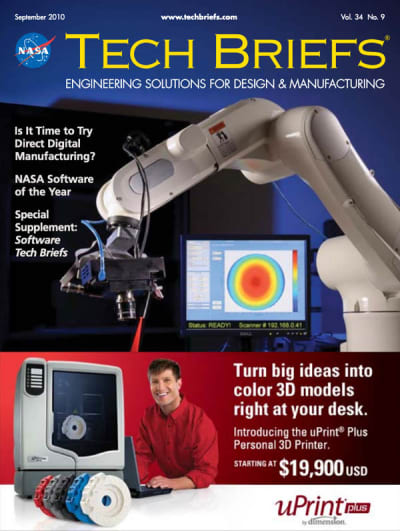
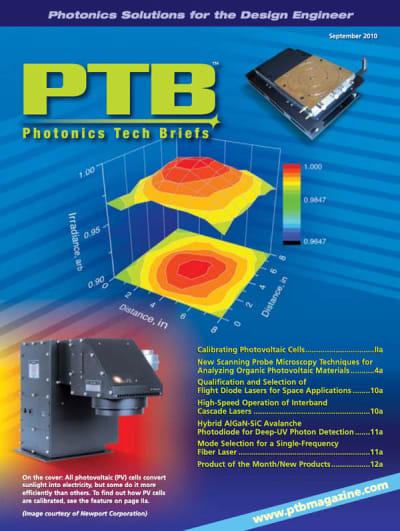
The September 2010 edition of NASA Tech Briefs, Imaging Technology, and Photonics Tech Briefs presents a comprehensive overview of advancements in technology, particularly focusing on imaging systems, photonics, and manufacturing processes. This issue is designed to inform readers about the latest innovations and applications in these fields, showcasing how they impact various industries, including aerospace, defense, and manufacturing.
Key Highlights:
-
Direct Digital Manufacturing: One of the central themes of this issue is the exploration of direct digital manufacturing (DDM). This innovative approach allows for the creation of complex parts directly from digital models, significantly reducing the time and cost associated with traditional manufacturing methods. The article discusses the potential of DDM to revolutionize production processes, enabling rapid prototyping and customization of components, which is particularly beneficial in aerospace applications where precision and efficiency are paramount.
-
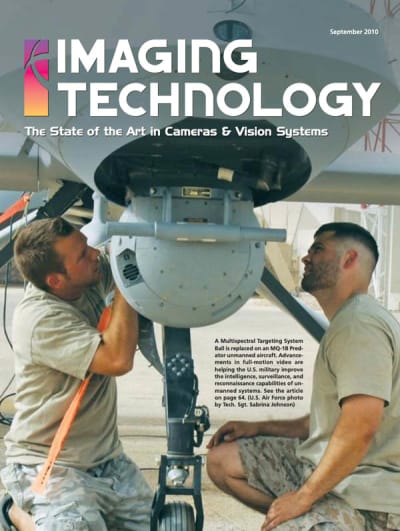
State of the Art in Cameras and Vision Systems: The magazine features an in-depth analysis of the latest developments in camera technology and vision systems. This section highlights advancements in multispectral imaging, which allows for the capture of data across multiple wavelengths, enhancing the ability to analyze materials and environments. The article discusses applications in various fields, including agriculture, environmental monitoring, and military operations, where enhanced imaging capabilities can lead to better decision-making and operational effectiveness.
-
Multispectral Targeting System: A notable case study presented in this issue is the multispectral targeting system used on the MQ-1B Predator unmanned aircraft. This system enhances the aircraft's surveillance and reconnaissance capabilities by providing detailed imagery across different spectral bands. The article outlines how this technology improves target identification and tracking, contributing to mission success in complex operational environments.
Calibration of Photovoltaic Cells: Another significant topic covered is the calibration of photovoltaic cells, which are crucial for solar energy applications. The magazine discusses new methodologies for accurately measuring the performance of solar panels, ensuring that they operate at optimal efficiency. This is particularly relevant as the demand for renewable energy sources continues to grow, and accurate calibration is essential for maximizing energy output and reliability.
-
Innovations in Imaging Technology: The issue also delves into various innovations in imaging technology, including advancements in sensor design, image processing algorithms, and data analysis techniques. These developments are critical for enhancing the performance of imaging systems in both commercial and military applications. The articles emphasize the importance of integrating cutting-edge technology to improve image quality, reduce noise, and increase the speed of image acquisition and processing.
-
Photonics Applications: The photonics section of the magazine explores the latest applications of light-based technologies in communication, sensing, and manufacturing. It highlights how photonics is transforming industries by enabling faster data transmission, more precise measurements, and innovative manufacturing techniques. The articles provide insights into the future of photonics and its potential to drive technological advancements across various sectors.
-
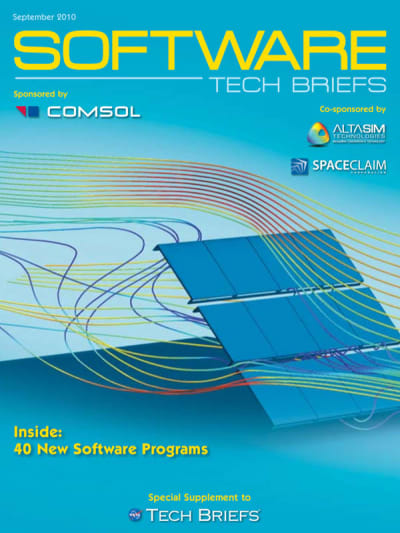
Software Innovations: The special supplement on software tech briefs discusses the role of software in enhancing the functionality and efficiency of imaging and manufacturing systems. It covers topics such as software for data analysis, simulation tools for design optimization, and user-friendly interfaces that improve accessibility for engineers and technicians. The integration of advanced software solutions is shown to be vital for maximizing the capabilities of hardware systems.
Conclusion:
The September 2010 edition of NASA Tech Briefs, Imaging Technology, and Photonics Tech Briefs serves as a valuable resource for professionals and enthusiasts in the fields of technology and engineering. By highlighting the latest advancements in direct digital manufacturing, imaging systems, and photonics, the magazine provides insights into how these technologies are shaping the future of various industries. The articles not only showcase innovative applications but also emphasize the importance of ongoing research and development in driving progress and improving operational efficiencies. As technology continues to evolve, the insights shared in this issue will be instrumental for those looking to stay at the forefront of technological advancements.
Features
-
Application Briefs
Robotic 3D Scanner Automatically Scans Spacecraft Heat Shields
Automated Data Acquisition and Analysis Test Station for NASA’s CEV
Tech Briefs
-
Physical Sciences
Instrument for Measuring Thermal Conductivity of Materials at Low Temperatures
Multi-Axis Accelerometer Calibration System
Pupil Alignment Measuring Technique and Alignment Reference for Instruments or Optical Systems
Autonomous System for Monitoring the Integrity of Composite Fan Housings
True Shear Parallel Plate Viscometer
Maglev Facility for Simulating Variable Gravity
Focusing Diffraction Grating Element With Aberration Control
-
Manufacturing & Prototyping
Producing Hydrogen by Plasma Pyrolysis of Methane
-
Information Sciences
3D GeoWall Analysis System for Shuttle External Tank Foreign Object Debris Events
Charge-Spot Model for Electrostatic Forces in Simulation of Fine Particulates
-
Mechanics & Machinery
Miniature Piezoelectric Macro-Mass Balance
Acoustic Liner for Turbomachinery Applications
Water Tank With Capillary Air/Liquid Separation
Large-Flow-Area Flow-Selective Liquid/Gas Separator
-
Electronics & Computers
Advanced Flip Chips in Extreme Temperature Environments
Adaptation of the Camera Link Interface for Flight-Instrument Applications
High-Performance CCSDS AOS Protocol Implementation in FPGA
High-Performance CCSDS Encapsulation Service Implementation in FPGA
Products
-
Briefs
Qualification and Selection of Flight Diode Lasers for Space Applications
High-Speed Operation of Interband Cascade Lasers
Hybrid AlGaN-SiC Avalanche Photodiode for Deep-UV Photon Detection
-
Articles
-
Articles
Using the Intel® Architecture in High-Performance Military Embedded DSP Applications
Protecting COTS Military Electronics From Shock and Vibration
OpenVPX — From Concept to Specification
-
Briefs
Multiphysics Analysis of a Burning Candle
Capacitively Coupled Plasma Analysis
3D Direct Modeling Streamlines Micro-Cogeneration System Design and Analysis Processes
Microwaving Moondust with COMSOL
Observing System Simulation Experiment (OSSE) for the HyspIRI Spectrometer Mission
Probabilistic Design and Analysis Framework
Momentum Management Tool for Low-Thrust Missions
Mixed Real/Virtual Operator Interface for ATHLETE
Antenna Controller Replacement Software
Efficient Parallel Engineering Computing on Linux Workstations
FAILSAFE Health Management for Embedded Systems
Water Detection Based on Sky Reflections
Nonlinear Combustion Instability Prediction
Characterization of Cloud Water-Content Distribution
Autonomous Planning and Replanning for Mine-Sweeping Unmanned Underwater Vehicles
'In-Situ' Pointing Correction and Rover Microlocalization
Dayside Ionospheric Superfountain
Hybrid-PIC Computer Simulation of the Plasma and Erosion Processes in Hall Thrusters
BioNet Digital Communications Framework
Operation Program for the Spatially Phase-Shifted Digital Speckle Pattern Interferometer — SPS-DSPI
Intelligent Patching of Conceptual Geometry for CFD Analysis
Autonomous Exploration for Gathering Increased Science
Real-Time Feature Tracking Using Homography
Stereo Imaging Tactical Helper
Sparse Superpixel Unmixing for Hyperspectral Image Analysis
Systems Maintenance Automated Repair Tasks (SMART)
Centralized Alert-Processing and Asset Planning for Sensorwebs
Support for Systematic Code Reviews With the SCRUB Tool
Planning and Execution for an Autonomous Aerobot
Real-Time Exponential Curve Fits Using Discrete Calculus
Optimal Codes for the Burst Erasure Channel
Short-Block Protograph-Based LDPC Codes











