

An improved magnetic levitation apparatus (“Maglev Facility”) has been built for use in experiments in which there are requirements to impose variable gravity (including zero gravity) in order to assess the effects of gravity or the absence thereof on physical and physiological processes. The apparatus is expected to be especially useful for experiments on the effects of gravity on convection, boiling, and heat transfer in fluids and for experiments on mice to gain understanding of bone loss induced in human astronauts by prolonged exposure to reduced gravity in space flight.
The maglev principle employed by the apparatus is well established. The basic equation for equilibrium levitation of a diamagnetic object is
|χB∇zB/μ0| = ρg,
of diamagnetic molecules (e.g., water molecules) and thus can be levitated by use of sufficiently strong magnetic fields having sufficiently strong vertical gradients.
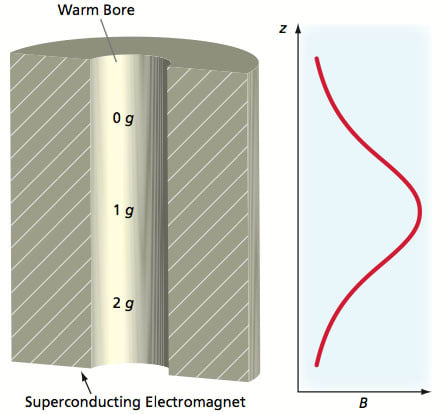
The heart of the present maglev apparatus is a vertically oriented superconducting solenoid electromagnet (see figure) that generates a static magnetic field of about 16 T with a vertical gradient sufficient for levitation of water in normal Earth gravity. The electromagnet is enclosed in a Dewar flask having a volume of 100 L that contains liquid helium to maintain superconductivity. The Dewar flask features a 66-mm-diameter warm bore, lying within the bore of the magnet, wherein experiments can be performed at room temperature. The warm bore is accessible from its top and bottom ends. The superconducting electromagnet is run in the persistent mode, in which the supercurrent and the magnetic field can be maintained for weeks with little decay, making this apparatus extremely cost and energy efficient to operate. In addition to water, this apparatus can levitate several common fluids: liquid hydrogen, liquid oxygen, methane, ammonia, sodium, and lithium, all of which are useful, variously, as rocket fuels or as working fluids for heat transfer devices. A drop of water 45 mm in diameter and a small laboratory mouse have been levitated in this apparatus.
This work was done by Yuanming Liu, Donald M. Strayer, and Ulf E. Israelsson of Caltech for NASA’s Jet Propulsion Laboratory. For more information, download the Technical Support Package (free white paper) at www.techbriefs.com/tsp under the Physical Sciences category. NPO-45886
This Brief includes a Technical Support Package (TSP).
Maglev Facility for Simulating Variable Gravity
(reference NPO-45886) is currently available for download from the TSP library.
Don't have an account?
Overview
The document outlines the Maglev Facility for Simulating Variable Gravity, designated as NPO 45886, developed at NASA's Jet Propulsion Laboratory (JPL). This facility is designed to conduct experiments that simulate various gravity environments, which are crucial for understanding the effects of different gravitational forces on physical and biological processes, particularly in space or on other planets.
One of the key features of the Maglev facility is its large warm bore of 66 mm, which allows for the levitation of water and other fluids, enabling a wide range of experiments at room temperature. The facility employs a superconducting magnet, which is energy-efficient and significantly reduces operational costs compared to traditional non-superconducting magnet systems. The superconducting magnet operates in a persistent mode, consuming only about 10 liters of liquid helium per day, contrasting sharply with the high power demands of other systems.
The facility can simulate gravity levels ranging from zero-g to 2g by adjusting the position of the sample within the magnet bore. It can also achieve hyper-g levels of up to 350g for specific fluids like liquid oxygen. This versatility allows researchers to study the behaviors of thermal fluid systems and biological systems under conditions that mimic those found in space.
Significantly, the Maglev facility has successfully levitated a live mouse for extended periods and created large levitated water droplets, with diameters reaching up to 45 mm, marking a notable achievement in ground-based laboratory experiments. The ability to levitate various fluids, including liquid hydrogen, methane, and ammonia, is essential for research related to rocket fuels and thermal management systems.
The document emphasizes the importance of understanding heat and mass transfer processes in microgravity, as these processes differ from those on Earth due to the absence of buoyancy-driven convection. This knowledge is vital for optimizing thermal control systems for space missions and addressing health risks, such as bone loss in astronauts during long-duration space flights.
Overall, the Maglev facility represents a significant advancement in the study of variable gravity effects, providing a platform for innovative research that can enhance our understanding of fluid dynamics and biological responses in extraterrestrial environments.











