

Mass balances usually use a strain gauge that requires an impedance measurement and is susceptible to noise and thermal drift. A piezoelectric balance can be used to measure mass directly by monitoring the voltage developed across the piezoelectric balance, which is linear with weight or it can be used in resonance to produce a frequency change proportional to the mass change (see figure). The piezoelectric actuator/balance is swept in frequency through its fundamental resonance. If a small mass is added to the balance, the resonance frequency shifts down in proportion to the mass. By monitoring the frequency shift, the mass can be determined.
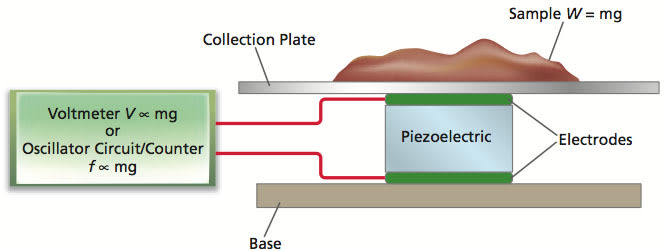
A piezoelectric actuator, or many piezoelectric actuators, was placed between the collection plate of the sampling system and the support structure. As the sample mass is added to the plate, the piezoelectrics are stressed, causing them to produce a voltage that is proportional to the mass and acceleration. In addition, a change in mass Δm produces a change in the resonance frequency with Δf proportional to Δm. In a microgravity environment, the spacecraft could be accelerated to produce a force on the piezoelectric actuator that would produce a voltage proportional to the mass and acceleration. Alternatively, the acceleration could be used to force the mass on the plate, and the inertial effects of the mass on the plate would produce a shift in the resonance frequency with the change in frequency related to the mass change.
Three prototypes of the mass balance mechanism were developed. These macro-mass balances each consist of a solid base and an APA 60 Cedrat flextensional piezoelectric actuator supporting a measuring plate. A similar structure with 3 APA 120 Cedrat flextensional piezoelectric actuators spaced equidistantly at 120° supporting the plate and a softer macro balance with an APA 150 actuator/sensor were developed. These flextensional actuators were chosen because they increase the sensitivity of the actuator to stress, allow the piezoelectric to be pre-stressed, and the piezoelectric element is a stacked multilayer actuator, which has a considerably lower input impedance than a monolithic element that allows for common instruments (e.g., input impedance of 10 megohms) to measure the voltage without rapidly discharging the charge/voltage on the piezoelectric actuator.
This work was done by Stewart Sherrit, Ashitey Trebi-Ollennu, Robert G. Bonitz, and Yoseph Bar-Cohen of Caltech for NASA’s Jet Propulsion Laboratory. For more information, download the Technical Support Package (free white paper) at www.techbriefs.com/tsp under the Mechanics/Machinery category. For more information, contact
This Brief includes a Technical Support Package (TSP).
Miniature Piezoelectric Macro-Mass Balance
(reference NPO-47161) is currently available for download from the TSP library.
Don't have an account?
Overview
The document discusses NASA's Miniature Piezoelectric Macro-Mass Balance, identified as NPO 47161, which is designed for measuring the mass of samples collected from celestial bodies during in-situ exploration and sample return missions. The need for such a device arises from the challenges of verifying sample mass in low or microgravity environments, such as those found on the moon or comets.
The proposed solution involves the use of piezoelectric actuators placed between a collection plate and a support structure. As mass is added to the plate, the piezoelectric material is stressed, generating a voltage proportional to the mass and acceleration. This mechanism allows for two independent methods of mass measurement: one based on voltage changes and the other on shifts in resonance frequency. In microgravity, spacecraft thrusters can be utilized to create acceleration, enabling the measurement of mass through these techniques.
Three prototypes of the mass balance mechanism have been developed, featuring different configurations of piezoelectric actuators. These include a solid base with a single APA 60 Cedrat flextensional actuator, a design with three APA 120 actuators spaced equidistantly, and a softer macro balance using an APA 150 actuator. The choice of flextensional actuators enhances sensitivity to stress and allows for pre-stressing of the piezoelectric elements, which are designed to have lower input impedance for effective voltage measurement.
The novelty of this invention lies in its solid-state design, which offers advantages over traditional strain gauge mass balances that are prone to noise and thermal drift. The piezoelectric balance can directly measure mass by monitoring voltage or frequency changes, providing a reliable and efficient method for mass determination in space. Additionally, the system is lightweight, low power, and can assist in the movement of samples in and out of the measuring chamber.
Overall, the Miniature Piezoelectric Macro-Mass Balance represents a significant advancement in space technology, enabling precise mass measurements of unconsolidated materials in challenging environments. This innovation is expected to play a crucial role in future space missions, enhancing our ability to study and understand extraterrestrial materials.











