The figure is a simplified depiction of a proposed spectrometer optical unit that would be suitable for incorporation into a remote-sensing instrumentation system. Relative to prior spectrometer optical assemblies, this unit would be compact and simple, largely by virtue of its predominantly two-dimensional character.
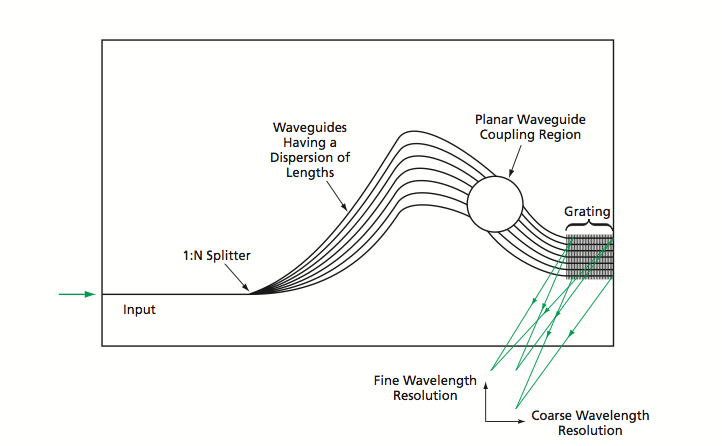
The proposed unit would be a combination of two optical components. One component would be an arrayed-wave-guide grating (AWG) — an integrated-optics device, developed for use in wavelength multiplexing in telecommunications. The other component would be a diffraction grating superimposed on part of the AWG.
The function of an AWG is conceptually simple. Input light propagates along a single-mode optical waveguide to a point where it is split to propagate along some number (N) of side-by-side waveguides. The lengths of the optical paths along these waveguides differ such that, considering the paths in a sequence proceeding across the array of waveguides, the path length increases linearly. These waveguides launch quasi-free-space waves into a planar waveguide-coupling region. The waves propagate through this region to interfere onto an array of output waveguides. Through proper choice of key design parameters (waveguide lengths, size and shape of the waveguide coupling region, and lateral distances between waveguides), one can cause the input light to be channeled into wavelength bins nominally corresponding to the output waveguides.
Notwithstanding the conceptual simplicity as described thus far, the function is complicated by the fact that the response of each output waveguide is characterized by a spectral periodicity with multiple frequency components spaced at multiples of the free spectral range appearing in each frequency bin. Hence, in the absence of a corrective measure, each output waveguide would carry multiple wavelength components, resulting in an ambiguous output.
In the proposed device, the degeneracy would be broken by means of the diffraction grating, which would be litho-graphically formed on the surface in the output waveguide region. The grating lines would cross the output waveguides, establishing orthogonal coordinate axes. One axis would represent coarse spectral resolution; the other, fine spectral resolution. The net result of superimposing the grating on the output waveguides would be to divert some of the light from wave-guide modes to free-space-propagating modes. Because the output diffraction angle of each mode would depend on its wavelength, the output waves propagating in free space would be sorted with coarse spectral resolution along one coordinate axis and fine spectral resolution along the other axis. The proposed unit could be designed, in conjunction with a planar photodetector array, to obtain an optimal match between the array pixel pattern and the wavelength-dispersion pattern.
This work was done by John Hong of Caltech for NASA’s Jet Propulsion Laboratory. NPO-42431
This Brief includes a Technical Support Package (TSP).
Compact Two-Dimensional Spectrometer Optics
(reference NPO-42431) is currently available for download from the TSP library.
Don't have an account?
Overview
The document discusses a compact two-dimensional (2D) spectrometer that leverages advancements in integrated optical technology, specifically the arrayed waveguide grating (AWG), which was initially developed for telecommunications applications. The AWG is designed to facilitate wavelength division multiplexing, allowing multiple wavelengths of light to be transmitted simultaneously through a single optical fiber.
In the proposed spectrometer, a lightwave input from a single-mode waveguide is divided into multiple parallel waveguide paths. These paths are engineered with varying lengths to create interference patterns that channel the input light into distinct frequency bins across an output array. However, without additional components, each output waveguide would respond to multiple wavelength components, leading to ambiguity in the output.
To address this issue, the spectrometer incorporates an optical grating, which breaks the periodic degeneracy of the output waveguide responses. This grating introduces a second coordinate axis, allowing for a clearer separation of the frequency bins. The result is a more precise and organized output, where each bin corresponds to a specific wavelength range, enhancing the spectrometer's resolution.
The design of this compact 2D spectrometer is particularly advantageous for matching the pixelation of 2D imaging focal plane arrays, which typically have a higher packing density (around 10^6 pixels) compared to 1D linear arrays (approximately 10^3 pixels). This increased pixel density allows for more detailed imaging and analysis, making the spectrometer suitable for various applications in scientific research and technology.
The document is part of NASA's efforts to disseminate aerospace-related technological advancements that have broader scientific and commercial implications. It emphasizes the potential of this spectrometer design to contribute to fields beyond aerospace, highlighting its relevance in areas such as environmental monitoring, medical diagnostics, and materials science.
Overall, the compact 2D spectrometer represents a significant step forward in optical technology, combining the principles of telecommunications with innovative design to achieve high-frequency resolution and efficient data collection across a wide spectrum. The document serves as a technical support package, providing insights into the research and development efforts at NASA's Jet Propulsion Laboratory.